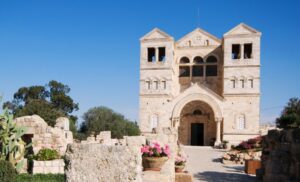
The Church of the Primacy of Saint Peter in Tabgha marks the traditional site where Jesus reinstated Peter as leader of the Apostles after the resurrection, as described in John 21. The small Franciscan chapel, built in 1933, preserves the ancient rock known as Mensa Christi where Jesus and the disciples shared breakfast.
The Church of the Primacy of Saint Peter sits along the northwestern shore of the Sea of Galilee in Tabgha, Israel, marking the traditional location where Jesus Christ reinstated Peter as leader of the Apostles after the resurrection. This modern Franciscan church, built in 1933, preserves one of Christianity’s most significant post-resurrection encounters and houses ancient remains that connect visitors directly to the earliest Christian traditions.
Biblical Context
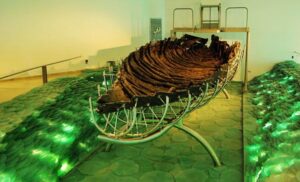
The pivotal event commemorated at this site unfolds in John 21:1-24, where Jesus appeared to his disciples for the third time following his resurrection. The apostles had spent a fruitless night fishing on the Sea of Galilee when a figure appeared on the distant shore at dawn. Though they failed to recognize him initially, the stranger instructed them to cast their net on the right side of the boat. The resulting miraculous catch of 153 fish prompted John to exclaim, “It is the Lord!” Peter, upon hearing this declaration, threw himself into the water and swam roughly 100 meters to shore while the others followed by boat.
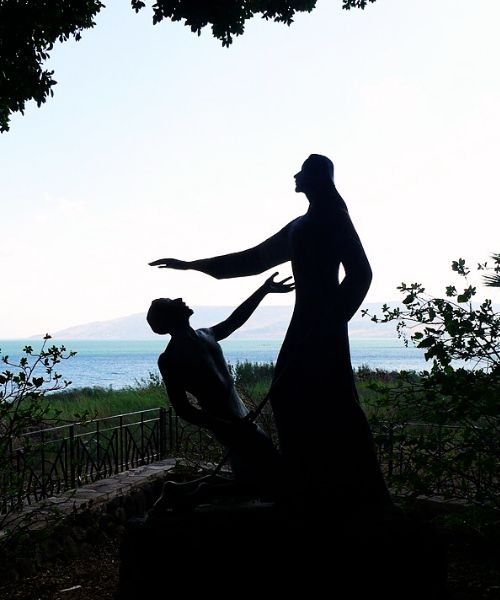
When they reached land, the disciples discovered Jesus had already prepared a breakfast of grilled fish and bread over a charcoal fire. The setting carries profound symbolic weight, as this marks the first time since Peter’s three denials during Jesus’s trial that the apostle encounters his master beside a charcoal fire. After the meal, Jesus posed the same question three times: “Do you love me?” With each of Peter’s affirmative responses, Jesus commissioned him to “feed my sheep,” effectively restoring Peter to leadership and establishing his pastoral authority over the church.
Early in the morning, Jesus stood on the shore, but the disciples did not realize that it was Jesus. He called out to them, “Friends, haven’t you any fish?” “No,” they answered. He said, “Throw your net on the right side of the boat and you will find some.” When they did, they were unable to haul the net in because of the large number of fish.
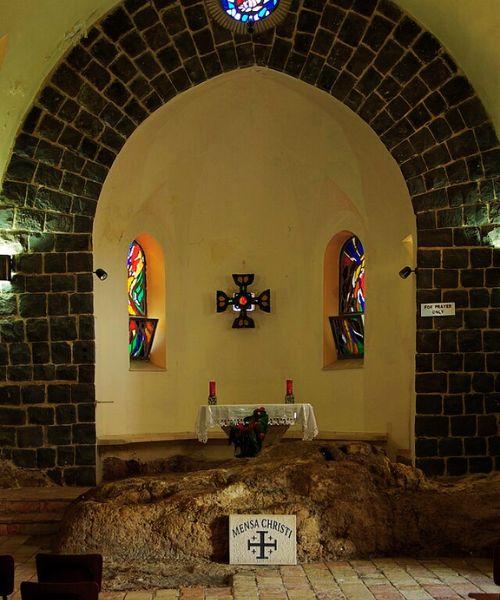
The Church of the Primacy of Saint Peter's Architecture
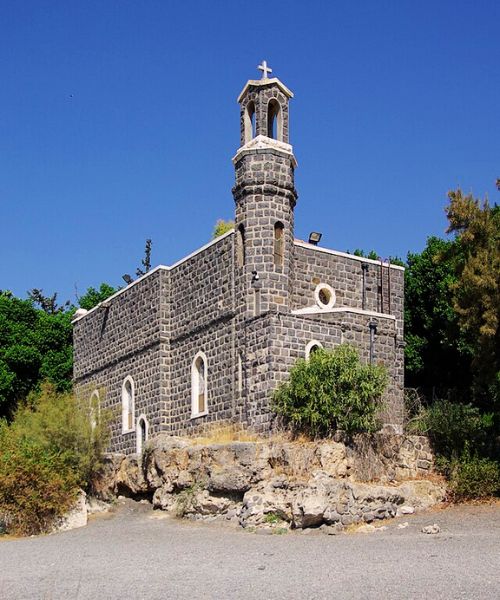
The current Church of the Primacy of Saint Peter, completed in 1933 under Franciscan custody, incorporates substantial remains from a 4th-century Byzantine church discovered during excavations. The architects deliberately preserved ancient elements, including original limestone foundations and mosaic fragments visible at the base of the modern walls. The church measures approximately 30 meters long and 20 meters wide, constructed primarily of local black basalt stone that gives the structure its distinctive dark appearance against the blue waters of the Sea of Galilee.
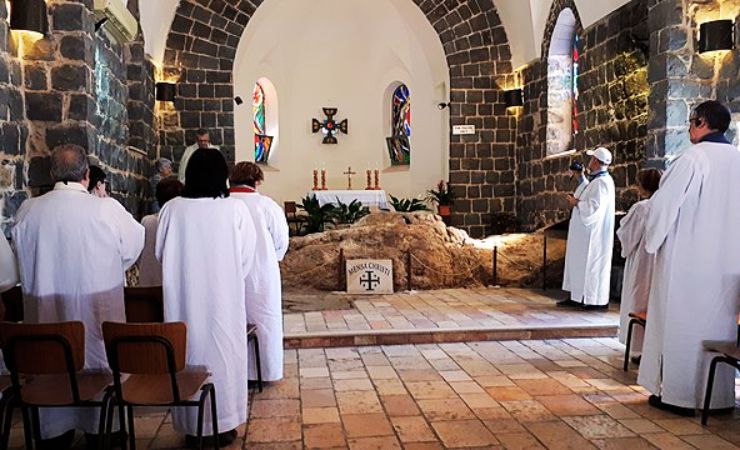
The church’s central feature is the “Mensa Christi” (Christ’s Table), a large limestone rock formation that projects naturally through the floor in front of the altar. This unworked stone, represents the traditional site where Jesus prepared the breakfast meal for his disciples. The rock’s surface shows ancient wear patterns and several small cavities that may have served practical purposes during early Christian gatherings.
The interior maintains deliberate simplicity, with a central nave flanked by two narrow aisles. White mosaic flooring, recreated based on 4th-century patterns, covers most of the interior space. The wooden roof structure follows traditional Galilean architectural styles. Natural lighting enters primarily through small windows along the sides, creating an atmosphere conducive to contemplation.
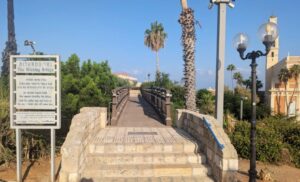
Outside the church, visitors can examine an ancient staircase carved into the limestone bedrock, likely dating to the Roman period. This stepped pathway, mentioned by the 4th-century pilgrim Egeria in 383 AD, may represent the “stone steps where the Lord stood” that she described in her detailed travel account. The steps descend toward the lake shore, providing a direct connection between the church and the water where the biblical events unfolded.
What Can Be Seen at The Church of the Primacy
- Mensa Christi: The natural limestone rock formation protruding through the altar area, believed to be the exact location where Jesus prepared breakfast for the disciples.
- Ancient Mosaic Remains: 4th-century mosaic fragments embedded in the modern church walls, featuring geometric patterns and early Christian symbols.
- Byzantine Foundation Walls: Original stone foundations from the early church, clearly visible at the base of the modern structure.
- Roman Period Staircase: Ancient stepped pathway leading from the church toward the Sea of Galilee shore.
- Franciscan Gardens: Peaceful grounds surrounding the church, planted with native Galilean flora mentioned in biblical texts.
- Modern Altar: Simple stone altar positioned directly above the Mensa Christi, designed to emphasize the ancient rock rather than overshadow it.
Practical Information
Opening Hours: Daily 8:00 AM to 5:00 PM (winter until 4:00 PM).
Admission: Free entry. Donations are welcome.
Location: Tabgha, approximately 10 kilometers northwest of Tiberias along the Sea of Galilee shore.
Parking: Free parking available in a small lot adjacent to the church. Space is limited during peak seasons and Christian holidays.
Dress Code: Modest dress required. Shoulders and knees must be covered. Hats should be removed inside the church.
Additional Information
What is the Church of the Primacy of Saint Peter?
The Church of the Primacy of Saint Peter is a Franciscan church in Tabgha, Israel, built in 1933 on the traditional site where Jesus reinstated Peter as leader of the apostles after the resurrection. The church preserves the Mensa Christi rock formation and incorporates 4th-century Byzantine church remains.
Why is it called the Church of the Primacy?
The church receives its name from the biblical account in John 21, where Jesus established Peter’s “primacy” or leadership over the apostles with the threefold commission to “feed my sheep.” This event restored Peter after his denial of Jesus during the crucifixion trial.
What is the Mensa Christi?
Mensa Christi, meaning “Christ’s Table,” is a natural limestone rock formation inside the church that measures roughly 3 by 1.5 meters. Christian tradition identifies this as the exact spot where Jesus prepared breakfast for his disciples after the miraculous catch of fish.
Are there archaeological remains at the site?
The Church of the Primacy of Saint Peter incorporates significant 4th-century Byzantine church foundations, mosaic fragments, and Roman-period stone steps. Archaeological excavations have revealed continuous Christian worship at this site since the early centuries after Christ.
Nearby Sites
- Church of the Multiplication: Located in Tabgha, near Capernaum, this church is traditionally believed to be the site where Jesus performed the miracle of feeding the 5,000 with five loaves and two fish.
Capernaum: Known as Jesus’ “own city”, Capernaum was the center of his ministry after he left Nazareth. The town is home to a modern church built over the house of Peter.
- Magdala: Magdala is a crossroads of Jewish and Christian History and the hometown of Mary Magdalene.
- Yardenit: This is a baptismal site located on a beautiful stretch of the Jordan River near the southern tip of the Lake of Gennesaret.
Keep reading
Part of our Christian Pilgrimage Guide →