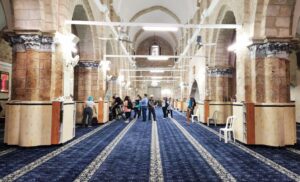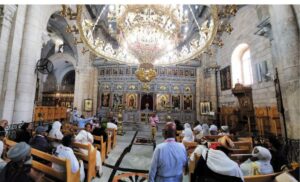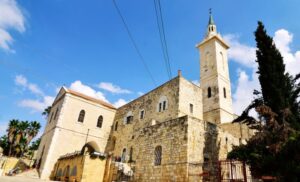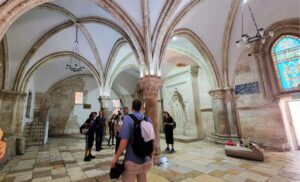
The Church of St. James is an ornately decorated Armenian Orthodox church located in the western Old City of Jerusalem, within the Armenian Quarter. It serves as the cathedral of the Armenian Patriarchate and honors both James the Greater and James the Just. The church features elaborate tile work, hanging lamps, and rich liturgical decorations, making it one of the most beautifully adorned worship spaces in the Holy Land.
The Church of St. James Jerusalem stands as one of the most magnificent religious edifices in the Armenian Quarter of the Old City. Built during the 12th century Crusader period, this spectacular cathedral serves as the spiritual center of the Armenian Orthodox Patriarchate of Jerusalem, which represents one of the world’s oldest Christian communities.
Location
The Church of St. James Jerusalem occupies a prominent position in the Armenian Quarter, located in the southwestern section of Jerusalem’s Old City. Visitors enter through Jaffa Gate and walk approximately 300 meters through the Armenian Orthodox Patriarchate Road. The church sits within a fortress-like compound that encompasses roughly one-sixth of the Old City’s total area.
The Church of St. James' Rich History
Armenia’s adoption of Christianity as its state religion in 301 CE made it the first nation to embrace the faith officially, establishing a foundation for Armenian presence in Jerusalem that would span nearly two millennia. Armenian Christians were pioneers in creating their own distinct quarter within the Holy City, arriving centuries before other Christian communities established permanent settlements.
The Church of St. James Jerusalem honors two revered martyrs who shared the same name but lived different lives. St. James the Great, one of Jesus’s twelve apostles and brother to John the Evangelist, suffered execution by Herod Agrippa I around 44 CE, becoming the first apostle to be martyred. St. James the Less, traditionally identified as Jesus’s brother or close relative, served as the first bishop of Jerusalem until his martyrdom by Temple authorities around 62 CE, approximately twenty years after the first St. James’s death.
Armenian tradition holds that the church contains the head of St. James the Great, while his body rests in Santiago de Compostela, the famous Spanish pilgrimage destination. The complete remains of St. James the Less are believed to rest within the church premises, making this sacred site a unique repository of apostolic relics.
The cathedral reached completion during the 12th century under Queen Melisende of Jerusalem, during the height of the Crusader Kingdom. This timing makes the Church of St. James Jerusalem one of the remarkably few Crusader-era churches in the Holy Land to survive completely intact through eight centuries of conquests, earthquakes, and political upheavals.
Architectural Splendor - The Artium
Visitors to the Church of St. James Jerusalem first encounter a remarkable closed courtyard, known as an atrium, which serves as both an artistic gallery and sacred burial ground. This atmospheric space showcases centuries of Armenian cultural expression through its stone walls decorated with intricate khachkars, traditional Armenian stone crosses that demonstrate exceptional medieval craftsmanship. The inscriptions carved into these monuments utilize the distinctive Armenian alphabet, originally developed by Saint Mesrop Mashtots in 405 CE under the patronage of Gregory the Illuminator.
The atrium holds profound spiritual significance as the final resting place of both saints honored by the church. According to centuries-old tradition, the tomb of St. James the Great, brother of the apostle John, occupies the right side of the courtyard, while the tomb of St. James the Less, the first bishop of Jerusalem, lies to the left. These ancient burial sites transform the atrium into a pilgrimage destination, where visitors can pay respects to two foundational figures of early Christianity.
Architectural Splendor - the Church
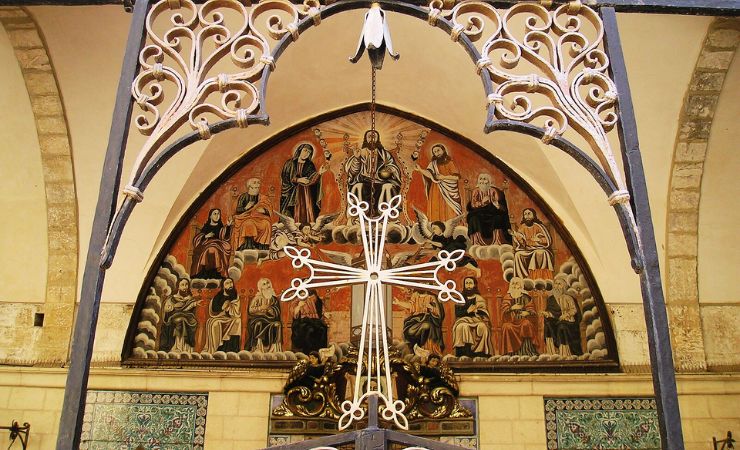
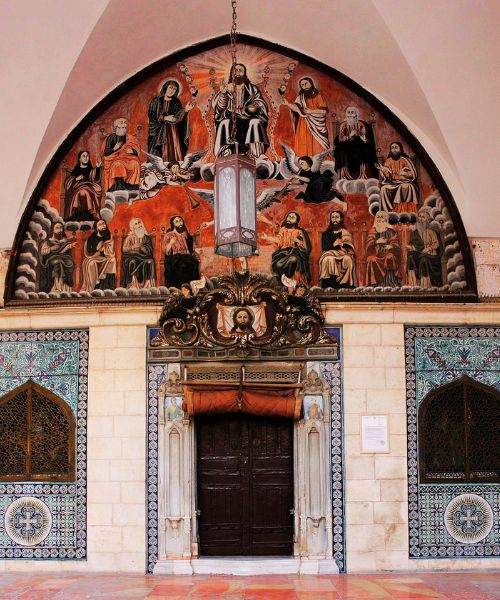
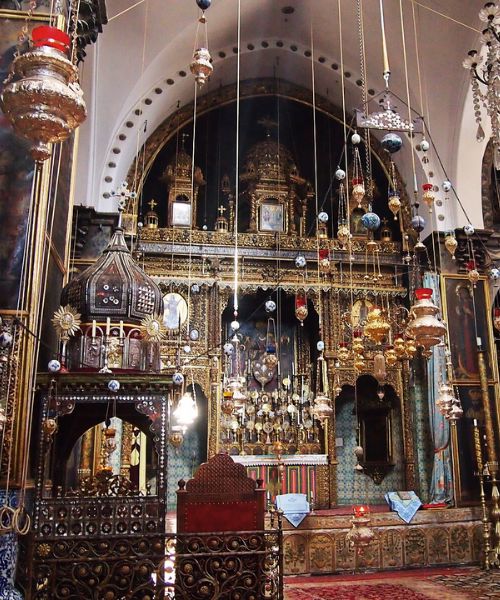
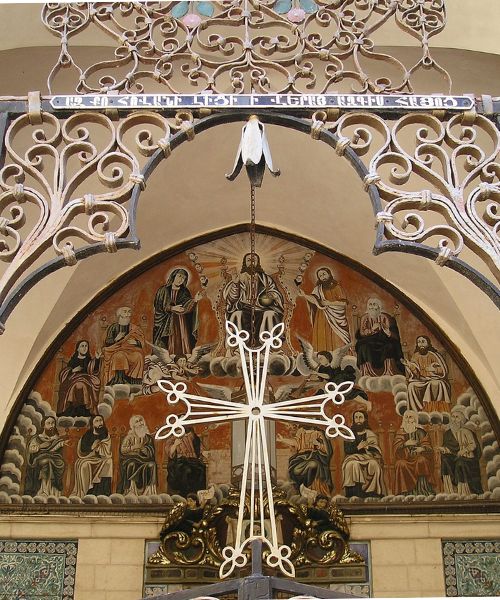
The interior of the Church of St. James Jerusalem overwhelms visitors with its extraordinary display of gilded altars, massive brass chandeliers suspended from the ceiling, and countless oil lamps adorned with ceramic eggs that catch and reflect light throughout the sanctuary. Ancient paintings cover the walls alongside intricately carved wooden panels, mother-of-pearl inlays, and bronze engravings that tell stories of Armenian saints and biblical scenes. Stunning blue and green ceramic tiles from Ottoman workshops create geometric patterns that complement the rich visual program, while the original marble floor remains covered by traditional purple, green, and red carpets woven with Armenian motifs.
The cathedral maintains its mystical Eastern Orthodox atmosphere through the complete absence of electric lighting, relying solely on high-set windows, oil lamps, and candles to illuminate the sacred space. During liturgical services, the interior transforms into an otherworldly environment where incense mingles with the chanting of ancient Armenian hymns, while priests wear elaborate vestments embroidered with gold thread. On sunny days, natural light streams through the windows to create dazzling reflections on the church’s treasures, but during overcast periods, the interior falls into mysterious shadows that enhance the building’s spiritual ambiance.
Ceiling decorations: The Chapel of Etchmiadzin features exquisite hanging ceramic eggs created in the famous pottery workshops of Kütahya, Turkey, during the 18th century. These distinctive Ottoman-era ceramics originally formed part of a larger commission intended for the restoration of the Church of the Holy Sepulchre in 1719. When plans changed, the Armenian Patriarchate acquired these masterpieces, incorporating them into the cathedral’s decorative scheme where they have remained for over three centuries, creating one of the most unique ceiling treatments in any Jerusalem church.
Chapels: The church contains several smaller chapels, each with specific liturgical functions. The Chapel of St. James the Great, positioned on the left side of the main nave, houses the most important shrine within the cathedral complex. Additional chapels, also located on the left side, serve specialized purposes but remain closed to casual visitors except during major feast days. The Church of St. Stephen, situated toward the front of the cathedral, functions as both the sacristy where liturgical vessels are stored and the baptistery where new members join the Armenian Orthodox community.
Thrones: Two magnificent thrones dominate the front of the cathedral, each with distinct significance in Armenian Orthodox tradition. The larger throne, dedicated to St. James the Less, features elaborate carvings and precious metal inlays, while behind it a low iron grille encloses the saint’s traditional burial location. The smaller throne serves as the ceremonial seat of the Armenian Orthodox Patriarch of Jerusalem, used during major liturgical celebrations and official occasions. The careful positioning of these thrones reflects the hierarchical nature of Armenian Orthodox worship, with the martyred saint taking precedence over earthly church leadership.
The Armenian Quarter: A Living History
The St. James Convent compound functions as a self-contained city within the Armenian Quarter, housing residential quarters for over 1,000 Armenian families behind its fortress-like walls. This remarkable complex encompasses the patriarchate headquarters, a pilgrim hospice, living quarters for nuns and priests, an Armenian school that preserves the language and culture, social clubs that maintain community bonds, and the historic printing press that began operations in 1833 as Jerusalem’s first printing establishment. This press produced the first books printed in Jerusalem and continues to publish Armenian liturgical and cultural materials.
Archaeological evidence suggests that the area across from the main gate, currently occupied by an Armenian Orthodox seminary, may have been the site of Pilate’s praetorium, the former palace of Herod the Great. If this identification proves accurate, the judgment seat where Jesus faced condemnation would have stood on the open square where the Church of St. James Jerusalem now rises, adding profound biblical significance to the site’s already rich Christian heritage.
The Armenian Quarter began taking organized form in the southwestern section of Jerusalem before 1100 CE, making it one of the oldest continuously inhabited ethnic quarters in the Old City. Following the expansion of the Jewish Quarter after 1967, the Armenian Quarter now occupies approximately one-sixth of the Old City’s total area. Unlike other quarters that have undergone significant modernization and development, the Armenian Quarter retains much of its original medieval character, with narrow stone streets, ancient archways, and traditional architecture that has remained largely unchanged for centuries.
Many current residents descend from survivors of the Armenian Genocide of 1915-1923, who sought refuge in Jerusalem during and after the Ottoman Empire’s systematic persecution. These families brought with them ancient traditions, crafts, and cultural practices that continue to flourish within the quarter’s protective walls.
Practical Information
The Church of St. James Jerusalem operates with limited visiting hours due to its active role as a functioning cathedral. The church typically opens to visitors Monday through Friday from 6:30 AM to 7:30 AM and again from 2:30 PM to 3:30 PM, with Saturday visits possible from 2:30 PM to 3:30 PM. Sunday access is generally restricted to worshippers attending liturgical services. Entrance is free of charge, though donations are welcomed to support the Armenian Patriarchate’s preservation efforts.
Visitors should dress conservatively with covered shoulders and knees, as required in all active religious sites.
Additional Information
What makes the Church of St. James Jerusalem unique among Holy Land churches?
The Church of St. James Jerusalem stands out as one of the few completely intact Crusader-era churches in the Holy Land, built during the 12th century and maintained continuously by the Armenian Orthodox community. Its extraordinary interior features gilded altars, massive chandeliers, Ottoman-era ceramic decorations, and relies entirely on natural light and oil lamps rather than electricity. The church houses relics of two different St. James martyrs and represents the world’s oldest Christian nation’s presence in Jerusalem.
Are there specific visiting hours for tourists at St. James Church Jerusalem?
The Church of St. James Jerusalem has limited visiting hours due to its active liturgical schedule. Visitors can enter Monday through Friday from 6:30-7:30 AM and 2:30-3:30 PM, with Saturday access from 2:30-3:30 PM. Sunday visits are restricted to worshippers attending services. These hours may change.
Which saints are buried at the Church of St. James in Jerusalem?
The Church of St. James Jerusalem honors two martyred saints named James: St. James the Great, one of Jesus’s twelve apostles who was beheaded by Herod Agrippa I around 44 CE, and St. James the Less, believed to be Jesus’s brother who served as the first bishop of Jerusalem until his martyrdom around 62 CE. According to Armenian tradition, the church contains the head of St. James the Great and the complete remains of St. James the Less.
How do I get to St. James Armenian Church from Jaffa Gate?
From Jaffa Gate, walk straight ahead into the Old City for approximately 100 meters, then turn right onto Armenian Orthodox Patriarchate Road. Continue for about 200 meters through the Armenian Quarter until you reach the church compound entrance. The total walking distance is roughly 300 meters and takes about 5 minutes. Look for signs in Armenian, Arabic, and English marking the way to the Armenian Quarter.
What is the Armenian Quarter like around St. James Church?
The Armenian Quarter surrounding the Church of St. James Jerusalem functions as a self-contained community with residential buildings, schools, social clubs, and Jerusalem’s first printing press established in 1833. The quarter houses over 1,000 Armenian families within fortress-like walls and maintains much of its original medieval character with narrow stone streets and traditional architecture. Many residents are descendants of Armenian Genocide survivors who found refuge in Jerusalem.
Nearby Sites
- Tower of David Museum: The museum is housed in the medieval citadel known as the Tower of David, offering stunning views of the Old City and beyond.
- Jaffa Gate: One of the seven main open gates in Jerusalem’s Old City Walls, Jaffa Gate is a popular starting point for tours and walks. Its name is derived from the fact that the road leading from it heads to the port city of Jaffa (Joppa).
- Zion Gate: The Zion Gate is one of the eight gates in the walls of the Old City of Jerusalem. It bears the marks of a significant battle during the 1948 Arab-Israeli War and leads directly into the Armenian and Jewish quarters.
- Dormition Abbey: Located on Mount Zion, Dormition Abbey is a massive, fortress-like basilica that commemorates the “falling asleep” (Dormition) of the Virgin Mary.
- Room of the Last Supper: Also known as the Cenacle, this is a second-story room in Jerusalem that Christians traditionally identify as the site of the Last Supper.
Keep reading
Part of our Christian Pilgrimage Guide →