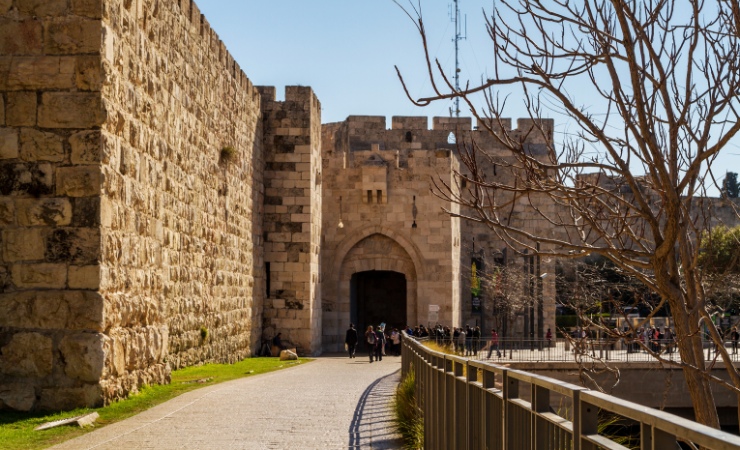
Jaffa Gate serves as one of seven main entrances to Jerusalem's Old City, located on its western side. Built in 1538 during Ottoman Sultan Suleiman the Magnificent's reign, it was named after the road leading to Jaffa port. The gate features distinctive L-shaped architecture for defensive purposes and remains a primary access point for visitors entering the historic quarters.
What strikes most visitors first about Jaffa Gate is that there are actually two entrances, not one. The original L-shaped passage dates to 1538, and the wide gap to its south was cut in 1898 for Kaiser Wilhelm II. You can still see where the original wall stood before that breach was made. Don’t miss the unique marking right next to the main entrance. Read on to learn more.
Where is Jaffa Gate located?
Jaffa Gate is on the western side of Jerusalem’s Old City walls. It opens onto the Armenian and Christian Quarters directly inside, and leads south toward the Jewish Quarter and the Western Wall. The Tower of David citadel stands immediately to its south, and the Mamilla pedestrian mall connects the gate to modern West Jerusalem on its western side.
It is one of eight gates still standing in the Ottoman-era wall, and the primary pedestrian entry point for visitors arriving from the city center.
Why does Jaffa Gate have different names?
In Hebrew, the gate is Sha’ar Yafo, named after the ancient port of Jaffa, roughly 60 km to the northwest. Travelers arriving by sea would enter Jerusalem here after walking the road from the coast.
In Arabic, the gate is Bab al-Khalil, meaning Gate of the Friend, a reference to Abraham, whom Islamic tradition calls “the beloved of God.” Because Abraham is buried in Hebron, whose Arabic name is al-Khalil, the gate is also known as Hebron Gate: the road south to Hebron began at this same spot.
Medieval Arabic sources also called it Bab Mihrab Dawud, Gate of David’s Chamber, based on a belief that a room in the nearby Herodian tower stump was King David’s prayer room. The Crusaders used the name “David’s Gate” for a gate they built just behind the current location.
What is the history of Jaffa Gate?
The ground beneath Jaffa Gate has been fortified for more than two thousand years. The Hasmonean kings built defensive walls here in the 2nd century BC. Herod the Great reinforced the position with three massive towers between 37 and 34 BC. When the Romans destroyed Jerusalem in 70 AD, they deliberately left those Herodian foundations standing to show the scale of what they had defeated.
The gate standing today was built in 1538, part of Sultan Suleiman the Magnificent’s full reconstruction of Jerusalem’s walls between 1535 and 1541. An Arabic inscription above the outer arch records the year as 945 of the Muslim Hijra calendar and names Suleiman as “king of the Turks, the Arabs, and the Persians.” The original gatehouse used an L-shaped passage as a defense: any attacker who forced the outer door had to make a 90-degree turn, exposing their unshielded right side to defenders above.
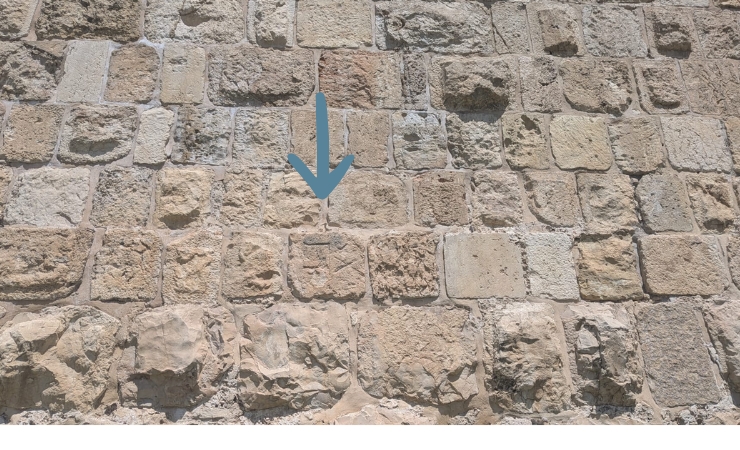
Most visitors miss this, but about 20 meters west of the main entrance, opposite a bus stop, there is a stone in the wall marked with an X and the letters “Fre”, the stamp of the Roman Tenth Legion. The Ottoman builders used whatever dressed stone they could find, and they had no idea what they were incorporating.
In 1898, Ottoman authorities cut a gap in the wall immediately south of the gatehouse so Kaiser Wilhelm II of Germany could enter Jerusalem on horseback without dismounting through the narrow L-shaped passage. That opening remains today as the vehicle entrance into the Old City from the west.
On December 11, 1917, British General Edmund Allenby walked through Jaffa Gate on foot, having dismounted his horse before entering as a deliberate gesture of respect. His entry ended 400 years of Ottoman rule over Jerusalem. The Times of Israel covered the centenary re-enactment of that moment in 2017.
During the 1948 Arab-Israeli War, the gate fell under Jordanian control and was sealed with concrete walls for nearly 20 years. Israel reopened it after capturing the Old City in the Six-Day War of 1967. A 1970 restoration added a Hebrew and Arabic inscription quoting the Book of Nehemiah (4:1) about the repair of Jerusalem’s walls. In 2010, the Israel Antiquities Authority completed a two-month restoration as part of a 4 million dollar project covering all 4 km of the Old City walls.
What can you see at Jaffa Gate?
The stone narrows as you pass through, the light shifts, and the sounds of modern Jerusalem drop away. Each feature inside the gate belongs to a different century.
The Ottoman gatehouse (L-shaped passage) — The original 1538 passage bends sharply to the right before opening into the Old City, a design that slowed attackers and forced them to turn into defenders above. The massive iron-plated wooden doors are still in place at the entrance. Standing inside with the stone ceiling close overhead, the military logic of the design is immediately clear.
Arabic dedicatory inscription — Above the outer arch, an ornate Ottoman-script inscription records the construction year as 945 of the Muslim Hijra and names Suleiman the Magnificent as “king of the Turks, the Arabs, and the Persians.” It was restored and reattached during the 2010 Israel Antiquities Authority project. Most visitors walk past without looking up, which is a genuine loss.
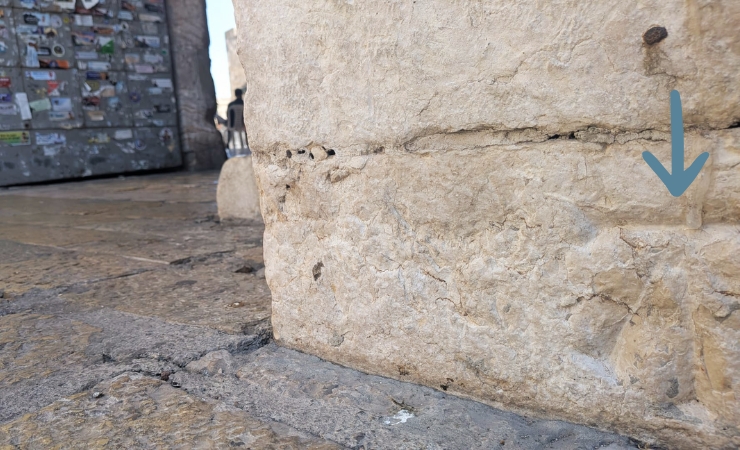
British Ordnance Survey benchmark — This is missed by everyone, and it is pretty cool (see picture below). British engineer Captain Charles Wilson led a topographical survey of Jerusalem in the 1860s. His surveyors carved 55 distinctive crow’s-foot arrowhead benchmarks into rocks and ancient monuments across the region. One is cut directly into the stonework at the right-hand side of the main entrance, just before you step into the Old City. It is easy to spot once you know to look for it.
The 1898 wall breach — The wide opening south of the original gatehouse has cleaner, smoother cut edges than the weathered Ottoman stone on either side, a visible sign that it was made in 1898 rather than 1538. Kaiser Wilhelm II rode through it on horseback in full imperial ceremony. It now carries vehicle traffic into the Old City, the only such opening on the western wall.
Two Ottoman tombs — Just inside the gate on the left, two worn Ottoman-era tombs are set into the wall. Tradition holds that they belong to the architects who designed Suleiman’s walls, buried here as punishment for leaving Mount Zion outside the new perimeter. Scholars regard the story as legend, but the tombs are genuine, and their worn surfaces stand out against the restored masonry around them.
What else is directly inside the gate?
David Street descends east from the gate into the covered bazaar, passing ceramic shops, spice stalls, and vendors selling cardamom coffee. The Tourist Information Center is just inside on the left and offers free maps and English-language advice. The Christian Information Center, opposite the Tower of David Museum, has mass times and pilgrimage information for Christian visitors.
The Tower of David Museum is directly adjacent to the gate. Built on Herodian foundations, it traces Jerusalem’s history from the Canaanite period to the 20th century. Its courtyard hosts evening light shows projected onto the ancient walls. Admission is separate from the gate. See the official Jaffa Gate visitor page for current ticketing options.
Practical visitor information
Jaffa Gate is always open and has no admission charge. The Tower of David Museum has separate admission and its own opening hours. Bus lines from central Jerusalem stop on Jaffa Road immediately west of the gate plaza.
Additional Information
- 16th Century (Beginning): The Ottoman Turks take control of Jerusalem. The city’s population and quarters remain largely unchanged.
- Mid-16th Century (Specifically 1538): Jaffa Gate is officially inaugurated as part of the rebuilding of the Old City walls by Suleiman the Magnificent.
- 1537-1541: The citadel (Tower of David) is expanded by Suleiman the Magnificent.
- 1635-1655: The Ottomans erect a minaret near the southwest corner of the citadel, which becomes commonly referred to as the “Tower of David” in the 19th century.
- Second Half of the 19th Century: Jaffa Gate becomes more active following development outside the city walls to the south and west.
- 1860: Jaffa Gate is the first gate in Jerusalem to be opened specially at night, due to pressure from Russians building nearby and wanting constant access for pilgrims.
- 1889: The New Gate, north of Jaffa Gate, opens, further increasing movement in the area around Jaffa Gate.
- 1896: The Jerusalem municipality relocates to a new building, making the area near Jaffa Gate a center of urban activity.
- 1898: A breach is made in the city wall between Jaffa Gate and the citadel by Ottoman authorities to allow German Emperor Wilhelm II and his retinue to enter Jerusalem in carriages. A portion of the citadel moat is filled in.
- Early 1900s: Mercantile emporia and stores belonging to various ethnic groups open near Jaffa Gate, creating a “European Market.”
- 1905: The Jerusalem municipality plants trees along Jaffa Road and installs the first public lighting network and garbage cans.
- 1908: An ornate clock tower is built on top of the historical Jaffa Gate tower in celebration of the 25th year of rule of Sultan Abdul Hamid II. The clock mechanism is delivered by the Dent company of London. Seven such clock towers are erected in what is now Israel and the Palestinian Territories, highlighting Jaffa Gate’s importance.
- 1912: The Bezalel Pavilion, a wooden structure housing a shop and exhibition hall for Bezalel art, is erected near Jaffa Gate.
- December 1917: British General Edmund Allenby enters Jerusalem on foot through Jaffa Gate, symbolizing the British capture of the city during World War I.
- 1922: The Ottoman clock tower on Jaffa Gate is dismantled by the British authorities for aesthetic reasons. The clock is re-erected on a new tower near the British Post Office and Town Hall.
- Mid-1940s: Houses and shops built adjacent to Jaffa Gate and the city wall on the outside are removed by the British to expose the wall.
- During the British Mandate: A marker outside Jaffa Gate serves as the Kilometre Zero for distances to and from Jerusalem. The area near Jaffa Gate serves as a central station for transportation to Jaffa, Bethlehem, and Hebron.
- July 1944: Demolition work is carried out at Jaffa Gate to clear the city wall.
- 1948: During the War of Independence, Jaffa Gate is blocked by a damaged armored vehicle and remains closed during the division of Jerusalem.
- 1948-1967: Jerusalem remains a divided city, with the Old City under Jordanian control. Israelis are not allowed to enter the Old City.
- 1967: Following the Six-Day War, Jaffa Gate is reopened, reconnecting the Old City with the New City. The street leading from Jaffa Gate to the Western Wall is initially named “Rehov Habira” (Capital City Street) and later changed to David Street.
- 1971: Ultra-Orthodox Jews are photographed walking in the interior plaza of Jaffa Gate.
- 1975: Jaffa Gate appears on an Israeli 10 Lirot banknote. It later appears on a 1 Shekel banknote.
- As part of the Mamilla Project: Mamilla Street is rebuilt as a pedestrian mall leading to Jaffa Gate, serving as an access route from central Jerusalem to the Old City.
- 2010: Jaffa Gate is reopened after a two-month renovation. An 1,800-year-old high-level aqueduct is exposed near Jaffa Gate during archaeological work.
Which side of the Old City is Jaffa Gate on?
Jaffa Gate is on the western side of Jerusalem’s Old City wall. It faces modern West Jerusalem and the Mamilla mall, and it opens directly onto the Armenian and Christian Quarters inside. The gate is the primary pedestrian entry point for visitors arriving from the city center or the main bus routes along Jaffa Road.
Is it safe to travel to Israel and visit Jaffa Gate now?
The Israeli government and most Western tourism authorities maintain updated travel advisories. Jerusalem’s Old City, including Jaffa Gate, has a continuous security presence. Check your government’s current advisory before traveling. The gate itself is open 24 hours and is among the most visited and monitored sites in the country.
What are the bullet holes on Jaffa Gate from?
The pockmarks and bullet scars visible on the stone facade of Jaffa Gate date primarily from the 1948 Arab-Israeli War, when the gate was contested between Israeli and Jordanian forces. Jordanian forces ultimately took control, and the gate was sealed with concrete walls and closed for nearly 20 years until Israel reopened it after capturing the Old City during the Six-Day War in 1967. During the 2010, the bullet marks were deliberately demarcated and preserved rather than filled in, treating them as historical evidence rather than damage to be hidden.
What is the L-shaped entryway at Jaffa Gate, and why was it built that way?
The L-shaped entryway is the original 1538 defensive design of the gatehouse, which forces anyone entering to make a 90-degree right-angle turn before passing into the city. This same defensive geometry was precisely why the Ottoman authorities cut a separate breach in the wall in 1898 for Kaiser Wilhelm II’s mounted procession, since horses and ceremonial banners could not navigate the turn.
What is the crow’s-foot benchmark at Jaffa Gate?
During Captain Charles Wilson’s 1860s survey of Jerusalem, British Ordnance Survey teams carved 55 arrowhead benchmarks into monuments across the region. One is cut into the stonework on the right side of the main entrance at Jaffa Gate, just before you step into the Old City. It is still clearly visible today.
Sites Nearby
- Tower of David: Also known as the Jerusalem Citadel, the Tower of David is an ancient citadel located at the entrance to the Old City. The citadel dates back to the Crusader, Mamluk and Ottoman periods.
- The Jewish Quarter: The Jewish Quarter is a treasure trove of history and culture. This area is home to several ancient synagogues, and historical buildings, and the Broad Wall erected by King Hezekiah in the 8th century BC.
- Christ Church: This is the oldest Protestant church in the Middle East, was inaugurated in 1849.
- The Armenian Quarter: Home to a tight-knit Armenian community. Rich in history, it houses the St. James Cathedral, a place of ornate beauty, and offers a unique blend of Middle Eastern and Armenian culture through its narrow streets, ancient buildings, and traditional craft shops.
- St. James Cathedral: This cathedral is part of the Armenian Patriarchate. The cathedral is dedicated to two Saints named James – St. James the Greater, one of Jesus’ twelve apostles, and St. James the Just, who was the brother of Jesus.
Keep reading
Part of our Jerusalem Travel Guide →