The Room of the Last Supper, also called the Cenacle or Upper Room, is a sacred site on Mount Zion in Jerusalem where Christian tradition holds Jesus shared his final Passover meal with his disciples. The current Gothic structure dates to the Crusader period and also holds significance in Jewish tradition as King David's traditional tomb location.
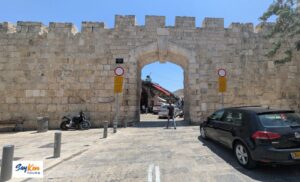
The Room of the Last Supper sits on Mount Zion in Jerusalem, roughly 100 meters outside the Zion Gate, in a compound that is holy to all three Abrahamic faiths. The Gothic chamber, also called the Cenacle or the Upper Room, has drawn pilgrims for over sixteen centuries to the spot where Jesus is believed to have shared his final meal with the twelve apostles before his crucifixion. Visit the rooftop when you’re done. The view into the Old City of Jerusalem is wonderful.
Where is the Room of the Last Supper?
The Room of the Last Supper sits on Mount Zion, approximately 100 meters outside the Zion Gate in Jerusalem’s Old City. The site occupies the second floor of a three-story stone building that houses significant religious sites for all three Abrahamic faiths. Visitors can reach the chamber by climbing external stairs on the building’s eastern side, with the entrance clearly marked for pilgrims and tourists.
What biblical events took place here?
Christian tradition identifies the Cenacle as the site of four events recorded in the Gospels, all occurring on the Thursday evening before Jesus’s crucifixion.
The Eucharist. Jesus took bread, gave thanks, broke it, and gave it to his disciples, saying, “This is my body given for you; do this in remembrance of me.” He did the same with the cup of wine, calling it the new covenant in his blood. This act established what Christians now call the Eucharist or Holy Communion.
And he took bread, and when he had given thanks, he broke it and gave it to them, saying, “This is my body, which is given for you. Do this in remembrance of me.” And likewise the cup after they had eaten, saying, “This cup that is poured out for you is the new covenant in my blood.
Luke 22:19-20
The prediction of betrayal. Jesus told the disciples that one of them would betray him, a reference to Judas Iscariot, who later handed Jesus over to the authorities for thirty pieces of silver.
And as they were reclining at table and eating, Jesus said, “Truly, I say to you, one of you will betray me, one who is eating with me.”
Mark 14:18
The washing of the disciples’ feet. Jesus rose from the table, wrapped a towel around his waist, and washed his disciples’ feet as an act of service, urging them to do the same for one another.
Jesus, knowing that the Father had given all things into his hands, and that he had come from God and was going back to God, rose from supper. He laid aside his outer garments, and taking a towel, tied it around his waist.
John 13:3-4
The foretelling of Peter’s denial. Jesus told Peter that before the rooster crowed that same night, Peter would deny him three times.
Jesus said to him, “Truly, I tell you, this very night, before the rooster crows, you will deny me three times.
Matthew 26:34
What is the connection to Pentecost?
The Cenacle is also the traditional site of Pentecost, fifty days after Easter Sunday, when the Holy Spirit descended on the apostles gathered in the upper room. Acts 2:1-4 records that “suddenly there came from heaven a sound like a mighty rushing wind” and “divided tongues as of fire appeared to them and rested on each one of them.” The apostles began speaking in multiple languages, enabling them to communicate with Jews from across the ancient world who had come to Jerusalem for the Passover festival. Christians mark this event as the birth of the Church.
When the day of Pentecost arrived, they were all together in one place. And suddenly there came from heaven a sound like a mighty rushing wind, and it filled the entire house where they were sitting. And divided tongues as of fire appeared to them and rested on each one of them. And they were all filled with the Holy Spirit and began to speak in other tongues as the Spirit gave them utterance.
Acts 2:1-4
How did the site become a mosque?
Christian veneration of Mount Zion as the site of the Last Supper first appears in written sources from the fourth century CE. A pilgrim from Bordeaux who visited Jerusalem in 333 CE mentioned a structure on Mount Zion, and Bishop Epiphanius later distinguished between a synagogue and a nearby “church of God” on the same hill.
Around 379 to 381 CE, the massive basilica Hagia Sion (“Holy Zion”) was built on the southwest hill of Jerusalem to commemorate events from the life of Jesus and the apostles. The Liturgy of St. James called it “the mother of all churches.” Sixth-century mosaics from the Church of Santa Maria Maggiore in Rome and the Church of St. George in Madaba, Jordan, depict the large Hagia Sion basilica alongside a smaller building with a distinctive slanted roof, confirming multiple sacred structures on the site.
The current Gothic structure dates to between the 12th and 14th centuries, built during the Crusader period. The Franciscans held custody of the site as a monastery center from the 14th century until 1524, when Ottoman authorities converted the upper chamber into the Masjid an-Nabi Dawud (Mosque of the Prophet David). Islamic architectural elements added at that time remain visible today alongside the original Christian features.
What can be seen inside the Room of the Last Supper?
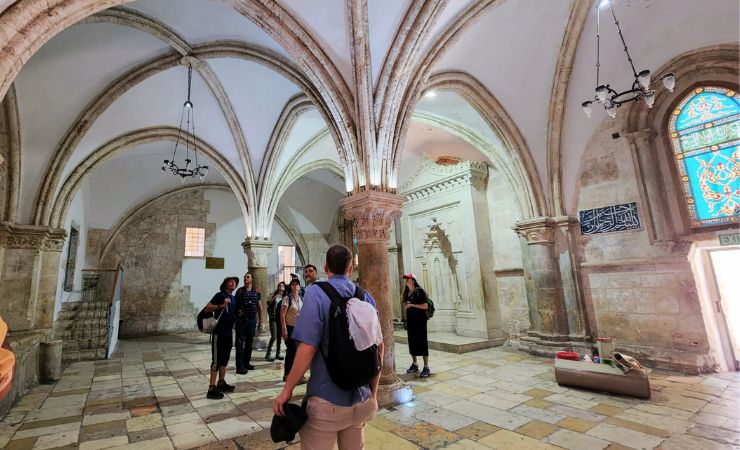
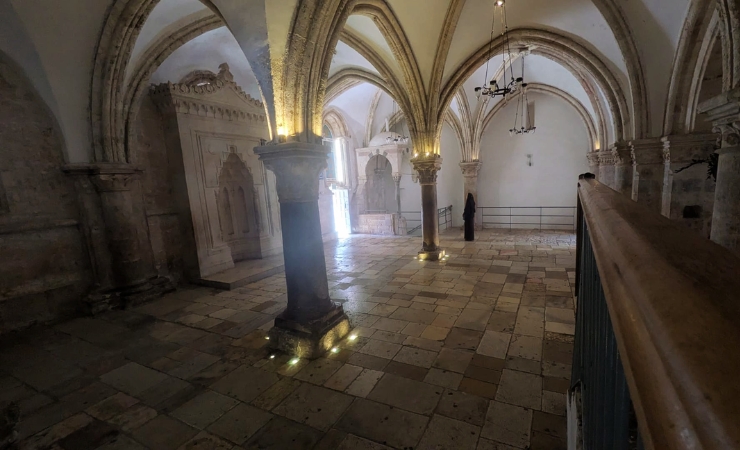
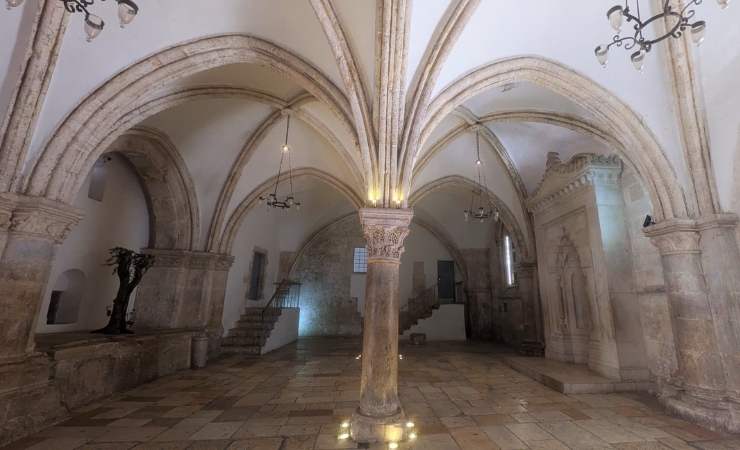
The chamber is divided into six rib-vaulted bays supported by three freestanding columns and six wall-mounted pillars. Stand in the room for a moment and look up: the web of pale stone ribs crossing overhead is the clearest sign that Crusader builders, not Byzantine ones, shaped this space.
Gothic vaulted ceiling — The ceiling is the room’s defining feature: pointed arches and ribbed vaults in the Western European Gothic style cover the entire rectangular chamber. Architectural analysis shows the structure was built during the Crusader period, between the 12th and 14th centuries CE.
Agnus Dei carving — At the apex of one arch, a carved “Agnus Dei” (Lamb of God) is still clearly visible. The symbol connects directly to Last Supper theology, where the lamb represents Christ’s sacrifice, and it predates the Ottoman conversion of the room by at least two centuries.
Pelican pillar — One of the decorated medieval columns bears a carved pelican, an early Christian symbol representing Christ’s self-sacrifice. Medieval Christians believed the pelican pierced its own breast to feed its young with its blood, making it a natural image for this room.
Ottoman mihrab and stained glass — After 1524, Ottoman builders added a mihrab (a prayer niche indicating the direction of Mecca), Arabic inscriptions in flowing Thuluth script, and geometric stained glass windows. The room reads simultaneously as a Gothic chapel and a mosque, a pairing unlike almost anywhere else in Jerusalem.
Bronze olive tree — A bronze olive tree replica, gifted to the Cenacle by Pope John Paul II, stands inside the room. The olive tree is a longstanding symbol of peace in both Jewish and Christian tradition, and its presence here, given by a pope to a site administered by the Israeli state, reflects the diplomatic dimension the room has carried into modern times.
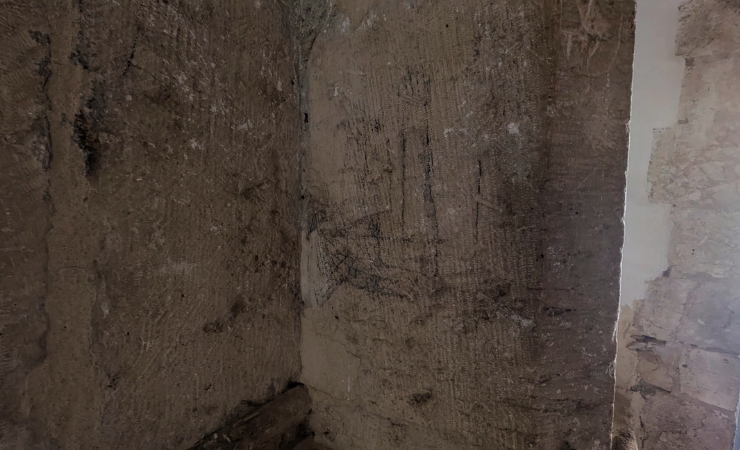
Medieval pilgrim graffiti — Wall inscriptions dating from the 14th to 16th centuries CE record the names, crests, and dates left by European pilgrims during the Franciscan period. When you walk into the room, turn 180 degrees to the right. Several inscriptions discovered in 2025 are on that wall, most notably:
- A carved coat of arms with the inscription “Altbach,” almost identical to the coat of arms of the modern city of the same name in southern Germany.
- Venetian galley drawing (see pic below) dated to the late Middle Ages, roughly 1300 to 1550 CE. Researchers estimate it depicts a Venetian galley, the large oar-and-sail ships that carried European Christian pilgrims across the Mediterranean to the Port of Jaffa.
Rooftop view — As you leave the room, go up to the compound’s rooftop rather than taking the stairs down. From there you see the Old City skyline and Dormition Abbey. Until Israel reunified the city in 1967, this was the closest lookout Jews had to the Old City, which gives the spot a significance that goes well beyond the view itself.
Practical Information
The Room of the Last Supper is open Sunday through Thursday from 8:00 AM to 6:00 PM, and Friday from 8:00 AM to 2:00 PM. The site is closed on Saturdays and Jewish holidays. Admission is free. All visitors must wear modest dress, with shoulders and knees covered.
Additional Information
Cenacle – Wikipedia
Last Supper – Wikipedia
Can the Cenacle on Mount Zion Really be the “Upper Room” of Jesus’s Last Supper?
Did Jesus’ Last Supper Take Place Above the Tomb of David?
Scholars Decipher Ancient Graffiti In Room Of Jesus’ Last Supper
Hidden medieval graffiti deciphered in room of Jesus’ Last Supper in Jerusalem
- Fourth Century: The tradition of the Cenacle location does not originate before this century. The site becomes a major feature of Christian pilgrimage.
- Late 4th Century: Epiphanius, bishop of Salamis, writes about the site being spared during the destruction of Jerusalem in 70 AD.
- Byzantine Period: A large basilica, Hagia Sion, is depicted on southern Mount Zion in mosaics, often flanked by a smaller building believed to be the Cenacle. This period saw significant Christian worship at the site, recognized as “Holy and glorious Sion, mother of all churches.”
- Until 1337: Syrian Christians maintain custody of the Cenacle.
- Late Middle Ages (late 13th century onwards): Graffiti in Western European churches, including the Cenacle, becomes widespread and is a subject of research. The Cenacle is the heart of a Franciscan monastery during this time.
- 1299: Mongol conquest of Syria and the Levant. Armenian troops, allied with the Mongols under King Hethum II, reach Jerusalem.
- 1300: An Armenian inscription reading “Christmas 1300” is found as graffiti in the Cenacle, likely left by Armenian troops who reached Jerusalem with the Mongols in 1299.
- 1337: The Cenacle passes into the custody of the Franciscan Order of Friars.
- 1436: Tristram von Teuffenbach of Styria travels to Jerusalem with Frederick Habsburg, the future Holy Roman Emperor. Tristram’s family crest is found as graffiti in the Cenacle.
- Early 16th Century (1516): Ottoman rule begins in Jerusalem.
- 1524 (930 AH): During the rule of Suleiman the Magnificent, Ottoman authorities take possession of the Cenacle and convert it into a mosque, the Masjid an-Nabī Dāwūd (Mosque of the Prophet David). An Ottoman datestone commemorates this conversion.
- 1551: The Franciscans are fully evicted from their surrounding buildings. Non-Muslims are banned from entering the Cenacle except by bribing custodians.
- Late 19th Century (around 1898): The German Kaiser acquires land near the Cenacle for the construction of the Church of the Dormition, honoring the assumption of Mary. This prompts scholarly and archaeological review of the area, including the Cenacle. H. Renard works as architect and archaeologist on the Dormition Church site.
- 1948: Jacob Pinkerfeld conducts a survey of the Cenacle site.
- 1948-1967: The Old City of Jerusalem is under Jordanian control. The Zion Gate is the border between Israel and Jordan during this time. The “trench” or tunnel on Mount Zion is used by Israelis to access Mount Zion from the Israeli side.
- 1948 onwards: The State of Israel takes possession of the holy places on Mount Zion, including the Cenacle hall.
- May 2014: Pope Francis visits the Holy Land and is permitted to celebrate Mass in the Cenacle.
- Present Day: The Cenacle building houses a synagogue on the first floor (traditionally the Tomb of King David), the “Upper Chamber” (Cenacle) on the second floor, which hosts pilgrims but no regular Christian services, and a mosque on the third story. All three Abrahamic religions coexist at the site.
Is the Room of the Last Supper the actual location where Jesus ate with his disciples?
The Room of the Last Supper represents a long-standing Christian tradition dating to the fourth century, but archaeological evidence cannot definitively prove this as the exact first-century location. The current Gothic structure dates to the 12th-14th centuries, built over earlier Byzantine-era foundations. While the precise historical authenticity remains debated among scholars, the site’s continuous veneration for over 1,600 years makes it one of Christianity’s most significant pilgrimage destinations.
Who is responsible for the Room of the Last Supper today?
The site is under Israeli state administration. The Franciscans held custody from 1337 until 1524, when Ottoman authorities converted it into the Masjid an-Nabi Dawud. No single Christian denomination controls it today, and visitors of all faiths are welcome without charge.
Is the Upper Room the same as the Last Supper room?
Yes. Upper Room, Cenacle, and Room of the Last Supper all refer to the same chamber on Mount Zion. “Cenacle” comes from the Latin word for dining room. The site is also traditionally identified as the location of Pentecost, fifty days after Easter Sunday.
Why does the Room of the Last Supper have Islamic architectural elements?
The Islamic features, including Arabic inscriptions and a mihrab, date to 1524 when Ottoman authorities converted the upper chamber into the Masjid an-Nabi Dawud (Mosque of the Prophet David). These elements coexist with the original Gothic Christian architecture, creating a unique interfaith architectural environment. The building’s third floor continues to function as a mosque, while the second floor serves Christian pilgrims.
What is the best tip for first-time visitors to the Cenacle?
After entering the room, turn 180 degrees to the right to find the medieval graffiti wall, including the carved “Altbach” coat of arms. Then, before leaving the compound, go up to the rooftop rather than down: the view of Dormition Abbey and the Old City skyline is one of the closest vantage points that existed before 1967.
Nearby Sites
- King David’s Tomb: Located in the lower story of the same building that houses the Room of the Last Supper, It’s believed to be the burial place of the biblical King David.
- The Jewish Quarter: Just passed the Zion Gate, the Jewish Quarter is revealed. This area is home to several ancient synagogues, and historical buildings, and the Broad Wall erected by King Hezekiah in the 8th century BC.
- St. James Cathedral This cathedral is dedicated to two Saints named James – St. James the Greater, one of Jesus’ twelve apostles, and St. James the Just, who was the brother of Jesus.
- The Roman Cardo Maximus: The Cardo is a remarkable representation of Roman engineering. Once the main thoroughfare in ancient Jerusalem, this grand column-lined street now houses a variety of shops and galleries.
Keep reading
Part of our Christian Pilgrimage Guide →