Dormition Abbey stands on Mount Zion in Jerusalem, marking the traditional site where Mary, mother of Jesus, fell into eternal sleep. The German Benedictine church features distinctive cone-shaped tower and Byzantine-style architecture. Built in the early 20th century, it houses beautiful mosaics and a crypt with a reclining Mary statue.
Perched on Mount Zion, Dormition Abbey draws visitors with its striking neo-Romanesque silhouette, hushed interior, and a history stretching back to the earliest centuries of Christian Jerusalem.
Dormition Abbey Location
Dormition Abbey is located on Mount Zion, just outside the walls of the Old City of Jerusalem. It stands near the Zion Gate, making it easily accessible for visitors exploring the city’s ancient sites. Arriving on foot from the Old City takes about five minutes through Zion Gate, while drivers can use the small parking area on the approach road off Hebron Road.
Biblical Context
While the site itself is not directly mentioned in the Bible, it is traditionally believed to be the place where the Virgin Mary fell into eternal sleep, or “dormition,” before her assumption into heaven. This belief is rooted in early Christian traditions and apocryphal texts that describe Mary’s peaceful passing and her subsequent assumption. According to these traditions, Mary was surrounded by the apostles when she fell asleep, and her body was later taken up to heaven by Christ. This event is celebrated in the liturgy of the Dormition of the Theotokos, supported by references in early Christian writings like the “Protoevangelium of James.” Anonymous traditions concerning the Dormition date back as early as the 3rd century, reflecting how central this belief was to the Jerusalem Christian community long before any formal church stood on the site.
The Site's History
The history of Christian veneration on this site dates back centuries. In the early 5th century, a Byzantine basilica known as Hagia Sion was built here under John II, Bishop of Jerusalem. This church was destroyed during the Sasanian sack of Jerusalem in 614 CE. After remaining in ruins for a period, a new church was constructed by the Crusaders on the site of the earlier demolished Byzantine church in the 12th century. This Crusader church was also destroyed in the 13th century, and the site remained mostly unused and in ruins for approximately 500 years until the late 19th century.
The transformation began when German Kaiser Wilhelm II visited Jerusalem in 1898, arriving for the dedication of the Lutheran Church of the Redeemer. He acquired the land on Mount Zion from Ottoman Sultan Abdul Hamid II for 120,000 German Goldmarks and presented it to the “German Association of the Holy Land” for the construction of a Catholic church. Archaeologists Frederick Bliss and Archibald Dickie conducted excavations on Mount Zion that same year, uncovering portions of the ancient city wall and contributing to the understanding of the site’s layered past.
The cornerstone for the new Benedictine abbey was laid on October 7, 1900, marking the start of construction by German Benedictine monks sent from Beuron Archabbey in Germany. The project was overseen architecturally by Heinrich Renard and directed on the ground by Theodor Sandel.
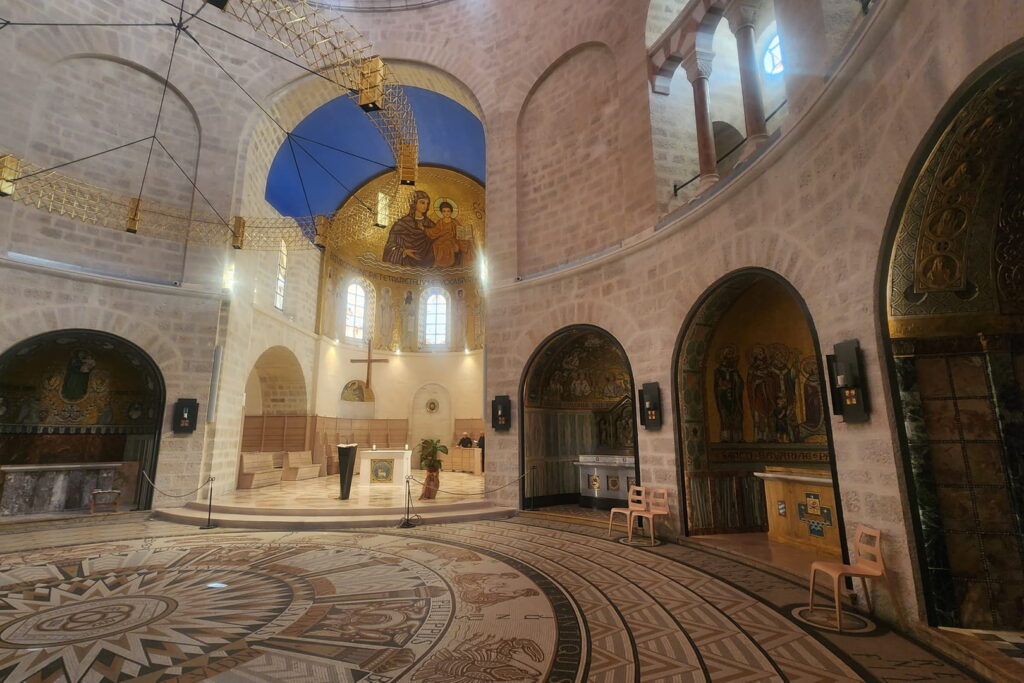
The Dormition Abbey was designed by architect Heinrich Renard in a neo-Romanesque style. The present church building is circular with a large central dome and several niches containing altars and a choir. The exterior drew inspiration from the Worms Cathedral, while the interior was modeled on Charlemagne’s palace chapel at Aix-la-Chapelle. The interior walls are adorned with inlaid mosaics depicting events from Christian history, as well as scenes from scripture, biblical figures, and Benedictine tradition.
The basilica was dedicated on April 10, 1910, by the Latin Patriarch of Jerusalem. The community endured three separate periods of internment, once after World War I, once during World War II, and once during the 1948 Arab-Israeli War, when the abbey also sustained shelling damage. Despite these disruptions, the Benedictine monks maintained their presence on Mount Zion, and in 1979 the community elected its own abbot for the first time. The abbey celebrated its centenary in 2006, resuming its original name after a period when it was known as the Abbey of Hagia Maria Sion.
Dormition Abbey's Architecture
The Dormition Abbey’s architecture blends Romanesque and Byzantine influences, shaped by Heinrich Renard’s deliberate references to two of the great monuments of medieval Christendom:
- Overall Design: The Abbey is a circular building featuring a large central dome and several smaller niches containing altars and a choir. This design was orchestrated by the German architect Heinrich Renard, with the exterior recalling the Worms Cathedral and the interior echoing Charlemagne’s palace chapel at Aix-la-Chapelle. The circular plan carries theological meaning, evoking completeness and eternity.
- Interior Mosaics: The floor mosaics of the upper church, designed in 1932, depict a creation story centered around the light of God, carried into the world by prophets, apostles, and evangelists. The mosaic includes the twelve signs of the zodiac, a distinctive feature rarely seen in Christian church floors, reflecting the medieval tradition of incorporating the natural calendar into sacred art.
- Crypt: The crypt, accessible via spiral staircases, houses a life-size ivory and cedar sculpture of the Virgin Mary in her final slumber, created by sculptor Joseph Guzman. The dome above features a mosaic of prominent women from the Bible, including Ruth, Esther, Judith, and Mary of Nazareth. Surrounding chapels were donated and dedicated by various countries, among them Germany, Austria, Hungary, and Brazil, giving the crypt an international character unique among Jerusalem’s churches.
- Bell Tower: The tower rises about 42 meters and offers a panoramic view of Jerusalem, including the Old City skyline, the Mount of Olives, and on clear days the hills of the Judean Desert. Visitors can climb the tower during open hours for a perspective of Jerusalem that few other vantage points provide.
Additional Information
- 1st Century CE: Early Christian traditions place the death (“Dormition”) of the Virgin Mary in Jerusalem, specifically at a site on Mount Zion. Some traditions also associate the Last Supper with Mount Zion.
- Early 5th Century CE: A basilica named Hagia Sion is established on Mount Zion, marking the traditional spot of Mary’s Dormition.
- 5th Century CE: A Late Antiquity wall is constructed around Jerusalem. Excavations indicate a more massive wall surpasses its defensive capabilities.
- Late 5th Century CE: More traditions regarding the Dormition of Mary begin to circulate in manuscripts, including the “Palm of the Tree of Life,” “Bethlehem,” and “Coptic” narratives. Anonymous traditions concerning the Dormition date back as early as the 3rd century or even earlier.
- Around the time of Emperor Maurice (582-602 CE): Emperor Maurice issues an edict setting the date for the celebration of the Dormition on August 15.
- 7th Century CE: Modestus, Patriarch of Jerusalem (630-632 CE), preaches at the Dormition celebration and notes the lack of specific information about Mary’s death.
- 12th Century CE: A monastic order known as the Abbey of Our Lady of Mount Zion is established at the site of the ruined Byzantine church. A new church is built.
- 13th Century CE: The 12th-century Crusader church on Mount Zion is destroyed. The monks move to Sicily.
- 16th Century CE: The Monastery of the Holy Cross comes into the possession of the Greek Orthodox Patriarchate.
- 1617 CE: The Abbey of Our Lady of Mount Zion order is absorbed into the Jesuits.
- 1898: German Kaiser Wilhelm II visits Jerusalem for the dedication of the Lutheran Church of the Redeemer. He purchases land on Mount Zion from Sultan Abdul Hamid II for 120,000 German Goldmark and presents it to the “German Association of the Holy Land” to build a Catholic church. Frederick Bliss and Archibald Dickie conducted excavations in Jerusalem, including on Mount Zion.
- 1900: The cornerstone for the Dormition Abbey is laid on October 7th. The construction design is entrusted to Heinrich Renard, and the direction of construction to Theodor Sandel.
- 1901-1910: The Dormition Abbey is constructed.
- 1906: The cornerstone laying ceremony for the Dormition Abbey is held in March. The first Benedictine monks are sent to Jerusalem from Beuron Archabbey in Germany.
- 1910: Construction of the Dormition Abbey is completed. The basilica is dedicated on April 10th by the Latin Patriarch of Jerusalem.
- 1918–1921: The German monks from Dormition Abbey are interned for the first time after the end of World War I.
- 1926: The monastery at Dormition Abbey is raised to the status of an abbey within the Beuron Congregation.
- 1939–1945: The German monks are interned for the second time during World War II.
- 1948: During the Arab-Israeli War, Dormition Abbey is damaged by shelling. The German monks are interned for the third time. The abbey is located in Israeli-controlled territory on Mount Zion, across from Jordanian-controlled territory.
- 1979: The Benedictine community at Dormition Abbey elects its own abbot for the first time.
- 1998–2006: The community at Dormition Abbey is known as the Abbey of Hagia Maria Sion.
- 2006: During the monastery’s centenary celebrations, the abbey resumes its original name, Dormition Abbey. “Hagia Maria Sion” becomes the name of the supporting foundation.
- January 2016: Vandals write anti-Christian slogans on the walls of Dormition Abbey.
What is the Dormition Abbey in Jerusalem?
Dormition Abbey is a Benedictine monastery and church on Mount Zion in Jerusalem, built between 1900 and 1910 on land purchased by Kaiser Wilhelm II. It marks the traditional site where the Virgin Mary is believed to have fallen into her final sleep before her assumption into heaven.
Why is it called “Dormition” Abbey?
The name comes from the Latin word “dormitio,” meaning sleep. In Catholic and Orthodox Christian tradition, Mary did not die in the ordinary sense but rather fell into a peaceful, death-like sleep, after which her body and soul were taken into heaven.
Can tourists visit the crypt at Dormition Abbey?
Yes, the crypt is open to visitors during regular church hours and is one of the most compelling parts of the abbey. It contains a life-size ivory and cedar sculpture of the sleeping Virgin Mary, a mosaic dome featuring prominent biblical women, and several chapels donated by countries from around the world. Access is via narrow spiral staircases, so visitors with mobility concerns should be aware before attempting the descent.
What should I wear when visiting Dormition Abbey?
As an active place of worship, the abbey requires modest dress. Shoulders and knees must be covered for both men and women. Visitors who arrive without appropriate clothing may be offered a scarf or wrap at the entrance.
What other sites are near Dormition Abbey on Mount Zion?
Mount Zion holds several major sites within a few minutes’ walk of the abbey. The Cenacle, or Room of the Last Supper, is directly upstairs from King David’s Tomb, and both are adjacent to the abbey. The Church of St. Peter in Gallicantu is a short walk down the slope toward the City of David. The Zion Gate into the Old City is less than five minutes away on foot.
Dormition Abbey Location
Nearby Sites
- King David’s Tomb: Believed to be the burial place of the biblical King David, located just a short walk from Dormition Abbey.
- The Cenacle (Room of the Last Supper): The traditional site of Jesus’ Last Supper with his disciples, situated on the same mount.
- Church of St. Peter in Gallicantu: A stunning church marking the site of Peter’s denial of Jesus, offering breathtaking views and historical insights.
- The Old City of Jerusalem: Just a stone’s throw away, with its myriad of historical, religious, and cultural sites, including the Western Wall, the Roman Cardo, Church of the Holy Sepulchre, and the Dome of the Rock.
Keep reading
Part of our Christian Pilgrimage Guide →