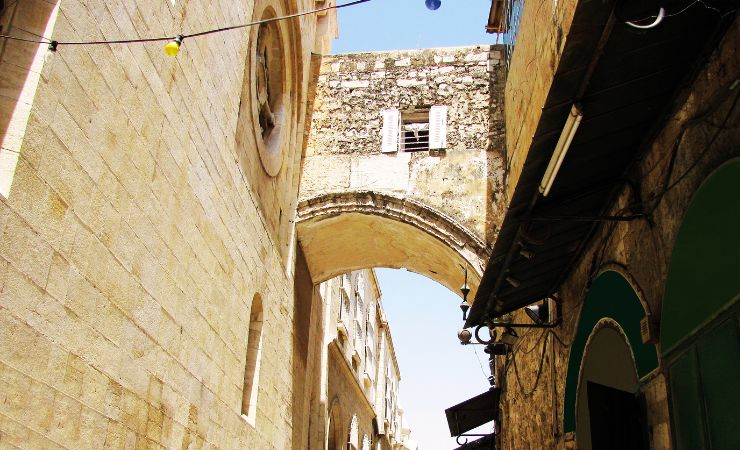
The Ecce Homo Arch is a Roman-era stone arch in Jerusalem's Old City, named after Pontius Pilate's phrase "Behold the Man." The arch spans the Via Dolorosa and is incorporated into the Convent of the Sisters of Zion. Built in the 2nd century CE under Emperor Hadrian, it originally formed part of a triple-arched gateway.
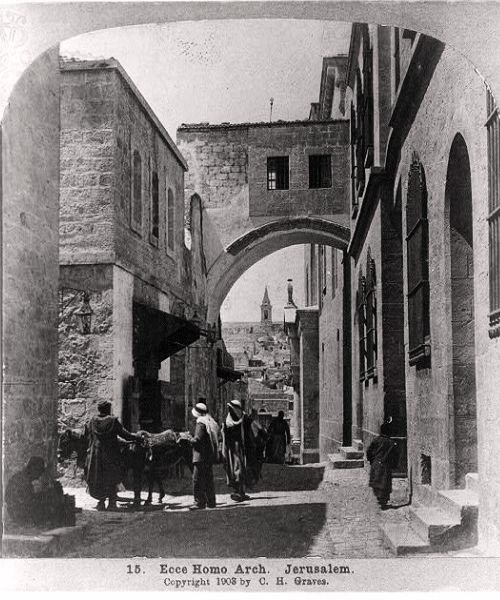
The Ecce Homo Arch stretches across the Via Dolorosa in Jerusalem’s Old City, taking its name from Pontius Pilate’s Latin phrase “Ecce Homo,” which translates to “Behold the Man.” While Christian tradition has long associated this ancient stone arch with the site where Pilate presented Jesus to the crowd.
Location of the Ecce Homo
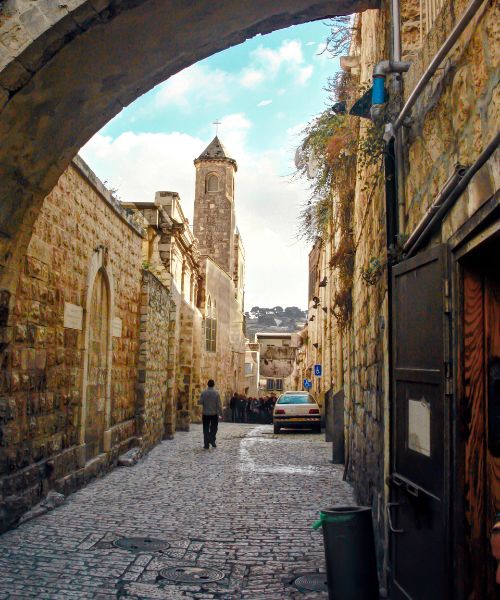
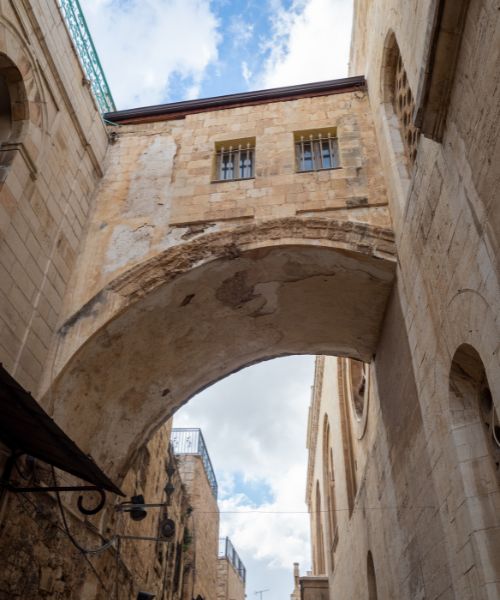
The Ecce Homo Arch stands at the intersection of the Via Dolorosa and Aqabat al-Takiya (Al-Wad Road) in the Muslim Quarter of Jerusalem’s Old City, approximately 150 meters northeast of the Damascus Gate. The arch connects the Sisters of Zion Convent on the north side to buildings on the south, creating a distinctive landmark that pilgrims recognize as the second station of the Via Dolorosa.
Biblical Context
According to the Gospel of John (19:13), Jesus was brought out by Pilate and shown to the people at a place called Gabbatha, also referred to as the Stone Pavement. Christian tradition has long associated this location with the area near the Ecce Homo Arch. For many centuries, believers identified this as the spot where Jesus was bound and crowned with thorns before a hostile crowd shortly before his crucifixion. Pilate uttered the words “Ecce Homo” as he presented the beaten and humiliated Christ to the masses, fulfilling the prophecy in Zechariah 6:12 that speaks of a man called “the Branch.”
This tradition places the trial near the Antonia Fortress, which once stood adjacent to the Temple Mount and served as a Roman military stronghold housing up to 600 soldiers. The fortress controlled the temple courtyards and provided direct access for Roman intervention during Jewish festivals. Over time, Christian churches and chapels were built nearby to commemorate these events, including the Chapel of the Condemnation, which was rebuilt in 1904 on the site of a medieval Crusader church that had been destroyed and reconstructed multiple times.
However, contemporary biblical scholars and archaeologists increasingly question whether Pilate conducted Jesus’ trial at the Antonia Fortress. Many now argue that the trial more likely occurred at Herod’s Palace, located near today’s Jaffa Gate on the western side of the city. Herod’s Palace served as the official residence for Roman governors when they visited Jerusalem, featuring luxurious accommodations, extensive gardens, and formal audience halls more suitable for official judicial proceedings than a military fortress.
So Jesus came out, wearing the crown of thorns and the purple robe. Pilate said to them, ‘Behold the man!
History of the Ecce Homo Arch and the Church
The Ecce Homo Arch has a complex and layered history spanning nearly two millennia of conquest, destruction, and religious devotion. Archaeological evidence indicates the arch formed part of a monumental triple gateway built by Emperor Hadrian around 135 CE as an entrance to the forum of Aelia Capitolina, the Roman city constructed on Jerusalem’s ruins following the Bar Kokhba Revolt. Hadrian’s urban planners designed this gateway to rival the grandest Roman forums, with three arches creating an impressive ceremonial entrance from the city’s northern approach. Excavations beneath the current structure reveal sophisticated Roman engineering, including vaulted chambers and water management systems that supported the bustling commercial district above.
The original triple arch structure consisted of:
The central arch, the largest at approximately 6.5 meters wide, still spans the Via Dolorosa and remains visible to all passersby.
The northern arch, measuring about 4 meters wide, was incorporated into the Basilica of Ecce Homo during the 20th century and now frames the altar in the convent chapel.
The southern arch was demolished during Ottoman urban development in the 18th century and no longer survives.
The Sisters of Zion, a Catholic congregation founded by Théodore and Alphonse Ratisbonne in 1843, acquired the site in 1857 after extensive negotiations with Ottoman authorities. During construction of their convent, the nuns discovered extensive remains beneath their property, including the famous Lithostrotos pavement and portions of the ancient Struthion Pool. They built the Ecce Homo Convent and the Basilica of Ecce Homo directly above these archaeological treasures, deliberately incorporating the northern arch into their chapel design. The basilica, completed in 1929, features the arch as its central architectural element, with the altar positioned directly beneath the ancient Roman stonework.
French architect Louis-Marie Cordonnier designed the convent complex to accommodate both the religious community and the growing number of pilgrims drawn to the site. The building includes a guest house, museum space, and extensive underground chambers that preserve the Roman-era remains. The Sisters established guided tours of the archaeological areas in the 1930s, making the Ecce Homo Arch one of Jerusalem’s earliest examples of religious tourism combined with archaeological education.
Archaeological Insights
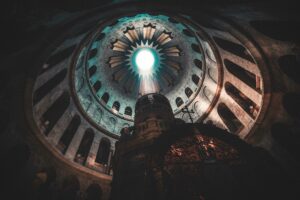
Modern archaeological investigation reveals that Hadrian’s original triple arch now exists only in fragments. The central span survives as the prominent arch visible to tourists walking along the Via Dolorosa, while the northern arch was skillfully integrated into the Basilica of Ecce Homo during construction in the early 20th century. The smaller northern arch now frames the tabernacle within the convent chapel, positioned beneath a Byzantine cross set against a gilded mosaic backdrop. Archaeological surveys conducted by the Biblical Archaeology Society have documented the precise engineering techniques used by Hadrian’s architects, including the use of dressed Meleke limestone quarried from local sources and sophisticated load-bearing calculations that have allowed the structure to survive earthquakes and military conflicts.
Beneath the arch, inside the Ecce Homo Convent, lies a remarkable stone pavement known as the Lithostrotos, from the Greek word meaning “stone pavement.” This extensive paved area consists of large limestone blocks, some weighing over a ton each. Early Christian tradition linked this pavement to Jesus’ trial because the Gospel of John mentions that Pilate brought Jesus to “a place called the Stone Pavement, which in Aramaic is Gabbatha” (John 19:13). The pavement’s impressive scale and the discovery of what appear to be judgment seats carved into some stones reinforced centuries of pilgrim belief about the site’s biblical significance.
Contemporary archaeological analysis, however, reveals a different chronology. The pavement dates to Hadrian’s reconstruction period around 135 CE, built as part of the Roman plaza system for Aelia Capitolina. Hadrian’s engineers constructed this pavement directly over the Struthion Pool, a massive Hasmonean-period water reservoir. The Romans filled portions of the pool with rubble and created barrel vaults to support the plaza above, a sophisticated engineering solution that converted the ancient water storage facility into the foundation for urban commercial space. Visitors can descend into the preserved sections to observe these Roman vaults and explore remnants of the original pool structure, including ancient steps and plaster waterproofing that date to the Second Temple period.
Archaeological excavations have uncovered:
Carved games etched into the pavement stones, including the “King’s Game” (Basilikos), a Roman military gambling game, along with dice games and board configurations used by soldiers during off-duty hours.
Anti-slip grooves cut into the stones in regular patterns, designed to prevent horses and wheeled vehicles from slipping on the polished limestone surface during Jerusalem’s rainy season.
Architectural fragments including column capitals, decorative moldings, and ashlar blocks from 1st century BCE to 1st century CE structures, likely reused from the demolished Antonia Fortress in Hadrian’s construction project.
The carved soldier games once provided compelling evidence for those who believed this was where Roman soldiers mocked Jesus before the crucifixion, as described in the Gospels. However, the games’ dating to the 2nd century CE demonstrates how archaeological discoveries can both support and complicate traditional religious narratives, requiring visitors to consider multiple layers of historical significance at sacred sites.
Practical Information
The Ecce Homo Arch itself can be viewed from the street at any time, as it spans the Via Dolorosa and remains open to pedestrian traffic 24/7. The archaeological museum and Lithostrotos pavement beneath the Sisters of Zion Convent require an entrance ticket.
Additional Information
Is the Ecce Homo Arch the actual site where Pontius Pilate presented Jesus?
While Christian tradition has long associated the Ecce Homo Arch with the biblical “Ecce Homo” moment, archaeological evidence indicates the current arch dates to around 135 CE, built by Emperor Hadrian after the Bar Kokhba Revolt. Many contemporary biblical scholars believe Pilate’s trial of Jesus more likely occurred at Herod’s Palace near today’s Jaffa Gate, rather than at the Antonia Fortress area where the arch stands. The site remains significant for Christian pilgrims as a place of prayer and reflection on Jesus’ passion.
What is the Lithostrotos pavement at Ecce Homo Arch?
The Lithostrotos is an extensive Roman stone pavement measuring about 2,500 square meters, located beneath the Sisters of Zion Convent. The name comes from the Greek word meaning “stone pavement.” Built during Hadrian’s reconstruction of Jerusalem around 135 CE, it served as the forum plaza of Aelia Capitolina. The pavement features carved games used by Roman soldiers and anti-slip grooves for horses and carts.
Can you see the Struthion Pool at the Ecce Homo site?
Yes, visitors to the archaeological museum can descend into preserved sections of the ancient Struthion Pool, a large water reservoir from the Hasmonean period that lies beneath the Roman pavement. The pool measures approximately 52 by 14 meters and features impressive Roman barrel vaults that Hadrian’s engineers built to support the plaza above. Ancient steps and waterproof plaster from the Second Temple period are still visible.
Is the Ecce Homo Arch accessible for people with disabilities?
The street-level arch is accessible to wheelchairs and those with mobility limitations. However, the underground archaeological museum requires navigating narrow staircases and uneven ancient stone surfaces that may be challenging for visitors with mobility issues. The convent does not have elevator access to the museum areas, so visitors should plan accordingly.
What You Can See Today
The central Ecce Homo Arch stands over the Via Dolorosa and supports a small room above.
The northern arch, incorporated into the chapel of the Ecce Homo Basilica, is visible inside the convent.
The archaeological area beneath the convent includes the Roman pavement and a view of the Struthion Pool. Entry requires a ticket.
Nearby Sites
-
St. Anne’s Church: Located at the start of the Via Dolorosa, St. Anne’s Church is a well-preserved example of Crusader architecture. It’s traditionally believed to be the birthplace of the Virgin Mary.
-
The Pool of Bethesda: Mentioned in the Gospel of John, the Pool of Bethesda is where Jesus is said to have performed the miracle of healing a paralytic.
- The Church of Flagellation: This Roman Catholic church in Jerusalem commemorates the spot where Jesus Christ was flogged by Roman soldiers before his crucifixion. Built by Antonio Barluzzi, it has beautiful stained glass windows and the courtyard’s symbolic mosaic floor.
- The Lion’s Gate: Also known as St. Stephen’s Gate or Sheep Gate, the Lion’s Gate is one of the seven open gates in Jerusalem’s Old City walls. It’s named after the pair of lion symbols carved into the wall, and it’s the starting point of the Via Dolorosa, the path that Jesus is believed to have walked on his way to crucifixion.
Keep reading
Part of our Christian Pilgrimage Guide →