Caesarea Philippi, also called Banias, is an ancient site at the foot of Mount Hermon in northern Israel, centered around a major natural spring. Originally dedicated to the Greek god Pan, it became a significant religious center and later the setting where Jesus declared Peter the foundation of his church, creating a powerful contrast between pagan worship and early Christianity.
Caesarea Philippi (Banias) sits at the southwestern foot of Mount Hermon, roughly 40 kilometers northeast of the Sea of Galilee, where one of Israel’s most powerful springs pushes out of a limestone cave beneath a 60-meter cliff. The site was already ancient when Jesus walked here, and the moment he chose it for Peter’s confession made it one of the most theologically charged addresses in the Bible.
Where Is Caesarea Philippi (Banias)?
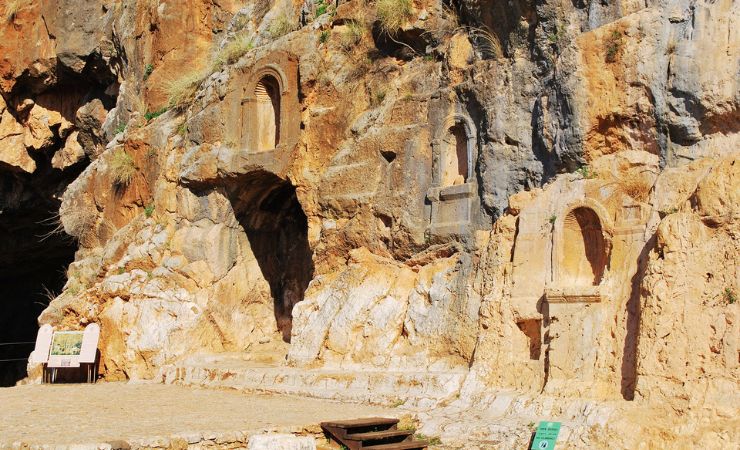
Banias occupies a strategic position in the Golan Heights, near the modern border with Lebanon. The Banias Spring (Nahal Hermon) emerges from a large limestone cave at the cliff base and is one of the three main sources of the Jordan River. The cave, the cliff, and the rushing water are all immediately visible from the main entrance path, there is no buildup, no waiting. You round a bend and the whole scene is in front of you at once.
Why Did Jesus Come to Caesarea Philippi?
According to the Gospels of Matthew and Mark, Jesus brought his disciples to Caesarea Philippi and asked who people said he was. When Peter answered, “You are the Christ, the Son of the living God” (Matthew 16:16), Jesus declared that revelation came from God, not human insight, and responded:
And I tell you, you are Peter, and on this rock I will build my church, and the gates of hell shall not prevail against it
The location was deliberate and provocative. At the time of Christ, Caesarea Philippi featured six distinct sites of pagan worship surrounding the cave: a temple to Augustus Caesar, a courtyard for Pan worship, a temple to Zeus, the Court of Nemesis, and both upper and lower tomb temples of the Dancing Goats. Ancient sources called the cave itself the “Gate of the Underworld (Hades),” where worshippers threw live animals into the dark water as sacrifices. Pagan rituals involving goats and humans as part of Pan worship took place within sight of the spring. Jesus’ disciples, faithful Jews, would have found this atmosphere deeply unsettling, which is precisely why the declaration landed with such force. Church fathers John Chrysostom and Jerome later emphasized how Jesus chose the very place associated with demonic forces to proclaim the church’s eternal triumph.
What Is the History of Caesarea Philippi (Banias)?
Hellenistic Period
The site gained prominence after Alexander the Great’s 4th-century BCE conquests. The historian Polybius records that the decisive Battle of Panium (c. 200 to 198 BCE) was fought here, with the Seleucids under Antiochus III defeating the Ptolemies and ending Ptolemaic influence in the southern Levant. Ptolemaic rulers had already established a cult center to Pan at the spring cave in the 3rd century BCE, the site’s Greek name, Paneion or Paneas, comes directly from that dedication. Archaeological finds from this era include Greek pottery sherds, coins bearing Ptolemaic royal portraits, and limestone relief carvings of Pan with his characteristic goat legs and reed pipes.
Roman Period
In 20 BCE, Emperor Augustus granted Herod the Great authority over Paneas. Herod immediately built a magnificent white marble temple honoring Augustus directly in front of the sacred cave. Josephus records that Herod “erected to him a very beautiful temple of white stone” at this “most celebrated place,” and excavations have confirmed that account with massive foundation blocks and architectural fragments on site.
Around 3 CE, Philip the Tetrarch, Herod’s son, founded a new city here and named it Caesarea in honor of Augustus Caesar. To distinguish it from Caesarea Maritima on the Mediterranean coast, it became known as Caesarea Philippi. Excavations have revealed broad basalt-paved streets, ashlar masonry public buildings, and sophisticated water management systems including lead pipes and ceramic aqueducts.
Under King Agrippa II, the city reached its peak. Agrippa expanded the urban center and temporarily renamed it Neronias in honor of Emperor Nero. Recent excavations have identified his palace: a massive complex covering approximately 10,000 square meters, with a civil basilica featuring marble columns, courtyards with geometric mosaics, reception halls with painted plaster walls, and vaulted passages connecting its sections. By the late 1st century CE, the sacred precinct near the spring included a temple at the cave mouth, ritual courtyards with alternating square and rounded niches for statues, and an open hospitality area in the Roman triclinium-nymphaeum style.
Christian and Byzantine Period
In the 4th century CE, Paneas became a bishop’s seat under the Phoenician province. Christians built a large basilica measuring approximately 40 by 20 meters atop Roman foundations, with an apse oriented eastward, and a smaller chapel near the cave entrance. Bishop Eusebius of Caesarea recorded that local Christians erected a bronze statue commemorating the woman with the issue of blood whom Jesus healed, placing it near the former pagan shrines, a deliberate act of symbolic reclamation.
Early Muslim Period
Following the Muslim conquest in 638 CE, Paneas became the capital of the Jund al-Urdunn (Jordan District). Arabic speakers found the letter “p” difficult to pronounce, so the name evolved to Banias, the name the site carries today. The geographer al-Muqaddasi described Banias as “the granary of Damascus.” Excavations have uncovered a synagogue from the 11th century later converted into a mosque, gold dinars, and silver artifacts from the 10th century. Documentary evidence from the Cairo Genizah confirms an independent Beit Din (rabbinical court) operating here, with both Jerusalemite and Babylonian Jewish traditions present.
Crusader, Ayyubid, and Mamluk Periods
The Crusaders captured Banias twice, calling it Belinas, and built a fortress to control the Jordan River headwaters. After Saladin’s victory at the Battle of Hattin in 1187, the Ayyubids dismantled the castle to prevent Crusader reuse. The Ayyubid ruler al-Aziz Uthman began reconstruction in 1227, incorporating angled walls to deflect projectiles and multiple defensive lines. Sultan Baibars renovated the site in 1265, adding a permanent garrison of approximately 200 soldiers. The gatehouse’s cross-vaulted ceiling and its alternating courses of light and dark stone (ablaq masonry) remain the finest example of Mamluk military architecture at Banias.
What Can You See at the Site Today?
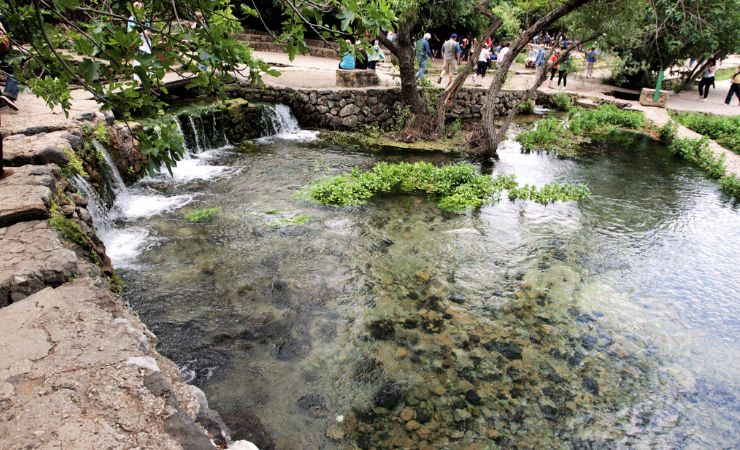
Banias operates as part of the Hermon Stream (Banias) Nature Reserve, managed by the Israel Nature and Parks Authority. The reserve divides into two connected areas: the archaeological springs area with the ancient city ruins, and the Banias Waterfall section reached via the famous hanging trail.
The Spring and Cave of Pan — The limestone cave where the spring originally emerged is the site’s most gripping feature. Earthquake activity has shifted the water so it now seeps from the bedrock at the cliff’s base rather than gushing from inside the cave, but standing at the dark entrance you can still feel why ancient people called this the “Gate of Hades.” Five niches carved into the cliff face once held statues of Pan, the Nymphs, and other Greco-Roman deities. Greek inscriptions still visible on the rock include a dedication to “Pan the lover of Echo” and a vow made by “the priest Valerius.”
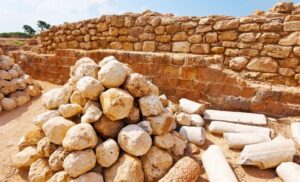
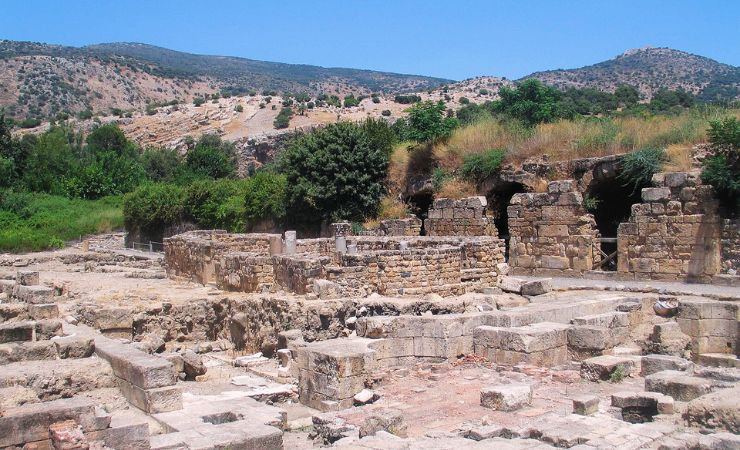
Temple Complex Remains — Foundations and architectural fragments from multiple building phases surround the cave. Scattered white marble blocks most likely originated from Herod’s temple to Augustus. The most substantial element is a rectangular platform measuring 15 by 9 meters that formed the base of that Augustus temple. Stone terraces mark the locations of various pagan temples and ritual courtyards that operated for centuries.
Roman Urban Ruins — The western portion of the site exposes the sophisticated layout of Caesarea Philippi at its height. Excavated sections of Agrippa II’s palace complex survive with distinctive opus reticulatum (net-pattern) concrete walls, vaulted chambers, surviving column bases, and mosaic floor fragments from the civil basilica. Lead pipes and ceramic aqueducts that once delivered spring water directly to public and residential areas are visible throughout.
Later Religious Structures — Foundation walls from the Byzantine basilica (40 by 20 meters, three-aisled plan) and parts of the medieval mosque that replaced the 11th-century synagogue are both visible. The mosque’s mihrab (prayer niche), oriented toward Mecca, remains clearly readable in the stonework, giving visitors a rare layered view of Christian and Islamic periods side by side.
Mamluk Fortress (Burj) — The 13th-century gatehouse is the most complete medieval structure at Banias. Its walls reach 12 meters, its defensive towers provided overlapping fields of fire across the Hula Valley, and the intact cross-vaulted ceiling overhead makes the military engineering immediately legible. A spiral staircase leads to upper chambers and the original defensive positions.
Banias Waterfall and Hanging Trail — Israel’s largest waterfall drops 10 meters, and it is most powerful in winter and spring when Mount Hermon snowmelt pushes the flow rate past 1,000 liters per second. The suspended wooden walkway runs 1.2 kilometers above the basalt gorge, putting visitors close enough to feel the spray while keeping the sensitive ecosystem intact below.
Historic Mills and Industrial Remains — Along the stream paths stand ruins of water-powered flour mills that operated from Roman through Ottoman times, representing nearly 2,000 years of continuous industrial use. The restored Matruf Mill still serves local villages during harvest season. Massive basalt grinding stones weighing over 500 kilograms and iron-fitted water wheel mechanisms are on display at several points. Remnants of the Trans-Arabian Pipeline (TAP) that once crossed the river add a layer of 20th-century history to the site.
Practical Information
Hours: April-September: 8:00 AM – 5:00 PM, October-March: 8:00 AM – 4:00 PM; Friday and holiday eves close one hour earlier.
Accessibility: The springs archaeological area features paved paths suitable for wheelchairs and mobility devices. The waterfall trail includes stairs and uneven terrain not accessible for mobility devices.
Additional Information
Antiquity
- c. 200 BCE: The place is mentioned for the first time under the name Paneion or Paneas, suggesting its use for the worship of the god Pan.
- 19 BCE: Emperor Augustus grants the area around Paneas to King Herod. Herod builds a magnificent marble temple in honor of Augustus at the site, known as Paneion.
- 2 BCE: Following Herod’s death, his son Philip rules the area. He establishes his capital at Paneas and renames it Caesarea, later known as Caesarea Philippi to distinguish it from Caesarea Maritima.
- Mid-1st Century CE: Agrippa II rules the area and makes Caesarea Philippi his capital. Josephus writes that Agrippa II greatly embellished the city, building a large palace and temples adorned with statues.
- 1st Century CE (New Testament period): According to Christian tradition, Jesus is in the area of Caesarea Philippi with his disciples. Simon Peter declares Jesus to be the Messiah, and Jesus gives Peter the “keys to the kingdom of heaven.”
- Late 1st Century CE: The sacred area begins to be built, initially as an open hospitality complex in the Roman Triclinium-Nymphaeum style at the cave’s entrance, likely by Agrippa II.
- 2nd-3rd Centuries CE: Temples and open ritual complexes dedicated to Pan and Zeus are built on the terrace below the cliff, east of the cave.
- 4th Century CE: With the spread of Christianity, the city becomes a seat of a bishop in the Phoenician province. The pagan cult of Pan ceases, and the temples are abandoned. However, the city of Paneas continues to flourish, with new streets added. Agrippa II’s palace is converted into a bathhouse.
- Mid-5th Century CE: A decline in the city’s status is noted.
Early Muslim Period
- 7th Century CE: Following the Muslim conquest, Banias becomes the capital of the Golan district and is mentioned in several historical sources. The settlement area significantly shrinks, likely concentrating near the spring and the northwestern quarter.
- 10th Century CE: The Muslim geographer al-Muqaddasi mentions Banias as the granary of Damascus, suggesting its economy was quite healthy, supported by findings of gold coins and a pair of silver bracelets. The settlement, now called Banias, is renewed due to waves of Muslim immigration. Jews also arrive and form two communities: Jerusalemite and Babylonian.
- 11th Century CE (Mid): A document from the Cairo Genizah indicates an independent Beit Din (Jewish court) in Banias, suggesting a well-established and important community.
Middle Ages
- 1099: In response to the Crusader conquest of the Galilee, the Muslims fortify Banias.
- 1227: The ruler al-Aziz Uthman begins rebuilding the Banias fortress. Simultaneously, he builds the Qal’at al-Subayba fortress (Nimrod Fortress) above Banias as a military base.
- 1265: Mamluk Sultan Baybars renovates the city and stations a military unit there. Mamluk Banias is the administrative center of the southern district of Damascus and controls many villages in the Golan and Hula Valley.
Modern Period
- Early 19th Century CE: European travelers begin visiting and “discovering” the site. The first modern visitor is likely Seetzen, who in 1806 describes it as a village of about twenty miserable houses but notes the remains of the fortress, cave, and inscriptions on the cliff.
- Post-1948 Arab-Israeli War: This division is solidified, with only the southern part of the stream remaining under Israeli control. The Syrians take control of the northern part of the stream, which is defined as a demilitarized zone in the armistice agreement with Syria.
- 1977: The Banias Stream Nature Reserve is declared, and the archaeological site is included within it. Hiking trails are established within the reserve, allowing visitors to explore the ancient natural landscapes and archaeological remains from the Roman, Byzantine, and Crusader periods.
What is Caesarea Philippi called today?
Caesarea Philippi is called Banias today. After the Muslim conquest in 638 CE, Arabic speakers replaced the “P” in Paneas with a “B” since the letter “p” does not exist in Arabic, producing the name Banias, which the site still carries.
What is the Banias Waterfall?
The Banias Waterfall is Israel’s largest waterfall, dropping 10 meters over a basalt gorge. It is most powerful in winter and spring when Mount Hermon snowmelt can push the flow rate above 1,000 liters per second. A 1.2-kilometer suspended wooden trail runs alongside it.
Was Caesarea Philippi an evil place in biblical times?
Ancient sources called the cave at Caesarea Philippi the “Gate of Hades.” The site hosted six pagan worship areas, including temples to Augustus, Zeus, and Pan. Worshippers threw live animals into the cave as sacrifices. Jesus chose this location deliberately when he declared Peter the foundation of his church.
Where exactly are the Gates of Hell mentioned in the Bible at Caesarea Philippi?
The “Gates of Hell” reference appears in Matthew 16:18 when Jesus tells Peter “the gates of hell shall not prevail against it” after Peter’s confession at Caesarea Philippi. Jesus deliberately chose this location because the spring cave was literally believed to be an entrance to Hades in pagan mythology, making his declaration about his church’s eternal victory over death particularly powerful in this setting.
What made the cave at Banias so significant for ancient pagan worship?
The cave served as the centerpiece for Pan worship because ancient peoples believed the dark depths and mysterious water flow represented a gateway to the underworld. Pagan rituals included throwing live sacrificial animals into the cave, with their disappearance into the dark waters interpreted as divine acceptance. The site featured six major pagan worship areas during Jesus’ time, including temples to Augustus Caesar, Pan, Zeus, and ritual courtyards.
What archaeological evidence exists for King Herod’s presence at Caesarea Philippi?
Archaeological excavations have uncovered substantial evidence of Herodian construction, including distinctive opus reticulatum (net-pattern) concrete walls, white marble temple foundations, and sophisticated architectural elements. Recent research by archaeologists has identified what may be Herod the Great’s palace through geometric patterns in decorative floor tiles and architectural parallels with other confirmed Herodian sites like Jericho and Masada.
Why did Jesus choose Caesarea Philippi for Peter’s confession instead of Jerusalem?
Jesus strategically selected this location at the northern frontier of his ministry to contrast the eternal truth of his identity with the false gods surrounding them. By making this pivotal declaration at the legendary “Gates of Hades,” Jesus emphasized that his church would triumph over death and darkness. The remote location also provided privacy for this crucial moment in preparing his disciples for his approaching crucifixion and resurrection.
How long should you plan for a complete visit to Caesarea Philippi?
Plan 3-4 hours for a thorough exploration of both areas. The springs archaeological site requires about 90 minutes to see the Cave of Pan, temple ruins, and palace remains. The waterfall area with the hanging trail takes approximately 45 minutes for the circular walk. Additional time is needed if hiking between locations or participating in guided tours.
Nearby Sites
- Tel Dan Nature Reserve:
Important archaeological remains, including a Canaanite city gate and biblical-era structures. - Nimrod Fortress (Qal’at Namrud): A massive medieval fortress situated on the slopes of Mount Hermon.
- Hula Nature Reserve: A nature reserve, famous for its seasonal bird migrations, and wetland ecosystems.
Keep reading
Part of our Galilee & Northern Israel Guide →