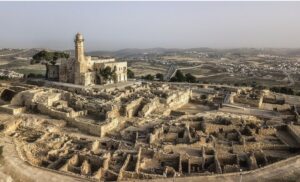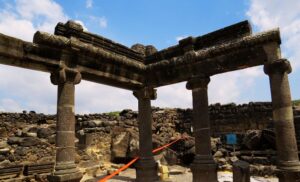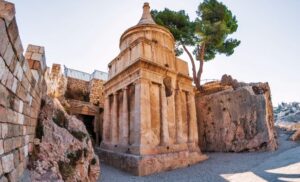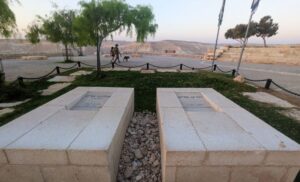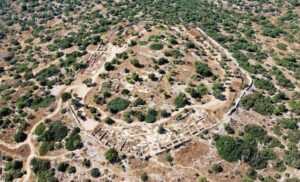
Beit She'arim National Park preserves an extensive ancient Jewish necropolis in the Lower Galilee, featuring elaborate rock-cut burial caves from the 2nd-4th centuries CE. The site served as the burial place of Rabbi Judah HaNasi and became a central cemetery for Jewish communities across the ancient world, showcasing remarkable stone sarcophagi and multilingual inscriptions.
Beit She’arim National Park encompasses one of Israel’s most significant archaeological sites, located in the southern Galilee. The park preserves an extensive rock-cut necropolis that provides unparalleled insights into Jewish burial customs, artistic expressions, and the survival of ancient Judaism during the Roman period. The site gained international recognition through Rabbi Judah the Patriarch’s burial here in 220 CE, transforming it into the most prestigious Jewish cemetery of its time. UNESCO designated this remarkable ancient cemetery as a World Heritage Site in 2015, acknowledging its outstanding universal value for understanding Jewish culture and history.
Location
Beit She’arim National Park sits approximately 20 kilometers east of Haifa, positioned in the rolling foothills of the Lower Galilee near the modern community of Kiryat Tiv’on.
History Throughout the Ages
- Iron Age: Archaeological evidence including pottery shards and building foundations suggests that a first settlement existed at the site as early as the Iron Age. Excavations have revealed residential structures and storage facilities typical of highland settlements during this period.
- Second Temple Period (1st century BCE – 1st century CE): Beit She’arim was founded at the end of the 1st century BCE, during the reign of King Herod. The Roman Jewish historian Josephus Flavius mentioned the town as Besara, identifying it as the administrative center of estates belonging to Queen Berenice in the Jezreel Valley during the 2nd century CE. The settlement featured typical Hellenistic urban planning with a main street, residential quarters, and public buildings.
- Roman Period (70-324 CE): Following the destruction of the Second Temple in 70 CE, Beit She’arim transformed into an important center of Jewish learning and authority. The Sanhedrin, Judaism’s supreme religious and legislative council, relocated here from Jerusalem. The town gained tremendous prominence when Rabbi Judah HaNasi established his study house here in the late 2nd century CE. The period from the 2nd to 4th centuries CE marked the height of the town’s prosperity and the primary era of necropolis use.
- Late Roman Decline (3rd-4th centuries CE): Construction quality declined toward the end of the third century CE, and the Sanhedrin eventually relocated to Sepphoris. Beit She’arim suffered devastating damage during the suppression of the Jewish rebellion against Gallus Caesar in 351 CE. Archaeological evidence shows extensive burning and destruction layers from this period. Despite the town’s decline, the prestigious necropolis continued attracting burials, though in simpler forms.
- Early Arab Period (7th century): The ancient town was completely abandoned during this period, leaving only the necropolis as evidence of its former significance. Bedouin tribes occasionally used some caves for shelter, but systematic burial practices ceased.
- Crusader Period (12th century): Limited archaeological evidence suggests temporary settlement activity in the area, likely connected to travelers and military outposts. Some inscriptions in Latin and repair work in certain caves date to this period.
- Ottoman Period (16th-20th centuries): A small Arab village called Sheikh Bureik developed above the necropolis from at least the late 16th century. The village inhabitants were unaware of the archaeological significance beneath their feet and occasionally used cave chambers for storage.
- British Mandate (1920s-1948): The Jewish National Fund purchased the village lands in the early 1920s, leading to the eviction of Arab tenants. Archaeological identification of the site as ancient Beit She’arim occurred in 1936 by Michael Avi-Yonah, launching systematic excavations that continue today.
Rabbi Judah HaNasi: The Patriarch of Beit She'arim
Rabbi Judah HaNasi (135-220 CE), known simply as “Rabbi” in Talmudic sources, wielded extraordinary influence as the most important Jewish leader of his generation. As head of the Sanhedrin and the recognized patriarch (nasi) of the Jewish people, he commanded both religious authority and political recognition from Roman administrators. His monumental achievement was redacting the Mishnah, the comprehensive collection of oral laws that became the foundation of Rabbinic Judaism and remains central to Jewish learning today.
The rabbi’s connection to Beit She’arim began when he relocated his study house and the Sanhedrin here from Shefar’am around 200 CE. His decision reflected both practical and personal considerations: he held tenant rights to extensive lands granted by Roman authorities, including valuable estates at Beit She’arim that generated substantial income. According to tradition preserved in the Babylonian Talmud, he received additional property in Beit She’arim as a personal gift from Emperor Marcus Aurelius Antoninus, with whom he maintained a remarkable friendship that transcended religious and cultural boundaries.
Health concerns forced Rabbi Judah HaNasi to relocate to Sepphoris during his final seventeen years, where the coastal climate provided relief from his ailments. However, he specifically requested burial in Beit She’arim, cementing the site’s transformation into the most prestigious Jewish cemetery of the ancient world. The Jerusalem and Babylonian Talmuds both preserve detailed accounts of his burial here circa 220 CE. The Talmud describes his elaborate funeral procession, during which representatives from eighteen synagogues and communities throughout the Land of Israel escorted his body to Beit She’arim, with tradition claiming that daylight miraculously extended until all mourners reached their homes safely.
Rabbi Judah HaNasi’s interment at Beit She’arim, combined with the Roman prohibition on Jewish burials in Jerusalem after 135 CE, created an unprecedented demand for burial plots near the revered patriarch. Jews from throughout the Land of Israel and the far reaches of the diaspora considered burial proximity to “Rabbi” the highest honor possible. Archaeological evidence strongly suggests that Cave complex No. 14 housed the patriarch’s family, featuring Hebrew and Greek inscriptions mentioning his sons Rabbi Shimon and Rabbi Gamliel, along with his distinguished student Hanania bar Hama. According to tradition, the rabbi specifically requested burial directly in the earth rather than in a sarcophagus, reflecting his humility even in death
The Necropolis: A City of the Dead
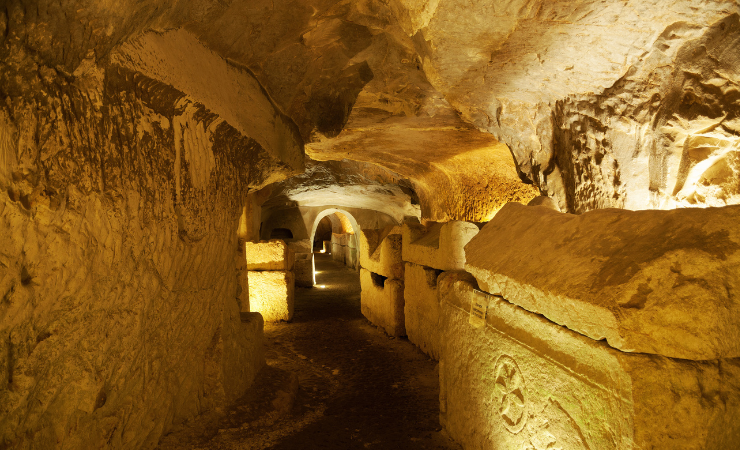
Beit She’arim National Park preserves one of the ancient world’s most extensive and sophisticated rock-cut cemetery complexes. The necropolis comprises more than 30 burial cave systems (catacombs) hewn into the soft limestone slopes southwest of the ancient town. These underground chambers range from intimate family tombs to vast multi-story networks containing hundreds of burial niches. The scale and craftsmanship of these installations suggest that cave cutting and preparation formed a major component of the town’s economy during the Roman period.
Structure and Architectural Features
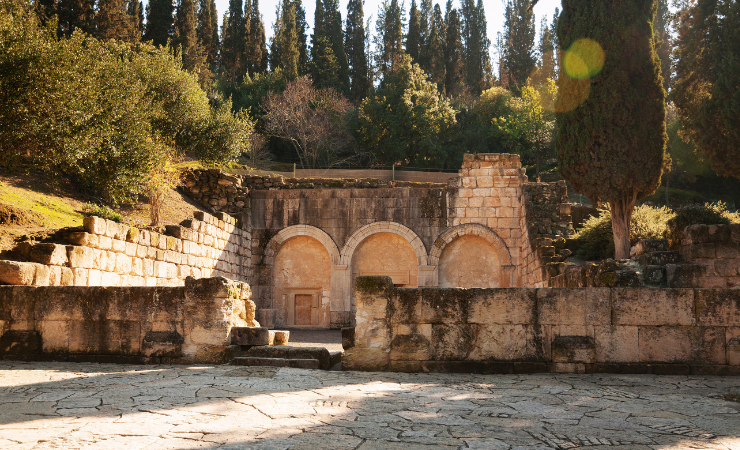
Most caves accessed through carefully planned open courtyards that create impressive facades inspired by Classical Roman and Hellenistic architecture. Master stonemasons carved elaborate stone doors mounted on working hinges, crafted in detailed imitation of wooden doors complete with decorative panels, raised bosses representing nail heads, and functional locks. Several of these massive stone portals, some weighing over a ton, still rotate smoothly on their original stone pivots after nearly two millennia. The site’s Hebrew name “Beit She’arim” (House of Gates) likely derives from these remarkable entrance features that impressed ancient visitors.
The interior layout follows sophisticated urban planning principles. Central hallways extend deep into the hillsides with networks of burial chambers branching systematically to maximize space utilization. Cave complex No. 1, known as the “Cave of the Horseman” due to its distinctive relief carving, demonstrates the most ambitious scale with 16 interconnected burial halls accommodating approximately 400 individual burial places across multiple levels.
Burial accommodations were carved in multiple configurations to serve different social classes and burial traditions. Wealthy families commissioned elaborate arcosolia (burial benches topped by gracefully arched ceilings), while simpler interments utilized basic loculi (wall recesses) or trough-shaped graves cut directly into chamber floors. Some prominent families constructed above-ground mausoleums over their cave entrances. Semi-circular stone structures with built-in benches positioned above certain caves likely served as gathering places for memorial prayers and annual commemorations.
Inscriptions and Cultural Documentation
The necropolis preserves inscriptions that provide unprecedented documentation of ancient Jewish society. Greek predominates among the languages used (reflecting Hellenistic cultural influence), with substantial numbers in Hebrew, Aramaic, and several examples in Palmyrene script from Syrian Jewish communities. These texts typically record the deceased’s name alongside expressions like “shalom” (peace) or “haval” (alas!), but longer inscriptions provide invaluable biographical details including genealogies, professional occupations, and geographical origins.
The geographical references reveal the international scope of Jewish dispersion during the Roman period, documenting communities from Syria, Lebanon, Egypt, Babylonia, and remarkably, southern Arabia. Some inscriptions demonstrate sophisticated literary education, incorporating poetic epigrams adapted from Homer’s classical works. Protective curses inscribed by families to deter tomb robbers provide insight into ancient security concerns and religious beliefs about afterlife consequences.
Artistic Decorations and Symbolic Imagery
The cave walls display an extraordinary fusion of Jewish religious symbolism with Greco-Roman artistic traditions. Traditional Jewish motifs include detailed menorahs (seven-branched candelabra), lulavs (palm branches), ethrogs (citrons), shofarim (ram’s horns), and Torah Ark representations. These appear alongside geometric patterns, animal figures (bulls, eagles, lions, birds, fish, horses), and imagery drawn from Hellenistic mythology and Roman artistic conventions. This artistic synthesis demonstrates the complex cultural negotiation between Jewish religious identity and broader Mediterranean cultural participation during the Roman period.
Sarcophagi and Burial Containers
The necropolis has yielded hundreds of sarcophagi crafted from various materials including local limestone, imported marble, clay, and lead. Evidence suggests that wooden coffins were also used, though only metal hardware components survive. Cave complex No. 20, designated the “Cave of the Coffins,” contained approximately 130 limestone sarcophagi decorated in distinctive local adaptations of Roman mortuary art.
Marble sarcophagi featuring elaborate mythological scenes were discovered throughout the complex, though many show damage from later lime production activities. The decorative programs combine foreign artistic motifs (bulls’ heads, eagles, confronting lions) with distinctively Jewish symbols, most notably the menorah. Archaeologists discovered what they termed the “mother of all menorahs” carved in high relief within the Cave of the Coffins, demonstrating exceptional artistic craftsmanship.
Several sarcophagi bear notable inscriptions commemorating rabbinic figures and prominent community members. Examples include the coffin of Rabbi Hillel [Halil], son of Rabbi Levi (who commissioned the cave construction), and the elegant marble sarcophagus of Kyra Mega, wife of Rabbi Joshua son of Levi. These inscriptions provide direct evidence of the rabbinic families and wealthy Jewish merchants who chose Beit She’arim as their eternal resting place.
Practical Information
Opening Hours: Beit She’arim National Park operates Sunday through Thursday from 8:00 AM to 4:00 PM (until 3:00 PM during winter months October-March), Friday and holiday eves from 8:00 AM to 1:00 PM, and Saturday from 8:00 AM to 4:00 PM. The park closes one hour earlier during winter months.
Admission Prices: Adult admission costs 22 NIS (approximately $6.50 USD), children receive discounted rates of 10 NIS (approximately $3 USD), and students with valid ID pay reduced rates. Annual National Parks passes provide significant savings for multiple visits. Group rates available for 20+ visitors with advance booking.
Accessibility: The visitor center and main pathways accommodate wheelchair users, though access to individual caves varies significantly.
Additional Information
What makes Beit She’arim National Park a UNESCO World Heritage Site?
UNESCO recognized Beit She’arim in 2015 for its outstanding universal value as a testimony to ancient Jewish culture during the Roman period. The site preserves the most extensive collection of Jewish catacombs from antiquity, featuring nearly 300 inscriptions in multiple languages and artistic decorations that demonstrate the synthesis of Jewish, Hellenistic, and Roman cultures. The necropolis represents a crucial period when Jewish communities adapted to diaspora conditions while maintaining religious identity.
How long does it take to visit Beit She’arim National Park?
A comprehensive visit to Beit She’arim National Park typically requires 2-3 hours to explore the main cave complexes, visitor center museum, and outdoor archaeological areas. Visitors interested in detailed archaeological examination or photography may prefer to allocate half a day. The park’s compact layout allows efficient touring, though individual caves require separate entry and can extend visit duration significantly.
Which caves can visitors enter at Beit She’arim?
Visitors can currently enter approximately 6-8 major cave complexes, including the famous Cave of the Horseman (Cave 1), the Cave of the Coffins (Cave 20), and the presumed burial cave of Rabbi Judah HaNasi’s family (Cave 14). Each cave offers unique features including different types of burial arrangements, artistic decorations, and historical inscriptions. Some caves may be temporarily closed for archaeological research or conservation work.
Is Beit She’arim suitable for children and families?
Beit She’arim National Park welcomes families with children and offers reduced admission rates for young visitors. The visitor center features interactive displays and educational materials suitable for various ages. However, parents should supervise children carefully within the caves due to uneven surfaces, low ceilings in some areas, and steep staircases. The outdoor archaeological areas provide excellent spaces for children to explore safely.
Can visitors see Rabbi Judah HaNasi’s actual burial place?
While Cave 14 is strongly associated with Rabbi Judah HaNasi’s family based on archaeological evidence and inscriptions mentioning his sons and students, the exact location of his personal burial remains uncertain. Archaeological research continues to investigate various locations within the complex. Visitors can explore the family cave and learn about the traditions surrounding his burial through interpretive displays and guided tours.
Sources and Additional Information
Nearby Sites
- Zippori (Sepphoris): A short drive north, this site offers stunning Roman mosaics and was another center of Jewish life—home to Rabbi Judah ha-Nasi’s final days.
- Mount Carmel: Ideal for hikers and nature lovers. Sites include the Mukhraka and Elijiah’s grave.
- Alonim Forest: Just a few minutes away—perfect for a shaded picnic or a contemplative walk after the caves.
Keep reading
Part of our Jewish Heritage Guide →