The Burnt House is an archaeological site in Jerusalem's Jewish Quarter preserving the remains of a priestly family's residence destroyed during the Roman conquest in 70 CE. Excavated in 1970, the site displays household artifacts, ritual objects, and burn marks that document the violent end of Second Temple Jerusalem.
Tucked away in the streets of Jerusalem’s Old City lies the Burnt House, a remarkable archaeological site that provides an intimate glimpse into the life of a priestly family during the Second Temple period and stands as a silent witness to the catastrophic events of 70 CE.
Location
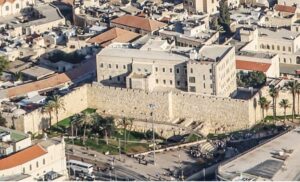
The Burnt House is located at 2 Tiferet Israel Street in the Jewish Quarter of Jerusalem’s Old City, approximately six meters beneath the current street level. The Jewish Quarter itself is compact and walkable. The site is roughly a five-minute walk from the Western Wall plaza and a two-minute walk from the Hurva Synagogue.
The Site's History
Uncovered in 1970 during extensive excavations led by archaeologist Nahman Avigad, the Burnt House provides a rare snapshot of Jerusalem’s Upper City in the final weeks before its destruction by the Romans. The Upper City was the wealthiest district of late Second Temple Jerusalem, home to the high-priestly families who served in the nearby Temple Mount complex. Avigad’s broader excavation campaign, which ran from 1969 to 1983, transformed scholarly understanding of what that neighborhood actually looked like, and the Burnt House was among its most dramatic finds.
The house is believed to have belonged to the Kathros family, a priestly lineage mentioned critically in the Talmud. A Talmudic lament in tractate Pesachim names the house of Kathros among the priestly families accused of exploiting the common people through their control of Temple commerce. The inscription “Bar Kathros” on a stone weight found in the kitchen connects the physical remains to that written record in a way that is almost without parallel in the archaeology of this period. Additional finds, including stone vessels and a mikvah cut into the floor, confirm the family’s strict adherence to Jewish purity laws, which required stone vessels because, unlike pottery, stone could not contract ritual impurity.
The date of destruction is not guesswork. Josephus recorded that the Romans set fire to the Upper City on the eighth of Elul, 70 CE, roughly a month after the Temple itself burned. Coins found within the ash layer of the Burnt House are consistent with that date, and the thick burn deposits left no ambiguity about what happened. The site was sealed by the destruction and untouched for nineteen centuries.
What Can Be Found at the Site
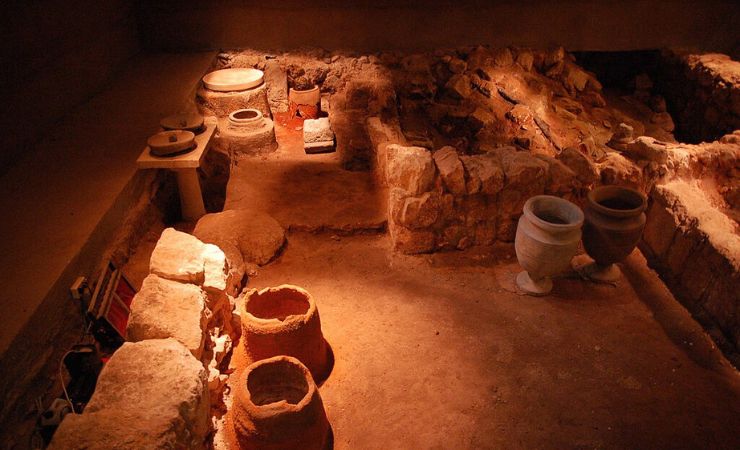
- Residential Layout: The excavated area covers approximately 55 square meters, featuring a small courtyard, four rooms, a kitchen, and a mikvah. The walls, preserved up to one meter in height, are coated with white plaster typical of upper-class Jerusalem homes of the late Second Temple period. Architectural details such as the stepped mikvah and the separation of kitchen from living spaces reflect the household routines of a priestly family that took purity obligations seriously.
- Household Artifacts: An array of everyday items, including ceramic and stone vessels, oil lamps, and grinding stones, provides a glimpse into the domestic life of the era. The stone kitchenware is particularly significant: Jewish law held that stone could not become ritually impure, so families of priestly rank preferred it over pottery. The inscribed stone weight reading “Bar Kathros” is displayed in context and represents one of the few direct epigraphic links between a Talmudic text and a specific archaeological find in Jerusalem.
- Evidence of Destruction: Charred wooden beams, burnt stones, and layers of ash vividly illustrate the intensity of the fire that consumed the house. The discovery of a young woman’s severed forearm near the entrance, still reaching toward a doorway, remains the site’s most haunting detail. No other human remains were found, suggesting the rest of the household fled before the flames reached them.
- Multimedia Presentation: The site includes a short audio-visual film shown in a small screening room adjacent to the excavated area. The film, available in several languages including English, reconstructs the final days of the house and its occupants.
Practical Information
The Burnt House is open Sunday through Thursday, 9:00 a.m. to 5:00 p.m., and Friday 9:00 a.m. to 1:00 p.m. The site is closed on Saturdays and Jewish holidays. Admission is approximately 24 NIS (roughly $8 USD) for adults in 2026, with reduced rates for students and children. A combined ticket covering both the Burnt House and the Herodian Quarter museum next door is available and represents better value for visitors planning to spend time in the Jewish Quarter.
Additional Information
What is the Burnt House in Jerusalem?
The Burnt House is an archaeological site in the Jewish Quarter of Jerusalem’s Old City, located approximately six meters below the present street level. It preserves the remains of a first-century dwelling destroyed by the Romans in 70 CE when they burned Jerusalem’s Upper City. The site is widely regarded as one of the most compelling pieces of physical evidence for the destruction of the Second Temple period city.
Who lived in the Burnt House?
The house is attributed to the Kathros family, a priestly clan mentioned by name in the Babylonian Talmud. An inscribed stone weight bearing the Hebrew phrase “Bar Kathros” was found in the kitchen during excavation, connecting the physical remains to that specific family. The Kathros family was associated with Temple service and was wealthy enough to inhabit the Upper City, Jerusalem’s most prestigious residential district.
How was the Burnt House discovered?
Israeli archaeologist Nahman Avigad uncovered the site in 1970 as part of a large-scale excavation of the Jewish Quarter that followed the reunification of Jerusalem in 1967. The reconstruction of the Quarter after years of Jordanian control required extensive ground work, which in turn revealed significant Second Temple period remains across the neighborhood. The Burnt House was preserved largely intact because the destruction sealed it and no subsequent construction disturbed the layer.
What artifacts were found in the Burnt House?
Excavators recovered stone vessels, ceramic pottery, oil lamps, iron spear tips, grinding stones, and the inscribed “Bar Kathros” weight. A mikvah, or ritual bath, was cut into the floor of one of the rooms. Most striking was the skeletal forearm of a young woman found near a doorway, the only human remains at the site. A layer of ash and charred beams covered the entire floor, consistent with an intense, rapid fire.
How long does a visit to the Burnt House take?
Most visitors spend between 45 minutes and one hour at the site, including the short audio-visual film shown in the screening room. If you are combining the visit with the adjacent Herodian Quarter museum, budget a total of two to three hours for the full complex. Groups with a licensed guide or a strong interest in the archaeology of the period often spend longer.
Nearby Sites
- The Herodian Quarter: Showcases luxurious mansions from the Second Temple period, reflecting the lifestyle of Jerusalem’s elite.
- The Cardo Maximum: An ancient Roman street that served as the main thoroughfare in Byzantine Jerusalem, now lined with modern shops and art galleries.
- The Broad Wall: A massive defensive wall built by King Hezekiah in the 8th century BCE, highlighting the city’s ancient fortifications.
- The Hurva Synagogue: A historic synagogue that has been destroyed and rebuilt multiple times, symbolizing the resilience of Jerusalem’s Jewish community.
Keep reading
Part of our Jewish Heritage Guide →