Christ Church was established in 1849 as the first Protestant church in the Middle East. Located in Jerusalem's Old City near Jaffa Gate, it was built by the London Society for Promoting Christianity Amongst the Jews. The church features a unique blend of Gothic architecture and Jewish symbolism, serving both Anglican and Messianic Jewish congregations today.
Christ Church Jerusalem holds the distinction of being the first Protestant church established in the Middle East, a milestone achievement in the region’s religious history. Built within the Ottoman walls of Jerusalem’s Old City and consecrated in 1849, this Anglican church represents a fascinating blend of Christian mission and architectural diplomacy. The church emerged during a pivotal period when European powers competed for influence in the Holy Land.
Where is Christ Church Located?
Christ Church Jerusalem occupies a prominent position in the Armenian Quarter of the Old City, approximately 50 meters from the Jaffa Gate. The church sits on Omar Ibn el-Khattab Street, directly opposite the entrance to the Tower of David Museum.
Historical Context
The establishment of Christ Church Jerusalem emerged from the complex geopolitical landscape of 19th-century Ottoman Palestine. In 1841, the Anglican Church of England and the German Lutheran Church formed an unprecedented joint Protestant diocese in Jerusalem, driven by both religious mission and imperial competition with Catholic France and Orthodox Russia for influence in the Holy Land. This ecumenical alliance, though short-lived, represented the first Protestant ecclesiastical authority established in Jerusalem’s millennia-long religious history.
The Church of England had purchased land near the Jaffa Gate in 1833 through the London Society for Promoting Christianity Amongst the Jews (now known as the Church’s Ministry Among Jewish People). This organization, founded in 1809, operated under the theological conviction that Jewish conversion to Christianity would precipitate the Second Coming. The society’s work in Jerusalem represented part of a broader evangelical movement that viewed the restoration of Jews to the Holy Land as fulfilling biblical prophecy.
Construction of the church faced significant obstacles from both Ottoman authorities and local religious communities who viewed Protestant missionary activities with suspicion. The project required diplomatic intervention from the British consul and support from influential evangelicals like Lord Shaftesbury, the 7th Earl who championed the cause of Jewish restoration to Palestine. A petition bearing over 30,000 signatures was presented to the Ottoman Sultan, demonstrating the international Protestant commitment to the project.
Originally named the “Apostolic Anglican Church,” the building was consecrated on January 21, 1849, by Bishop Samuel Gobat, the second Anglican Bishop in Jerusalem. The church served as the cathedral seat of the Anglican Bishop until 1899, when St. George’s Cathedral was completed outside the Old City walls.
The Church's Architecture
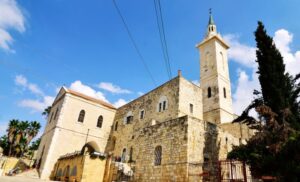
The architectural design of Christ Church Jerusalem represents a calculated theological and cultural statement. Master stonemasons from Malta constructed the building using the distinctive golden Jerusalem stone, employing Neo-Gothic Revival architecture typical of 19th-century Anglican churches. However, the exterior deliberately omits traditional Christian symbols, particularly the cross, which was considered potentially offensive to the local Jewish population the church hoped to convert.
Instead, Jewish religious symbols adorn the building’s facade and interior. A seven-branched menorah crowns the church’s exterior, while Stars of David appear in the stained glass windows. These design choices reflected the London Society’s strategy of presenting Christianity as the fulfillment of Judaism rather than its replacement. The church’s bell tower, rising 25 meters above street level, provides commanding views across the Old City while its bells call both Christian and Jewish communities to worship.
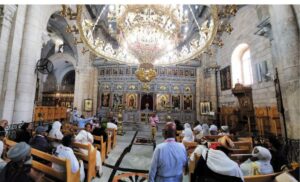
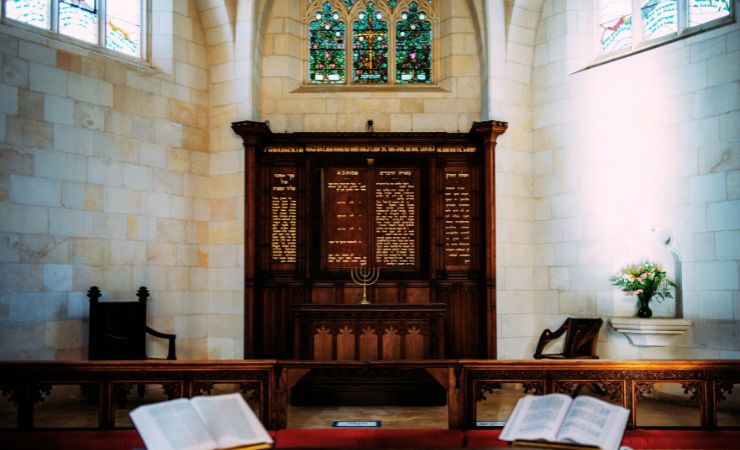
The interior layout follows synagogue traditions rather than conventional church design. The sanctuary faces east toward the Temple Mount, mirroring the orientation of Jerusalem’s synagogues. Behind the altar, wooden paneling evokes the appearance of a Torah ark, the sacred cabinet housing scripture scrolls in Jewish worship. The pews are arranged to face the Temple Mount rather than a traditional Christian altar configuration.
Most significantly, biblical passages and the Apostles’ Creed are inscribed in Hebrew on the eastern wall, emphasizing the church’s mission to Jewish residents. The original organ, installed in 1874 and still functioning, was specifically chosen to accommodate both Christian hymns and Jewish liturgical music.
The church compound includes adjacent buildings that housed the first modern hospital in Jerusalem, a pharmacy, and educational facilities, demonstrating the comprehensive approach of Protestant mission work. The complex’s design integrates these social services around a central courtyard, following Mediterranean architectural traditions.
Practical Information
Opening Hours are Sunday through Friday 9:00 AM to 5:00 PM, Saturday 9:00 AM to 1:00 PM. Closed on major Christian holidays and during special services.
Contact: Phone +972-2-627-7727. Email info@christchurchjerusalem.org for tour bookings and special arrangements.
Additional Information
What makes Christ Church Jerusalem historically significant?
Christ Church Jerusalem holds the distinction of being the first Protestant church established in the Middle East, consecrated in 1849. The church represents a unique collaboration between Anglican and Lutheran denominations during the Ottoman period and served as the cathedral seat for Anglican bishops until 1899. Its establishment marked the beginning of organized Protestant missionary activity in the Holy Land.
Why does Christ Church have Jewish symbols instead of crosses?
The church was designed specifically to appeal to Jerusalem’s Jewish community as part of Christian missionary efforts. Menorahs, Stars of David, and Hebrew inscriptions replace traditional Christian symbols on the exterior and interior. This architectural strategy reflected the London Society for Promoting Christianity Amongst the Jews’ belief that Christianity represented the fulfillment rather than replacement of Judaism.
What is the relationship between Christ Church and the Anglican Diocese?
Christ Church served as the cathedral seat of the Anglican Bishop in Jerusalem from 1849 to 1899, when St. George’s Cathedral was completed. The church remains part of the Anglican Diocese of Jerusalem and continues to serve as an active parish church. The compound includes the historic Christ Church Guest House, which has accommodated pilgrims and dignitaries for over 170 years.
Are guided tours available at Christ Church Jerusalem?
Guided tours are available for groups of 10 or more with advance booking through the church office. Individual visitors can explore the church freely during opening hours and often encounter volunteer guides who share the building’s history. Tours focus on the unique architecture, missionary history, and the church’s role in 19th-century Jerusalem.
Nearby Sites
- Jaffa Gate: One of the main gates in the Old City of Jerusalem, Jaffa Gate is historically significant and a popular starting point for many tourists exploring the city.
- Tower of David: Located near the Jaffa Gate, the Tower of David is an ancient citadel with archaeological findings spanning over 2,000 years, now housing a museum detailing Jerusalem’s history.
- St. James Cathedral: Situated in the Armenian Quarter, St. James Cathedral is a 12th-century Armenian church known for its ornate interiors and as the burial place of two Christian saints, James the Greater and James the Just.
- Church of the Redeemer: Located in the Christian Quarter, the Church of the Redeemer is a Lutheran church with a tall bell tower offering panoramic views of the Old City.
Keep reading
Part of our Christian Pilgrimage Guide →