The Horns of Hattin is an extinct volcano with distinctive twin peaks near Tiberias where Saladin decisively defeated the Crusader army on July 4, 1187. This catastrophic loss led to Jerusalem's fall and marked the beginning of Crusader decline in the Holy Land.
The Horns of Hattin, an extinct volcano with twin peaks, represents one of the most consequential battlegrounds in medieval history. On July 4, 1187, Sultan Saladin’s forces crushed the largest Crusader army ever assembled, effectively ending nearly a century of Christian dominance in the Holy Land. This devastating defeat led directly to the fall of Jerusalem and launched the Third Crusade, forever altering the balance of power in the Middle East.
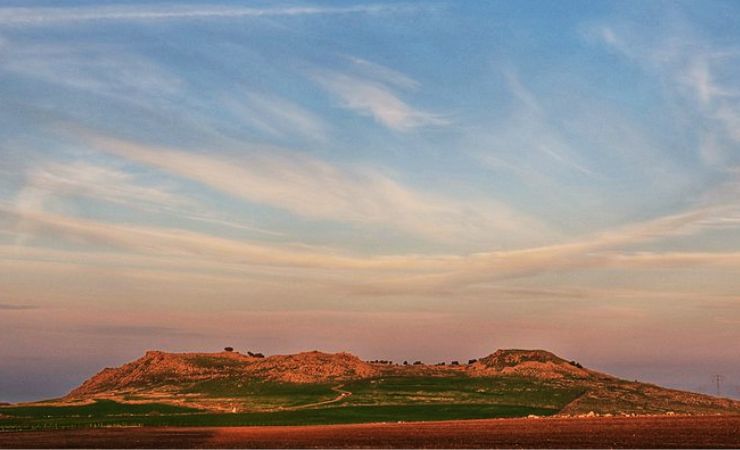
Location and Geology
The Horns of Hattin rises 326 meters above sea level in the Lower Galilee, approximately 10 kilometers west of the Sea of Galilee and 6 kilometers north of Tiberias. This extinct volcanic formation consists of two distinct peaks connected by a saddle, creating the distinctive “horns” that give the site its name. The western peak reaches 318 meters while the eastern peak stands at 326 meters, both formed from ancient basalt flows that occurred during the region’s intensive volcanic period.



Biblical Context of the Horns of Hattin
During the 19th century, many Protestant pilgrims and scholars identified the Horns of Hattin as the location where Jesus delivered the Sermon on the Mount. The elevated position, commanding views across Galilee, and the natural amphitheater formed by the twin peaks seemed to match Gospel descriptions of the mountainous setting where Christ taught his disciples and the multitudes.
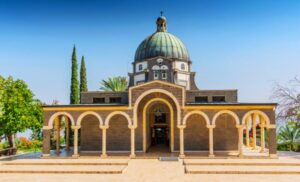
While the traditional site near Tabgha at the Church of Beatitudes has gained widespread acceptance, a significant number of Protestant denominations and biblical scholars continue to regard the Horns of Hattin as the authentic location. Archaeological evidence from first-century Galilean sites Israel Antiquities Authority excavations supports the area’s importance during Jesus’s ministry period.
The Church of God denomination erected a distinctive pyramidal monument in 2023 on the western peak to commemorate what they believe is the actual site where Jesus preached the Beatitudes. The structure serves as a pilgrimage destination for visitors who accept this alternative tradition, while the panoramic views from this elevated position continue to inspire reflection on the Gospel narratives regardless of one’s position on the site’s biblical authenticity.
Lessons Learned from the Battle of Hattin
The catastrophic defeat at the Horns of Hattin resulted from a cascade of strategic and tactical errors that transformed the most powerful Crusader army ever assembled into a trapped, dehydrated force ripe for annihilation. Military historians have identified these critical mistakes that sealed the Crusaders’ fate.
Provocation and Breaking Treaties: Reynald of Châtillon’s reckless violations of truces with Muslim forces provided Saladin with the justification he needed for war. Reynald’s attacks on pilgrim caravans traveling between Damascus and Mecca, combined with his audacious plan to march on the holy cities themselves, united previously fractured Muslim factions under Saladin’s banner.
Strategic Miscalculation: King Guy of Jerusalem abandoned the proven defensive strategy that had protected the Crusader states for decades. Against the counsel of experienced commanders like Raymond III of Tripoli, Guy chose to march his entire army across hostile terrain to relieve Tiberias, playing directly into Saladin’s hands.
Water Crisis: The Crusader army attempted a 25-kilometer march across arid terrain in July heat without securing reliable water sources. Saladin’s forces systematically blocked access to springs and wells along the route, while Muslim light cavalry set grassfires that created choking smoke and further dehydrated the Christian forces.
Terrain Trap: The rocky, uneven ground around the Horns of Hattin negated the Crusaders’ primary tactical advantage – their heavy cavalry charges. The enclosed valley prevented effective maneuvers while providing Muslim archers with elevated positions for devastating volleys.
Failure of Rear Guard Protection: The Christian army stretched into a vulnerable column during their march, with inadequate screening forces protecting their flanks and rear. This allowed Saladin’s mounted archers Israel to conduct continuous harassment attacks that wore down the Crusaders before the decisive battle.
Intelligence Failures: The Crusaders underestimated both Saladin’s tactical brilliance and his ability to coordinate multiple Muslim armies. They failed to recognize that they faced not merely another raid, but a carefully orchestrated campaign designed to eliminate Christian power in the Levant.
Internal Political Divisions: The Crusader leadership remained divided by personal rivalries and competing territorial interests even as they marched toward disaster. The lack of unified command structure hampered effective decision-making at crucial moments.
Tactical Inflexibility: European heavy cavalry tactics, while devastating on open ground, proved inadequate for desert warfare conditions. The combination of extreme heat, difficult terrain, and mobile enemy forces required adaptations the Crusaders failed to implement.
These cumulative errors transformed what should have been a manageable military situation into the worst disaster in Crusader history, demonstrating how strategic overreach combined with tactical incompetence can destroy even the most formidable military force.
What Can Be Seen at the Horns of Hattin
The Horns of Hattin offers visitors a combination of natural beauty, archaeological remains, and panoramic views that bring the site’s dramatic history to life. The twin peaks themselves provide the most striking visual feature, with walking trails connecting both summits and the saddle between them.
Western Peak Monument: The Church of God’s pyramidal structure, erected in 2023, marks what this denomination believes to be the location of Jesus’s Sermon on the Mount. The modern monument provides a focal point for reflection and prayer.
Eastern Peak Views: The higher eastern horn offers the most expansive panoramas across the Sea of Galilee, Jordan Valley, and Golan Heights. On clear days, visitors can see as far as Mount Hermon to the north and the hills of Samaria to the south.
Medieval Battlefield Markers: Information panels throughout the site explain the battle’s progression and key tactical positions. Stone markers indicate where various phases of the fighting occurred, including the final Crusader camp and Saladin’s command position.
Archaeological Features: Scattered basalt stones and ancient foundations dot the landscape, remnants of various periods of occupation. While most visible remains date to later periods, archaeologists have identified artifacts from the Crusader era.
Nature Trails: Well-marked hiking paths wind through the site, offering different perspectives on both the geological formations and historical significance. The trails range from easy walks suitable for families to more challenging climbs to the peak summits.
Additional Information
When did the Battle of Hattin take place?
The Battle of Hattin occurred on July 4, 1187, during the height of summer heat in the Galilee region. The battle lasted approximately eight hours, from dawn until mid-afternoon, when the remaining Crusader forces finally surrendered to Saladin’s army.
How many soldiers fought at the Horns of Hattin?
The Crusader army numbered approximately 20,000 men, including 1,200 heavily armored knights, 4,000 light cavalry, and 15,000 infantry. Saladin commanded an estimated 30,000 troops, including Egyptian, Syrian, and Mesopotamian forces that he had united under his leadership.
Why is the Horns of Hattin significant to the Crusades?
The Battle of Hattin effectively ended the First Crusader Kingdom of Jerusalem, leading directly to the fall of Jerusalem itself three months later. The devastating defeat eliminated the largest Christian army in the Holy Land and triggered the Third Crusade as European powers attempted to reclaim their lost territories.
What happened to the survivors of the Battle of Hattin?
King Guy of Jerusalem and many noble prisoners were taken captive but later released or ransomed. However, Saladin ordered the execution of all captured Knights Templar and Hospitaller, viewing these military orders as the most dangerous enemies of Islam. Common soldiers were sold into slavery.
Is the Horns of Hattin really where Jesus gave the Sermon on the Mount?
While some Protestant denominations and 19th-century pilgrims identified the Horns of Hattin as the location of the Sermon on the Mount, most biblical scholars and Christian denominations accept the traditional site near the Sea of Galilee at the Mount of Beatitudes. Archaeological evidence supports both locations as significant during the first century AD.
Nearby Sites
Magdala: Magdala is believed to be the hometown of Mary Magdalene. Recent excavations have unearthed a first-century synagogue.
National Park Arbel: A nature reserve known for its cliffs and panoramic views of the Sea of Galilee. Includes the ancient Synagogue in Arbel from the Byzantine period.
Ancient Synagogue in Tiberias: This ancient synagogue is a few synagogues built one on top of the other.
- Jesus Boat: The Jesus Boat, also known as the Ancient Galilee Boat, is an ancient fishing boat from the 1st century AD.
Nebi Shuyab: Also known as the Tomb of Jethro, it’s a Druze holy site dedicated to Jethro, the father-in-law of Moses.
Keep reading
Part of our Galilee & Northern Israel Guide →