Arbel National Park features a dramatic cliff overlooking the Sea of Galilee, Jordan Valley, Golan Heights, and Mount Hermon. The site preserves caves where Jewish rebels hid from Herod's forces in 38 BCE and contains remains of an ancient synagogue from the Roman and Mishnaic periods, making it historically significant beyond its stunning views.
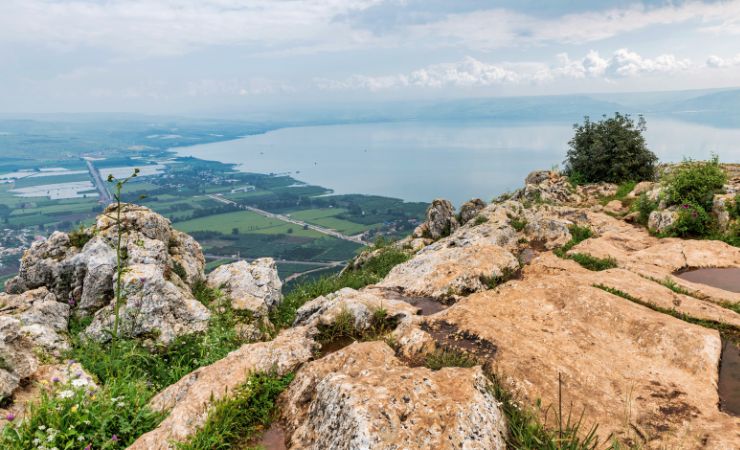
Arbel National Park features a dramatic cliff face that commands sweeping views across the Jordan Valley, the Sea of Galilee, the Golan Heights, Mount Hermon, and the Galilee hills. Beyond its spectacular natural vantage point, the site preserves layers of human history, from ancient cave fortifications to Byzantine synagogue ruins, where stories of Jewish resistance and religious tradition converge against one of Israel’s most striking geological backdrops.
Location
Arbel National Park sits approximately 8 kilometers west of Tiberias in the eastern Lower Galilee. The park entrance lies along Route 77, with clear signage directing visitors from the main highway. From the parking area, multiple trails lead to different sections of the cliff and archaeological sites.
Overview and Geology
Arbel National Park encompasses 3,200 hectares of protected geological and archaeological terrain, declared a nature reserve in 1967. The protected area includes the towering Arbel Cliff, Mount Nitai, Mount Savyon, the distinctive Horns of Hittim, and the fertile Arbel Plateau. Beyond serving as a dramatic viewpoint, the park functions as a critical wildlife corridor connecting fragmented habitats across the Galilee region.
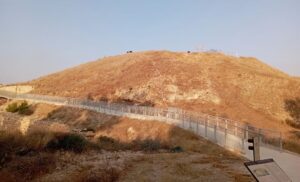
The park’s centerpiece, the Arbel Cliff, rises from limestone and dolomite formations dating to the Cenomanian period, approximately 100 million years ago. The cliff face reaches 181 meters above sea level and towers 390 meters above the Sea of Galilee’s surface, creating one of the steepest drops in the region. Natural caves and crevices dot the cliff face, formed through millennia of water erosion and tectonic activity. These geological features would later provide both refuge and strategic advantage for ancient peoples who sought shelter in this imposing landscape.



The Battle of Mount Arbel
Mount Arbel witnessed one of the most dramatic military encounters of the Hasmonean period, meticulously documented by the historian Flavius Josephus. Around 39-38 BCE, the cliff became a fortress of last resort during the struggle between Hasmonean prince Antigonus II Mattathias and the Roman-backed Herod the Great. After Herod seized the regional capital of Sepphoris, he dispatched his forces under the command of his general Ptolemy to the village of Arbela, where Antigonus’ supporters had taken refuge.
The siege extended for 40 days as Herod’s troops attempted to dislodge the rebels from the cliff’s natural cave system. When direct assault proved impossible due to the sheer rock face, Herod’s military engineers devised an ingenious but brutal solution. They constructed large wooden chests and iron baskets, lowering soldiers down the cliff using ropes and pulleys anchored at the summit. Armed with grappling hooks and torches, these suspended soldiers extracted rebels from their cave shelters, often hurling them to their deaths on the rocks below.
Josephus records that some defenders, faced with capture, chose to throw themselves and their families from the cliffs rather than surrender. Among the most harrowing accounts was that of an elderly man who killed his seven sons and wife before leaping to his own death, cursing Herod as he fell. Herod observed this siege from a fortified position on the opposite hill, watching as his forces systematically cleared the caves through fire and violence.
Three decades later, during the First Jewish Revolt (66-73 CE), Josephus himself fortified the “cave of Arbel” as part of his defensive preparations in the Galilee. Archaeological evidence suggests he reinforced both the eastern and western cave systems, with stone walls and defensive structures still visible today on the cliff face.
Byzantine Synagogue on Mount Arbel
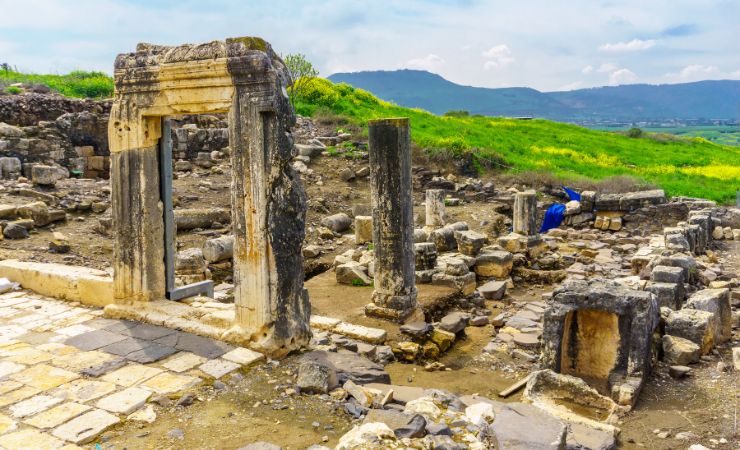
The ancient Jewish settlement near Mount Arbel preserves the remains of a magnificent limestone synagogue that exemplifies Byzantine-period Jewish architecture. This synagogue in Arbel features a remarkable eastern-facing entrance carved from a single block of limestone, an architectural choice that reflects the Jewish tradition of orienting prayer toward Jerusalem. The monolithic doorframe, measuring approximately 3 meters in height, displays intricate decorative elements including carved rosettes and geometric patterns typical of Galilean synagogue design.
Archaeological excavations reveal the synagogue was constructed in the 4th century CE during the flourishing of Jewish communities under Byzantine rule. The building served the local population continuously until the 8th century CE, with significant renovations undertaken in the late 6th or early 7th century following earthquake damage common to the region.
Rabbinic sources record that this region holds special significance in Jewish messianic tradition. According to the Talmud, the Messiah will appear in the “Valley of Arbel” (Bukat Arbel), making the synagogue’s eastern orientation both liturgically and eschatologically meaningful.
Practical Information
Arbel National Park operates daily from 8:00 AM to 5:00 PM (until 4:00 PM in winter months).
The park provides free parking near the main entrance, with additional overflow areas during peak seasons. The Synagogue is location outside of the National Park and is open at all times.
Additional Information
How long does it take to visit Arbel National Park?
A typical visit to Arbel National Park takes 2-3 hours, depending on which trails you choose. The main cliff viewpoint can be reached in 30 minutes of easy walking, while the complete synagogue and cave exploration requires 3-4 hours for experienced hikers.
Can you see the Sea of Galilee from Arbel National Park?
Yes, Arbel National Park provides one of the most spectacular panoramic views of the Sea of Galilee from its cliff-top vantage point. The viewing platform offers unobstructed sightlines across the entire lake, the Jordan Valley, and surrounding mountain ranges. Early morning visits provide the clearest visibility and best photography.
What historical events happened at Mount Arbel?
Mount Arbel witnessed two major historical events: Herod’s siege of Jewish rebels in 39-38 BCE, where his forces used innovative cliff-assault tactics, and Josephus’ fortification of the caves during the First Jewish Revolt (66-73 CE). These events demonstrate the site’s strategic military importance in ancient times.
Practical Information
Nearby Sites
The Severus Synagogue of Tiberias: The synagogue at Tiberias dates back to the Roman and Byzantine periods that showcases intricate mosaics from many eras.
Tomb of Nebi Shu’eib: Revered as the tomb of Jethro, Moses’ father-in-law, this site is the most significant religious shrine for the Druze community.
Magdala: Believed to be the hometown of Mary Magdalene. Excavations have unearthed a first-century synagogue from the time of Jesus.
Jesus Boat at Genosar: The 2,000-year-old fishing boat from the time of Jesus was discovered in the muddy shores of the Sea of Galilee.
Keep reading
Part of our Galilee & Northern Israel Guide →