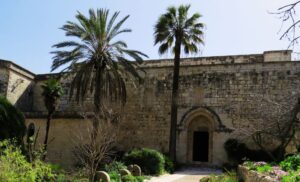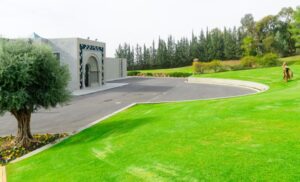
The Severus Synagogue at Hammat Tiberias National Park features a spectacular mosaic floor dating to the 4th century CE. Located near ancient hot springs south of Tiberias, this synagogue showcases the prosperity and confidence of the Jewish community during the Roman-Byzantine period through its intricate zodiac wheel and Hebrew inscriptions.
The Severus Synagogue sits within Hammat Tiberias National Park, a short drive south of the city center along the western shore of the Sea of Galilee. Its dazzling mosaic floor, preserved beneath the synagogue’s ancient stones, reveals the wealth and artistic confidence of a Jewish community living amid the cultural currents of the Roman and Byzantine worlds. Among the finest ancient synagogue mosaics ever uncovered in Israel, the floor alone makes this site worth a dedicated visit.
Location
The Severus Synagogue sits within the archaeological park of Hammat Tiberias, a site famed since antiquity for its 17 steaming mineral springs. Hammat Tiberias lies along the western shore of the Sea of Galilee, near Tiberias. The park entrance is on Route 90, roughly 2 kilometers south of central Tiberias, and is well-signposted from the main road.
Tiberias in Late Antiquity: A Thriving Jewish Center
After the destruction of Jerusalem and the failed Bar Kokhba revolt of 135 CE, Tiberias rose to prominence as a spiritual and cultural hub for Jewish life. From 193 CE to the end of the 4th century, it served as the seat of the Sanhedrin, the supreme Jewish religious and legal authority. The Jewish Talmud was compiled here, and leading rabbinic academies drew scholars from across the Jewish world.
By the Byzantine period, the Jewish community here thrived with remarkable resilience. Records suggest as many as thirteen synagogues stood in Hammat Tiberias at its height. Among them was Synagogue A (Hammath Tiberias North), discovered in 1921, with its basilical hall and precious artifacts like the limestone menorah and the inscribed “Chair of Moses.” Yet it is Synagogue B, the Severus Synagogue, that has captured scholars’ and visitors’ imaginations most powerfully, largely because of the extraordinary mosaic program preserved beneath its floor.
Tiberias was a city of intellectual debate, religious scholarship, and sustained cultural exchange. Archaeological evidence shows a confident Jewish society drawing on elements of the surrounding Greco-Roman world while maintaining a distinctly Jewish identity, a dynamic visible nowhere more clearly than in the Severus Synagogue itself.



The Severus Synagogue: Built in Layers
Excavations at Hammat Tiberias, led by Moshe Dothan between 1961 and 1963, revealed that the Severus Synagogue is not a single building but a stack of sacred spaces built one atop the other across several centuries. The site was first excavated by Nahum Slouschz in 1920, but Dothan’s systematic dig exposed the full stratigraphic picture.
First Layer (1st century CE)
Before any synagogue rose here, the site hosted a public building from the Roman period, perhaps tied to civic or bathhouse activities connected to the hot springs.Second Layer – First Synagogue (c. 230 CE)
Around 230 CE, the first synagogue was constructed atop the Roman ruins. Little survives of this building apart from fragments of mosaic floor, hinting at the community’s initial step toward creating a dedicated house of worship.Third Layer – The Severus Synagogue (3rd–4th centuries CE)
This second synagogue building is what visitors see highlighted today. Built as a square basilica, it featured a central nave flanked by three aisles, divided by rows of columns. Worshippers would enter through three doorways in the northern wall, their eyes inevitably drawn to the elaborate mosaic flooring. The building measured roughly 15 by 15 meters and was decorated with the exceptional mosaic program described below. This synagogue was likely destroyed in the early 5th century, possibly by an earthquake or during the anti-Jewish violence that accompanied the decline of the Roman patriarchate.Fourth Layer – A Larger Synagogue (5th–6th centuries CE)
A final synagogue rose over the Severus Synagogue’s remains in the 5th to 6th centuries. This was a significantly larger building, but it, too, fell into ruin, probably during the upheavals of the 8th century CE.
These overlapping layers reveal a resilient community rebuilding and preserving its sacred spaces through the centuries, each generation raising its house of worship directly above the one before it.
Inside the Mosaic
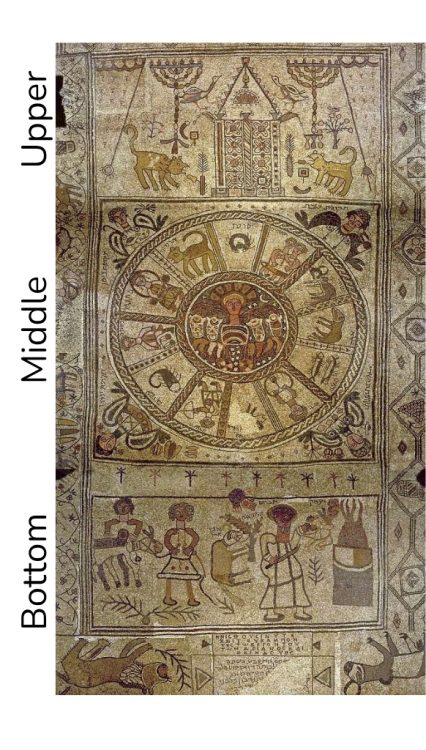
The mosaic floor of the Severus Synagogue, laid in the 4th century CE and composed of thousands of hand-cut stone tesserae, is one of the best-preserved examples of late antique synagogue art in the world. The floor is arranged in three main panels, read from south to north as worshippers moved toward the Torah shrine.
Uppermost Panel: Symbols of Jewish Faith
At the top of the mosaic, a Torah shrine sits in splendid detail, its arched doors flanked by curtains. On either side stand two majestic menorahs, their seven branches depicted with careful symmetry. Scattered around are ritual objects: a shofar (ram’s horn), a lulav (palm frond), and an etrog (citron). These familiar Jewish symbols anchor the floor’s meaning unmistakably in the tradition of Jewish sacred art, even as the panels below engage freely with Greco-Roman visual culture.
Middle Panel: The Zodiac Wheel and Helios
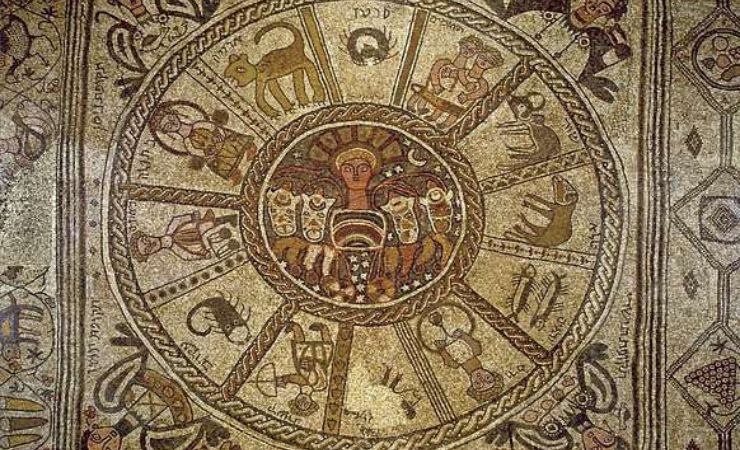
In the middle panel, the Greek sun god Helios rides a quadriga, a four-horse chariot, across a bright circle representing the heavens. Rays shoot from his haloed head as he grips a celestial sphere and whip, clad in a flowing imperial cloak. Surrounding him, the twelve signs of the zodiac circle counterclockwise, each labeled in Aramaic and exquisitely depicted:
Aries (ram)
Taurus (charging bull)
Gemini (twin youth)
Leo (roaring lion)
Virgo (maiden with a torch)
Libra (man with scales)
Scorpio (partially preserved)
Capricorn (goat-fish hybrid)
Aquarius (youth pouring water)
Pisces (two fish)
Cancer and Sagittarius were unfortunately destroyed when a later wall sliced through this section of the floor.
In the corners between the zodiac and the mosaic’s square frame, four female busts represent the seasons: Spring crowned in flowers, Summer with sickle and wheat, Autumn holding fruit, and Winter cloaked against the chill.
Scholars debate whether the zodiac here served religious, calendrical, or purely decorative purposes. One influential interpretation, advanced by Erwin Goodenough and later refined by others, suggests the imagery expressed the Jewish belief that their God governed the entire cosmos, including the heavenly bodies that pagan cultures personified.
Bottom Panel: Dedications and Identity
At the base of the mosaic run eight Greek inscriptions, framed by two lions rendered in bold, confrontational poses. The most notable inscription dedicates the floor to “Severus, the pupil of the most illustrious patriarchs,” giving the synagogue its modern name. This Severus was likely a student of influential Jewish leaders, possibly associated with the patriarchal house of Hillel II or Judah III, who led the Jewish community in the 4th century. The use of Greek for these dedications, alongside Aramaic zodiac labels and Hebrew religious symbols, captures the multilingual, multicultural reality of Jewish life in late antique Tiberias.
Practical Information
Hammat Tiberias National Park, which includes the Severus Synagogue, is managed by the Israel Nature and Parks Authority. The park is open Sunday through Thursday from 8:00 a.m. to 5:00 p.m. (last entry 4:00 p.m.), and Friday and holiday eves from 8:00 a.m. to 4:00 p.m. (last entry 3:00 p.m.). The site is closed on Saturdays and Jewish holidays.
Parking is available at the park entrance at no additional charge. The site is wheelchair accessible, with paved paths leading to the main mosaic viewing area.
Additional Information
Pre-Iron Age:
- c. 7000 years ago: First settlement at Tel Dan.
- c. 2700 BCE: The first city is established at Tel Dan (initially known as Laish or Leshem).
- c. 1750-1550 BCE (Middle Bronze Age II B-C): The Canaanite city of Laish is well-fortified with an earthen rampart (10-15 meters high with a stone core) and a mud-brick arched gate (“Gate of Three Arches”). The city enjoys trade with Mesopotamia and Sidon and is mentioned in Egyptian Execration Texts and Mari documents as a source of tin.
- Mid-15th Century BCE (Late Bronze Age I): Thutmose III of Egypt conquers Laish. Mycenaean culture influences are present, including a Mycenaean tomb.
- 13th Century BCE (Late Bronze Age II B): A smaller settlement exists.
- 12th Century BCE (Iron Age IA): Granary pits and metalworking indicate a developing copper industry, possibly linked to early Israelite settlement. Philistine pottery is also found.
- 11th Century BCE (Iron Age IA): Destruction layer.
Iron Age:
- 10th Century BCE (Iron Age IB – Iron Age IIA): After the Israelite conquest, the tribe of Dan, having trouble in the south with the Philistines, migrates north, conquers Laish, and renames it Dan after their ancestor. Jeroboam I, the first king of the Northern Kingdom of Israel after the split from Judah, builds cultic sites in Bethel and Dan, including placing one of the two golden bulls in Dan to rival Jerusalem as a religious center.
- 9th Century BCE (Iron Age IIB):Ben-Hadad I of Aram Damascus is bribed by Asa, King of Judah, to break his alliance with Baasha, King of Israel, and attacks Israelite cities, including Ijon and Dan.
- Ahab, King of Israel, expands the cultic complex at Dan.
- The Tel Dan Stele is erected by an Aramean king, likely Hazael of Aram Damascus, commemorating a victory over the Kingdom of Israel. The stele mentions the killing of Joram, King of Israel, and Ahaziah, King of the “House of David” (Kingdom of Judah). This event aligns with the biblical account of Jehu’s revolt, although the stele attributes the killings to the Aramean king.
- Early 8th Century BCE (Iron Age IIB):Jeroboam II, King of Israel, adds steps to the cultic platform at Dan.
- The Tel Dan Stele is likely destroyed and its fragments used as building material, possibly by Jehoash, King of Israel, who fought against Aram and recaptured cities taken by Hazael.
- c. 750 BCE (Iron Age II C): Tel Dan is destroyed by a large fire, likely during the Assyrian conquest.
- 733/732 BCE: Tiglath-Pileser III of Assyria conquers the Northern Kingdom of Israel. While Abraham Biran suggested this as the end of Dan, there is no direct biblical or Assyrian record of Dan’s destruction at this time.
- Late 8th Century BCE (Iron Age IIB): Level associated with the Assyrian conquest contains a room of altars, bronze and silver scepter head, and Paleo-Hebrew, Phoenician, and Aramaic inscriptions.
- Late 8th/7th Century BCE (Iron Age II C): Destruction layer associated with the Babylonian destruction.
Post-Iron Age:
- Persian-Hellenistic Period (4th-1st Centuries BCE): The cultic site at Dan is revived. A bilingual (Greek and Aramaic) inscription “To the god who is in Dan” testifies to its continued religious importance.
- Roman Period (1st-4th Centuries CE): Dan is conquered during the revolt against the Romans and subsequently destroyed, leading to its abandonment. The main settlement shifts to Banias.
- Mamluk and Early Ottoman Periods (15th-16th Centuries CE): Possible farmstead or small village exists at the site, with remains of a small cemetery found.
- 1917: Arthur Hjelt visits Tell el-Kadi (Tel Dan) and describes its abundant water source and lush vegetation, recognizing its potential for archaeological excavation and hoping for a Finnish expedition. World War I interrupts his plans.
- 1963: A brief test excavation is conducted by Z. Yeivin on behalf of the Department of Antiquities and Museums.
- 1966 onwards: Extensive archaeological excavations begin at Tel Dan, primarily led by Abraham Biran, initially for the Department of Antiquities and Museums and later for the Nelson Glueck School of Biblical Archaeology of Hebrew Union College-Jerusalem. Over 33 seasons of excavation take place.
- 1979: The Canaanite arched gate is discovered.
- July 21, 1993: Gila Cook, a surveyor for the excavation team, discovers the first fragment (A) of the Tel Dan Stele.
- 1994: Two more fragments (B1 and B2) of the Tel Dan Stele are discovered by the excavation team led by Abraham Biran in the gate area.
- Since the late 20th Century: The Tel Dan Stele is displayed at the Israel Museum in Jerusalem.
- 2001: The Israel Nature and Parks Authority, with assistance from the World Monuments Watch, erects a shelter over the Canaanite gate to protect it.
What is the Severus Synagogue at Hammat Tiberias?
The Severus Synagogue is a 4th-century CE synagogue located within Hammat Tiberias National Park, on the western shore of the Sea of Galilee. It takes its name from a Greek dedicatory inscription in its mosaic floor, which honors a man named Severus described as a pupil of the patriarchs. The synagogue is celebrated for its exceptionally well-preserved mosaic floor, which combines Jewish religious imagery with a zodiac wheel and the figure of the Greek sun god Helios.
Where exactly is the Severus Synagogue located?
The synagogue is inside Hammat Tiberias National Park, on Route 90 approximately 2 kilometers south of central Tiberias. The park sits directly on the shore of the Sea of Galilee, and the park entrance is clearly signed from the main road. Parking is free at the site, and the drive from Tiberias city center takes about five minutes.
Why does a synagogue have a zodiac and the god Helios in its mosaic?
This is one of the most discussed questions in the archaeology of late antique Judaism. Scholars propose that the zodiac and Helios may have expressed Jewish dominion over the cosmos under God, served a calendrical function tied to festival dates, or simply reflected the artistic conventions of the wider Greco-Roman world. No consensus exists, but the imagery was clearly not seen as incompatible with Jewish worship.
How old is the mosaic floor, and how well is it preserved?
The mosaic dates to the 4th century CE, placing it roughly 1,600 to 1,700 years old. It is among the best-preserved ancient synagogue mosaics in Israel. The central zodiac panel and the upper panel with Jewish symbols survive in remarkable detail, though two zodiac signs, Cancer and Sagittarius, were destroyed by a wall built in a later phase of the site.
Who were the patriarchs mentioned in the Severus inscription?
The inscription dedicates the mosaic to Severus, identified as a pupil of “the most illustrious patriarchs.” These patriarchs were almost certainly members of the Nasi dynasty, the hereditary leadership of the Jewish community in the Roman era, likely including figures such as Hillel II or Judah III, who led the community in the 4th century CE.
Nearby Sites
- Tiberias Hot Springs: Dip into the same mineral waters known to Romans and Jews alike for their healing powers.
- Mount Arbel: Hike for panoramic views over the Sea of Galilee and explore ancient caves once used as hideouts.
- Magdala: Visit the hometown of Mary Magdalene, where excavations have uncovered another stunning first-century synagogue.
- Bet Alpha Synagogue: Marvel at another zodiac mosaic floor, echoing the artistic spirit seen at Hammat Tiberias.
Keep reading
Part of our Jewish Heritage Guide →