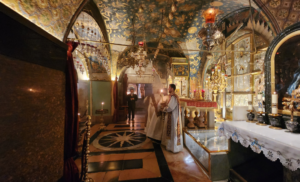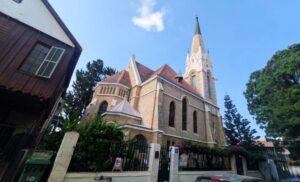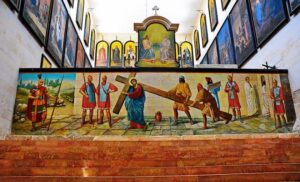
The Synagogue Church in Nazareth marks the traditional site of the ancient village synagogue where Jesus preached and was rejected by his hometown crowd, as described in Luke 4:16-30. Located in central Nazareth, this Melkite Greek Catholic church commemorates the dramatic episode when locals attempted to throw Jesus off a cliff after his controversial sermon.
The Synagogue Church Nazareth derives its name from centuries-old tradition identifying this site as the location of the ancient village synagogue where Jesus worshipped, studied, and delivered his most controversial sermon. This modest Christian sanctuary holds profound significance as the place where, according to Luke’s Gospel, townspeople attempted to hurl their hometown rabbi from a nearby cliff after he proclaimed himself the fulfillment of messianic prophecy.
Location
The Synagogue Church Nazareth sits on Kenisat al-Rum Street in the old city center of Nazareth, approximately 200 meters southeast of the Basilica of the Annunciation. The church occupies a strategic position within the ancient village boundaries, where first-century archaeological remains indicate a thriving Jewish community.
Biblical Context
The Synagogue Church Nazareth marks the probable site of ancient Nazareth’s synagogue where Jesus spent his formative years learning Torah and participating in Sabbath worship. Archaeological evidence suggests that first-century Nazareth supported a population of 200-400 residents, sufficient to maintain a synagogue according to Jewish law, which required a minimum of ten adult male worshippers (minyan). The building would have served as the community’s religious, educational, and social center, where Jesus likely received his early scriptural education and developed his profound knowledge of Hebrew sacred texts.
Luke’s Gospel provides the most detailed account of Jesus’s dramatic confrontation at this synagogue. After reading from Isaiah 61:1-2, Jesus declared, “Today this scripture is fulfilled in your hearing” (Luke 4:21), directly claiming messianic authority. The congregation’s initial admiration turned to murderous rage when Jesus referenced God’s favor toward Gentiles, citing Elijah’s ministry to a Phoenician widow and Elisha’s healing of Naaman the Syrian. This theological challenge to Jewish exclusivity provoked the violent response that led to the attempted execution at Mount Precipice.
Jesus left there and went to his hometown, accompanied by his disciples. When the Sabbath came, he began to teach in the synagogue, and many who heard him were amazed. What are these remarkable miracles he is performing? ….And they took offense at him. Jesus said to them, “A prophet is not without honor except in his own town, among his relatives and in his own home.” He could not do any miracles there, except lay his hands on a few sick people and heal them. He was amazed at their lack of faith.
Mark 6:1-6
Matthew (13:54-58) and Mark (6:1-6) offer parallel accounts that emphasize the townspeople’s familiarity with Jesus as the local carpenter’s son, highlighting the sociological tension between Jesus’s humble origins and his claims to divine authority. These Gospel writers focus on the spiritual blindness that prevented his neighbors from recognizing his true identity. The accounts differ in their details but converge on the central theme of rejection, with Jesus’s famous declaration that “a prophet is not without honor except in his hometown” becoming a foundational text for understanding divine revelation’s reception throughout Christian history. The cliff identified with this incident, Mount Precipice, rises 397 meters above sea level south of Nazareth, providing a precipitous drop that matches Luke’s narrative description.
Historical Overview of the Current Synagogue Church
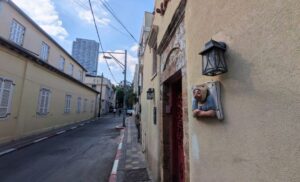
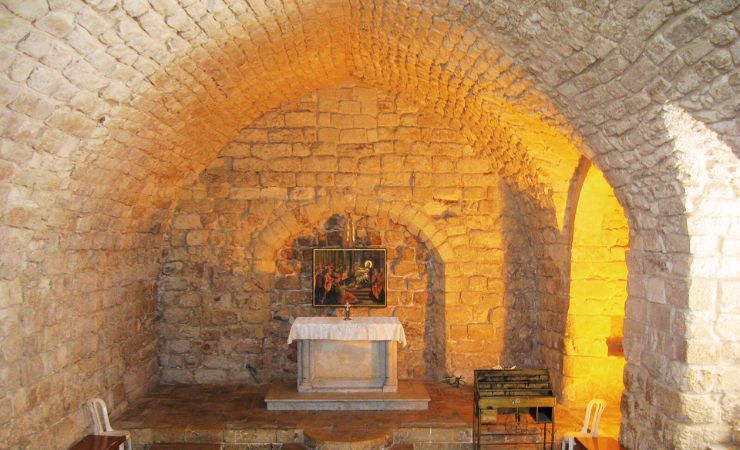
The current Synagogue Church Nazareth represents layers of continuous Christian worship spanning nearly fifteen centuries. The structure displays distinctive architectural features that reflect its complex history, including its sunken floor level approximately 1.5 meters below street grade, which suggests construction atop earlier foundations. An emblematic bilingual sign in Arabic and English reading “Synagogue” marks the entrance, emphasizing the site’s traditional identification with the biblical location.
The Melkite Greek Catholic Church maintains custody of the site, inheriting stewardship from a succession of Christian communities. In 570 CE, the Italian pilgrim Antoninus of Piacenza documented visiting Nazareth’s synagogue, claiming to have seen the original sacred books and the very bench where Jesus sat during worship. This early witness provides crucial evidence for the site’s veneration in late antiquity, though the physical remains from that period have not survived archaeological investigation.
The church’s architectural evolution reflects changing political and religious circumstances in the Holy Land. During the Crusader period (12th century), Christian builders likely constructed a church on this traditional site, creating the foundations visible today. The Franciscans initially administered the sanctuary, maintaining Franciscan custody until the 18th century. A pivotal transition occurred when the regional ruler Zahir al-Umar transferred authority to the Greek Catholics, recognizing their growing influence in Galilee’s Christian communities.
By 1887, the expanding Greek Catholic community had constructed the larger Melkite Church of the Annunciation directly adjacent to the Synagogue Church. This proximity created a unique complex where pilgrims can experience both the site of Jesus’s controversial sermon and the traditional location of the Annunciation to Mary. The architectural relationship between these two churches reflects the theological connection between the Incarnation and Jesus’s public ministry launch in his hometown synagogue.
Archeological Findings
Archaeological investigations around the Synagogue Church Nazareth have uncovered significant evidence for first-century settlement, though direct excavation beneath the church itself remains limited due to its active religious use.
- Ancient Foundations: The church floor lies approximately 1.5 meters below current street level, indicating construction over earlier structural remains. This elevation difference suggests either natural accumulation over centuries or deliberate building atop Crusader-era foundations from the 12th century.
- Settlement Evidence: Excavations at the nearby Basilica of the Annunciation have revealed extensive evidence of first-century domestic life, including rock-cut storage pits for grain, underground cisterns for water collection, and installations for olive oil and wine production.
- Burial Evidence: Multiple rock-cut tombs discovered in the 19th and early 20th centuries throughout Nazareth correspond to first-century Jewish burial practices. The tomb designs, featuring rolling stone closures and family burial chambers, match the period when Jesus lived in the village, though precise dating remains challenging without modern excavation techniques.
- Ceramic Finds: Pottery fragments recovered from stratified deposits around the church area include typical first-century Jewish household items, cooking vessels, and storage jars that reflect the material culture described in Gospel accounts of daily life in Galilee.
Additional Information
Is the Synagogue Church Nazareth the actual synagogue where Jesus preached?
While the exact location cannot be confirmed archaeologically, centuries of Christian tradition identify this site as the synagogue where Jesus delivered his controversial sermon recorded in Luke 4:14-30. The church stands within the ancient boundaries of first-century Nazareth, and archaeological evidence confirms the village supported a Jewish community large enough to maintain a synagogue during Jesus’s lifetime.
What denomination operates the Synagogue Church Nazareth?
The Melkite Greek Catholic Church maintains custody of the Synagogue Church Nazareth. They acquired stewardship in the 18th century from the Franciscans through a decree by regional ruler Zahir al-Umar. The Melkites represent an Eastern Catholic community that follows Byzantine liturgical traditions while maintaining communion with Rome.
What is the connection between the Synagogue Church and Mount Precipice?
According to Luke’s Gospel, after Jesus’s controversial sermon at the synagogue, angry townspeople attempted to throw him from a cliff outside Nazareth. Christian tradition identifies Mount Precipice (Har Kedumim), located south of the city, as this cliff. The site rises 397 meters above sea level and offers a precipitous drop matching the Gospel narrative.
Why is the floor of the Synagogue Church below street level?
The church floor sits approximately 1.5 meters below current street level, likely indicating construction over earlier structural foundations. This elevation difference suggests either natural accumulation of debris over centuries or deliberate building atop Crusader-era church remains from the 12th century, when European Christians established religious structures throughout the Holy Land.
Sites Near the Synagogue Church, Nazareth
- Church of the Annunciation: A significant Christian Catholic site believed to be where Angel Gabriel announced to Mary that she would conceive Jesus.
- Greek Catholic Church of Annunciation: The Orthodox Church of the Annunciation. Close to it is Mary’s Well.
- Mount Precipice: Also known as the “Hill of the Leap of the Lord.” This is where an angry mob attempted to throw Jesus off a cliff after he preached in the Church Synagogue.
- Sepphoris: An ancient city known for its rich mosaic art. It was a significant urban center in the time of Jesus.
Part of our Christian Pilgrimage Guide →