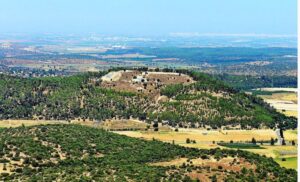
Keren Carmel, known as Mukhraka, is a site on Mount Carmel's southeastern tip traditionally marking where Prophet Elijah confronted the prophets of Baal in a biblical showdown. The hilltop location offers panoramic views of the Jezreel Valley and houses a Carmelite monastery commemorating this dramatic Old Testament event where Elijah proved God's power through fire from heaven.
Keren Carmel, better known as Mukhraka, is traditionally associated with the dramatic biblical story of the Prophet Elijah’s showdown with the prophets of Baal. A Carmelite monastery has operated here since the 1880s, and the rooftop panorama alone is worth the drive up from the Jezreel Valley.
Location
Mukhraka Mount Carmel sits on the southeastern tip of the Carmel range, near the Druze town of Daliyat al-Karmel, roughly 25 kilometers southeast of Haifa. The site stands at approximately 480 meters (1,575 feet) above sea level, and the surrounding terrain drops sharply toward the Jezreel Valley to the east.
Biblical Context
Mukhraka, meaning “the place of burning” in Arabic, is where tradition places the Prophet Elijah’s confrontation with the prophets of Baal, as told in 1 Kings 18:16-45. The story unfolds during the 9th century BCE, under the reign of King Ahab of Israel. Ahab’s Phoenician queen, Jezebel, had aggressively promoted the worship of Baal and Asherah throughout the northern kingdom, reportedly funding 450 prophets of Baal and 400 prophets of Asherah at the royal court. Elijah, the fiercest prophetic opponent of this apostasy, declared a drought that gripped the land for three years before demanding a public reckoning on Mount Carmel.
The terms of the contest were simple. Each side would prepare a bull on an altar and call on their deity to send fire. Baal’s prophets went first, crying out from morning until the afternoon sacrifice, cutting themselves in frenzied supplication. Nothing happened. Elijah then rebuilt a ruined altar using twelve stones, one for each tribe of Israel, dug a trench around it, and drenched the offering and wood with water three times until the trench overflowed. He prayed a single, brief prayer. Fire fell from heaven and consumed the sacrifice, the wood, the stones, the soil, and the water in the trench. The assembled crowd fell prostrate and declared: “The Lord, He is God!” Elijah then ordered the execution of Baal’s prophets at the Kishon River at the foot of the mountain, and rain broke the drought that same evening.
The episode is one of the most dramatic in all of prophetic literature, and Mount Carmel’s geography adds weight to the narrative. The ridge commands a view of both the Jezreel Valley and the distant Mediterranean, the very horizon over which Elijah’s servant spotted the small cloud that heralded the returning rain (1 Kings 18:44).
Then the fire of the LORD fell and burned up the sacrifice, the wood, the stones and the soil, and also licked up the water in the trench. When all the people saw this, they fell prostrate and cried, ‘The LORD—he is God! The LORD—he is God!
1 Kings 18:38-39



The Carmelite Order and Mukhraka Monastery
History of the Carmelite Order
The Carmelite Order traces its origins to the late 12th and early 13th centuries, when a group of Christian hermits settled on Mount Carmel, likely during the Crusader period. They drew spiritual inspiration from Elijah and regarded the prophet as the model of solitary prayer and zeal for God. Pope Honorius III formally approved their rule around 1226, though the order considers 1209 its founding year based on the earliest written formula of life it received. As Muslim forces reclaimed the Levant in the 13th century, the hermits relocated to Europe, where the order grew into a major mendicant community known for its contemplative tradition and, eventually, for the mystics Teresa of Avila and John of the Cross. Through all their migrations, Mount Carmel remained the symbolic heartland of their identity.
Acquisition and Construction of Mukhraka Monastery
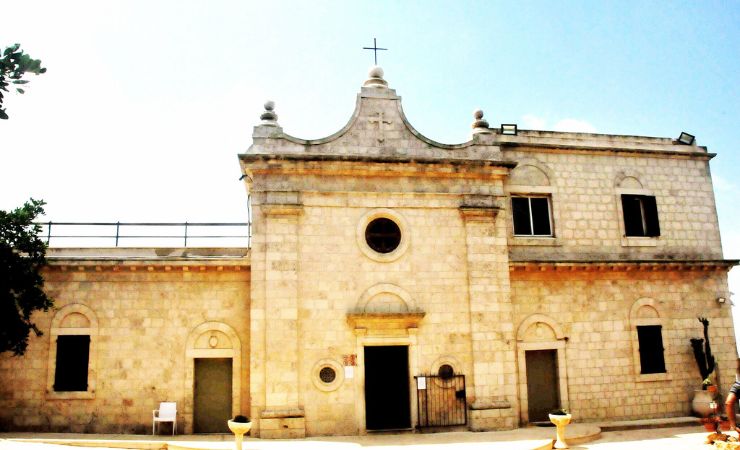
The Carmelites acquired the land at Mukhraka in 1867, purchasing it from local landowners during the late Ottoman period. The site had long been identified by Christian tradition as the precise ridge where Elijah’s altar stood, and earlier generations of pilgrims had visited the rocky outcrop even without a permanent structure to mark it. A Crusader chapel had once stood here, but it lay in ruins by the time the Carmelites arrived.
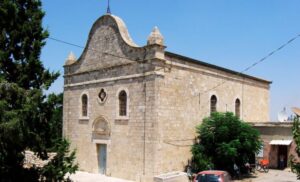
Construction of the current monastery and church began shortly after the acquisition and was completed in 1883. The builders incorporated stonework from the earlier Crusader remains into the foundations, a deliberate act of continuity with the site’s devotional history. The monastery has been maintained by a small Carmelite community ever since. It functions as a place of monastic prayer, a destination for Christian pilgrimages, and an open site for visitors of all faiths who come to understand the story of Elijah on its original terrain.
Features of the Monastery and Church
- Chapel of St. Elijah: The central feature of the monastery is the chapel dedicated to the Prophet Elijah. The interior is deliberately austere, reflecting the simplicity that characterizes the Carmelite tradition. Its most striking element is the altar built from twelve stones, representing the twelve tribes of Israel, directly echoing the altar Elijah assembled before calling down fire from heaven. Inscriptions from 1 Kings 18 appear on the chapel wall in several languages, giving the space a devotional quality that visitors of many backgrounds find moving.
- Statue of Elijah: A statue of Elijah was installed in the monastery’s courtyard in 1914. It depicts the prophet in a dynamic, triumphant posture, sword raised, immediately following his victory over the Baal prophets. Ottoman soldiers vandalized the original statue during World War I. The replacement figure, which stands today, preserves the same iconography: Elijah as defender of monotheism, zealous and unyielding. The statue has become one of the most photographed subjects at the site.
- Observation Deck: The monastery’s rooftop terrace is reached by a narrow interior staircase and offers one of the finest elevated views in northern Israel. On a clear morning, visitors can identify the Jezreel Valley spread out below, the hills of the lower Galilee to the northeast, and the faint blue line of the Mediterranean to the west. This is the same horizon over which Elijah’s servant watched for the returning rain cloud. The terrace is open to all visitors during monastery hours and requires no special permission to access.
Practical Information
Mukhraka Mount Carmel is managed by the Carmelite Order and is open to the public. The monastery typically receives visitors Sunday through Friday, roughly 8:00 a.m. to 5:00 p.m., though hours may be reduced during liturgical celebrations and during the midday rest period common in summer months.
Admission is free, though a small donation toward the upkeep of the site is appreciated and customary. Parking is available in the lot directly outside the gate at no charge.
Additional Information
What is Mukhraka Mount Carmel and why is it significant?
Mukhraka is a ridge-top site on the southeastern spur of the Carmel mountain range, traditionally identified as the location where the Prophet Elijah challenged 450 prophets of Baal in a dramatic contest described in 1 Kings 18. The name means “the place of burning” in Arabic, referencing the fire that consumed Elijah’s altar. A Carmelite monastery built in 1883 marks the spot and is open to pilgrims and visitors of all faiths.
Can visitors access the rooftop observation deck at Mukhraka?
Yes. The rooftop terrace is open to all visitors during monastery hours and is reached by a steep, narrow interior staircase. The view from the top takes in the Jezreel Valley, the Galilee hills, and on clear days the Mediterranean coast, all landmarks connected to the Elijah narrative. Visitors with mobility difficulties may find the staircase challenging, but the courtyard and chapel at ground level are accessible.
What is the connection between the Carmelite Order and Elijah?
The Carmelite Order was founded by Christian hermits who settled on Mount Carmel in the late 12th century and took Elijah as their spiritual father and model. They saw his life of solitary prayer, radical dependence on God, and prophetic courage as the ideal for their own contemplative vocation. That identification with Elijah has shaped Carmelite spirituality ever since, and Mukhraka remains a pilgrimage destination of particular importance within the order.
Sources and Additional Information
Nearby Sites
Daliyat al-Karmel: A Druze town nearby known for its colorful market, traditional food, and unique culture. It’s a great place to explore local crafts and cuisine.
Megiddo National Park: An archaeological site of an ancient city with impressive remains, including gates, palaces, and a unique water system. It is also traditionally associated with the biblical Armageddon.
- Beit She’arim National Park: An ancient Jewish necropolis with intricate burial caves and inscriptions, a UNESCO World Heritage Site.
- Nazareth: The hometown of Jesus, where the Angel Gabriel announced to Mary that she would give birth to the Son of God. Nazareth is home to the Church of Annunciation, the Synagogue Church, and Mary’s Well.
Keep reading
Part of our Christian Pilgrimage Guide →