The Garden Tomb is a peaceful site in Jerusalem proposed as an alternative location for Jesus's crucifixion and burial. Discovered in 1867, it features a rock-cut tomb and nearby cliff face resembling a skull, though most scholars favor the Church of the Holy Sepulchre as the authentic site.
Overview
The Garden Tomb Jerusalem sits outside the Old City walls near Damascus Gate, serving as an alternative site where many Protestant Christians believe Jesus was crucified, buried, and resurrected. The Garden Tomb (Jerusalem) Association, a charitable trust based in the United Kingdom, owns and maintains this peaceful site. Archaeological evidence dates the tomb itself to the Iron Age II period (8th-7th centuries BCE), though its identification as the biblical burial place remains a matter of faith and scholarly debate.
Location of the Garden Tomb
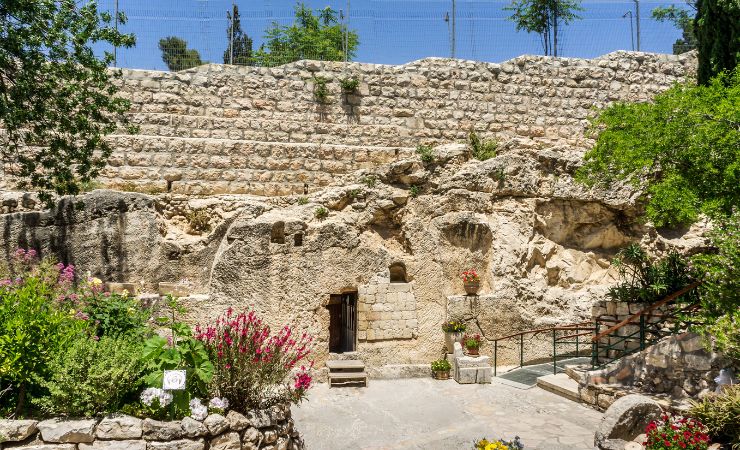
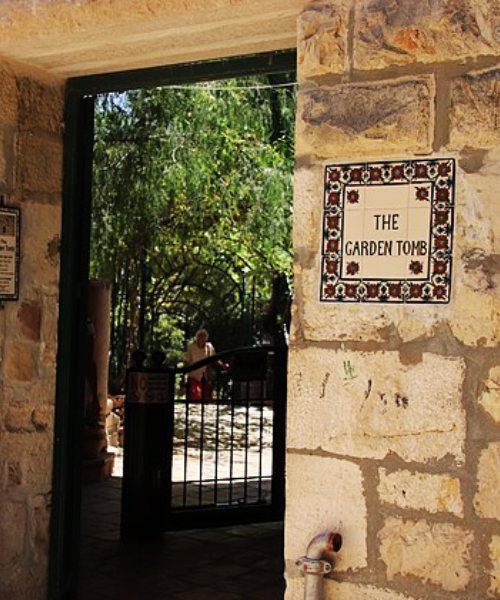
The Garden Tomb Jerusalem occupies a quiet corner of East Jerusalem approximately 300 meters northwest of the Damascus Gate, one of the primary gateways into the city’s historic heart. The site sits along Nablus Road near the intersection with Conrad Schick Street, positioned outside what would have been the ancient city walls during the Second Temple period. This location places it within walking distance of the bustling Muslim Quarter.
Biblical Context
The Garden Tomb Jerusalem aligns with several biblical descriptions of Jesus’ burial site. Hebrews 13:12 describes Jesus suffering “outside the gate” of Jerusalem, matching this location beyond the ancient city walls. The Gospel of John provides the most detailed account, describing both a garden setting and the proximity to the crucifixion site. Archaeological surveys confirm that this area contained gardens, vineyards, and burial grounds during the first century CE, as indicated by the presence of an ancient winepress and burial customs of the period.
The Garden Tomb's Historical Lens
The Garden Tomb Jerusalem emerged as a pilgrimage site during the 19th century Protestant revival movement. German scholar Otto Thenius first proposed Skull Hill as the site of Golgotha in 1842, followed by Fisher Howe in the 1850s and 1870s. The tomb itself was rediscovered in 1867 during excavations in the area. General Charles Gordon, a British Army officer and evangelical Christian, visited the site in 1883 and became convinced of its authenticity after observing the skull-like appearance of the nearby rocky escarpment.
Gordon’s endorsement sparked international interest, and by 1885, the Garden Tomb Society had formed to purchase and maintain the property. The site offered Protestant pilgrims an alternative to the Church of the Holy Sepulchre, located at the end of the Via Doloroas, which had been associated with Catholic and Orthodox traditions since the 4th century. This division reflected broader theological differences between Protestant emphasis on biblical literalism and Catholic reliance on ecclesiastical tradition in religious sites.
Archaeological Findings
- The Tomb (Sepulcher): The burial cave was discovered around 1867 and consists of two chambers: an outer chamber with a single stone bench and an inner chamber featuring a triple-bench design along three walls. The benches were originally about a meter wide and more than two meters long. The tomb’s original entrance was small and low. Later, Byzantine Christians modified the benches, carving them into casket-like troughs. Israeli archaeologist Gabriel Barkay’s 1986 analysis determined that the tomb’s architectural features, particularly the triple-bench design and low entrance, date to the Iron Age II period (8th-7th centuries BCE), making it significantly older than the time of Jesus.
- The “Skull Hill” (Golgotha): Adjacent to the Garden Tomb Jerusalem grounds is a rocky escarpment that resembles a human skull, which General Charles Gordon famously associated with the biblical Golgotha, the “Place of the Skull.” Its position outside the ancient city walls and along a major road leading north would have made it a practical and visible place for Roman executions. Ancient sources, including Eusebius, noted that Golgotha was located “north of Mount Zion,” a description that matches the geography of Skull Hill. Modern quarrying and construction have altered the cliff face, making the skull-like appearance less pronounced than in Gordon’s time.
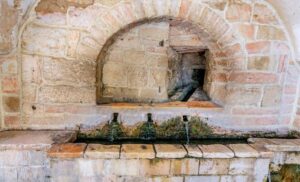
- The Winepress: South of the tomb’s entrance lies a small, well-preserved winepress. Some suggest this points to the presence of a vineyard in ancient times, reinforcing the Gospel’s reference to a garden setting. Excavated in 1924 and thought to predate Christianity, the winepress supports the idea of agricultural activity at the site. The circular treading floor measures approximately 1.5 meters in diameter, with a collection vat carved into the bedrock below.
- The Large Cistern: A massive underground cistern near the tomb could hold between 200,000 and 250,000 gallons of water. Some have cited it as evidence of a garden existing here during the first century. However, archaeological findings show that the cistern was cut and plastered between A.D. 1100 and 1187, during the Crusader period. Crusader crosses carved into its interior walls confirm this medieval dating, contradicting claims of first-century usage.
- The Rock-Cut Channel (“Rolling Stone Track”): Beneath the tomb entrance is a rock-cut channel that many have interpreted as the track for a large rolling stone meant to seal the tomb. However, archaeological analysis reveals that the channel slopes away from the entrance and has a slanted edge, making it unsuitable for a rolling stone. Instead, comparisons with other Crusader sites suggest that this feature was part of a water trough, built as part of a stable complex to help channel water for animals. Research by archaeologist Amos Kloner indicates that first-century tombs typically used square blocking stones rather than rolling discs.
Practical Information
The site operates Monday through Saturday from 8:30 AM to 5:30 PM, closing at noon on Saturdays and remaining closed on Sundays and major Christian holidays.
Free guided tours in multiple languages are available throughout the day, typically lasting 30-45 minutes and covering the biblical, historical, and archaeological aspects of the site.
Visitors should dress modestly, covering shoulders and knees, as this is an active place of worship and contemplation.
The garden paths are accessible for wheelchairs and strollers, though the tomb interior requires climbing several stone steps.
Additional Information
Detailed Timeline
- Third or Second Centuries BC (Hellenistic Era): Burial niches at the site of the later Church of the Holy Sepulchre are likely carved. Riccardo Lufrani suggests dating the Garden Tomb to this period as well.
- Late First Century BC: Single burials attested in the Herodian center of Jericho. Single loculus systems in use.
- Between 63 BC and 4 BC (During the reign of the last Hasmonean monarchs or Herod the Great): The “second wall” of Jerusalem is built, annexing new neighborhoods and shifting the city limits. The site of the Holy Sepulchre, being fifty meters west of this new wall, becomes an area where new tombs would not have been permitted according to Jewish custom.
- 50 BC to AD 70: The use of ossuaries among Jews is traced to this period.
- Circa AD 30: Jesus is crucified outside the city walls near a garden. His body is taken down, wrapped in linen with spices, and placed in a new, unused tomb owned by Joseph of Arimathea in a garden. The tomb is sealed with a large stone. This tomb is likely a single-chamber, triple-bench tomb with a low doorway and a square, plug-like blocking stone.
- After AD 30: The tomb of Jesus is found empty, a central tenet of Christianity.
- Late First Century AD: The Romans destroy Jerusalem.
- 300s: The site of the Church of the Holy Sepulchre is identified by the Romans as the burial site of Jesus, based on local traditions.
- 306-337 (Reign of Constantine): The site of the Church of the Holy Sepulchre was a temple to Venus prior to this time.
- Circa AD 1100-1187 (Crusader Period): The bell-shaped cistern near the Garden Tomb is cut out and plastered during this time. Crusader crosses are carved into its interior.
- 1639: Quaresmius notes “western heretics” doubting the traditional site of Christ’s tomb.
- 1741: German pilgrim Jonas Korte publishes a book arguing against the traditional location of Calvary, stating it is now in the middle of the town.
- 1840s-1880s: Christian scholars propose Skull Hill, near the Damascus Gate, as the location of Golgotha. This includes Otto Thenius (1842), Fisher Howe (1853, 1871), H. B. Tristram, and Claude R. Conder.
- 1867: The Garden Tomb, an ancient rock-cut tomb, is discovered near Skull Hill in Jerusalem.
- 1883: General Charles Gordon visits the Garden Tomb area and is struck by the skull-like appearance of the rocky escarpment (Skull Hill). He connects this to the biblical description of Golgotha.
- Latter Half of the 19th Century: Tombs are found near “Gordon’s Golgotha.” Gordon concludes one of these must be the tomb of Jesus.
- 1885: The Garden Tomb Society is formed and purchases the Garden Tomb and surrounding land.
- 1894: Arthur William Crawley Boevey produces an introduction and guidebook to the Garden Tomb for the Committee of the Garden Tomb Maintenance Fund.
- Early 1920s: Mabel Bent revises and enlarges the Garden Tomb guidebook.
- 1986: Israeli archaeologist Gabriel Barkay publishes an article arguing the Garden Tomb dates to the Iron Age II (8th-7th centuries BCE) based on its features. Dan Bahat concludes the Church of the Holy Sepulchre is a plausible location for Jesus’ crucifixion and burial as it was outside the city walls in his day.
- 1999: Peter Walker publishes “The Weekend that Changed the World: The Mystery of Jerusalem’s Empty Tomb.” Israeli archaeologist Amos Kloner suggests Jesus’ tomb was sealed with a square blocking stone, not a rolling stone disc, based on the prevalence of such stones in First Century tombs.
- 2001: Archaeological research on the Garden Tomb site is essentially complete.
What is the difference between the Garden Tomb and the Church of the Holy Sepulchre?
The Garden Tomb Jerusalem represents a Protestant alternative to the traditional Catholic and Orthodox site at the Church of the Holy Sepulchre. While both claim to be the burial place of Jesus, they differ in atmosphere, denominational support, and archaeological evidence. The Garden Tomb offers a quiet, garden-like setting that many find easier to envision as the biblical garden tomb, while the Holy Sepulchre carries the weight of 1,700 years of Christian tradition and veneration.
What archaeological evidence supports the Garden Tomb as Jesus’ burial site?
Archaeological analysis reveals that the Garden Tomb dates to the Iron Age II period (8th-7th centuries BCE), making it several centuries older than the time of Jesus. While this doesn’t support its identification as the biblical tomb, the site does contain first-century features including an ancient winepress and evidence of garden cultivation. Most scholars consider the Church of the Holy Sepulchre to have stronger archaeological support based on continuous Christian veneration since the 4th century.
How do I get to the Garden Tomb from the Old City?
The Garden Tomb Jerusalem is located approximately 300 meters northwest of Damascus Gate, making it easily accessible on foot from the Old City. Exit through Damascus Gate, cross the busy intersection, and walk north along Nablus Road toward the intersection with Conrad Schick Street. The walk takes about 5-10 minutes from Damascus Gate, and signs in English point the way to the Garden Tomb entrance.
Can large groups visit the Garden Tomb Jerusalem?
Yes, the Garden Tomb Jerusalem welcomes large groups including tour buses, church groups, and educational delegations. Groups of 15 or more are encouraged to contact the site in advance to arrange special tour times and ensure adequate guide availability. The garden can accommodate multiple groups simultaneously, though the tomb interior has space limitations that may require groups to be divided for the actual tomb visit.
Nearby Sites
The Church of the Holy Sepulchre: An equally revered alternative site for Jesus’ crucifixion and resurrection, located just a short distance from the Garden Tomb inside of Jerusalem’s Old City Walls.
Damascus Gate: Damascus Gate is one of the primary gateways into the historic heart of East Jerusalem. It is close to Herod’s Gate too.
Rockefeller Archaeological Museum: The museum showcases a vast collection of antiquities discovered mainly during the British Mandate.
- The Via Dolorosa: A path within the Old City, believed to be the route that Jesus trod towards his crucifixion. Notable sites along the road is the Church of the Flagellation and the Church of Condemnation.
Keep reading
Part of our Christian Pilgrimage Guide →