St. Anne's Church is a remarkably preserved 12th-century Crusader church in Jerusalem's Muslim Quarter, built over the believed birthplace of the Virgin Mary. The Romanesque structure survived centuries due to its conversion into an Islamic school after Saladin's conquest, and was later gifted to France in 1856. It features exceptional acoustics and sits adjacent to the ancient Pool of Bethesda.
St. Anne’s Church Jerusalem stands among the most remarkably preserved examples of Crusader architecture in the Holy Land. This 12th-century church marks the site where Christian tradition places the birthplace of the Virgin Mary, making it a place of profound reverence for pilgrims worldwide. The church represents one of only a handful of structures remaining from the Crusader period, offering visitors an authentic glimpse into medieval Jerusalem’s heritage.
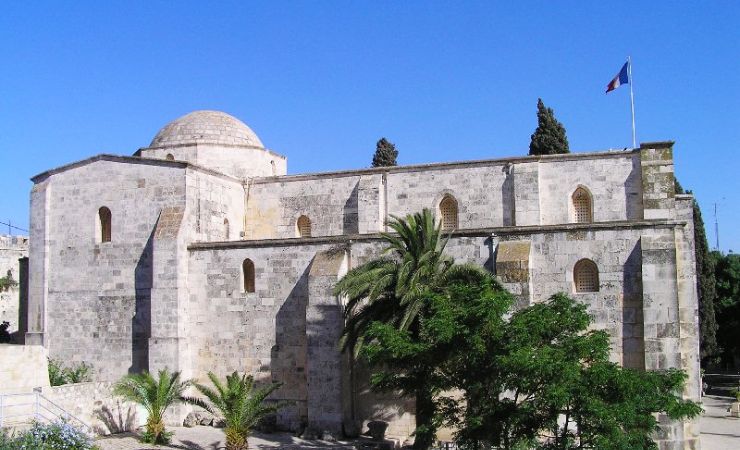
Location St. Anne's Church
St. Anne’s Church occupies a prominent position in the Muslim Quarter of Jerusalem’s Old City, adjacent to the Lions’ Gate entrance. The church sits approximately 50 meters northeast of the ancient Pools of Bethesda, creating a sacred complex that has drawn pilgrims for centuries. Visitors enter through a peaceful courtyard garden before ascending stone steps to the church entrance. The site’s location along the Via Dolorosa makes it easily accessible to those following the traditional pilgrimage route through the Old City.
Biblical Context
St. Anne’s Church Jerusalem connects to the earliest narratives of Christian tradition through its association with the Holy Family. According to the second-century apocryphal text known as the Protoevangelium of James, this site witnessed the birth of Mary, the future mother of Jesus Christ. The account describes how Saint Anne, after years of childlessness, received divine intervention and gave birth to Mary at this location in Jerusalem.
Early Christian tradition records that Mary’s parents, Joachim and Anne, lived in this area of Jerusalem near the Temple Mount. The proximity to the Pools of Bethesda holds particular significance, as some traditions suggest that Anne received the annunciation of Mary’s conception while drawing water from these pools. The story tells that both parents had received separate divine messages about their future child, meeting at the Golden Gate of the Temple to share their revelations.
The site gained additional theological importance through its connection to the Immaculate Conception doctrine in Catholic tradition. Pilgrims have venerated this location for over 1,500 years, recognizing it as the place where God’s plan of salvation began through Mary’s birth. The grotto beneath the current church preserves what believers consider the actual room where Mary was born.
Picture credit: Shmulikc1204, CC BY-SA 4.0 via Wikimedia Commons
The History of the Church
The origins of St. Anne’s Church Jerusalem trace back to the Byzantine period, when a small chapel first marked the traditional birthplace of the Virgin Mary.
The current magnificent structure was built between 1130 and 1138 during the height of Crusader rule in Jerusalem. Queen Melisende of Jerusalem commissioned the church’s construction, dedicating it to Saint Anne and establishing it as part of a Benedictine convent. The church exemplifies the finest aspects of Romanesque architecture in the Holy Land, featuring thick stone walls, rounded arches, and minimal decoration that emphasizes the building’s spiritual gravitas.
Following Saladin’s conquest of Jerusalem in 1187, the church underwent a dramatic transformation. The Ayyubid rulers converted it into the Salahiyya Madrasa, an Islamic school of theology. For nearly seven centuries, the building served this educational function, with Arabic inscriptions above the entrance preserving this period of its history. The Ottomans continued to use the structure as a madrasa until the mid-19th century.
The church’s return to Christian hands occurred through diplomatic channels rather than conquest. In 1856, Sultan Abdulmecid I presented the site to France as a gesture of gratitude for French support during the Crimean War. The White Fathers, a Catholic missionary order, took custody of the property and began extensive restoration work under architect Christophe-Edouard Mauss.
The restoration project, completed in 1878, carefully preserved the medieval structure while revealing the ancient grotto beneath. Workers discovered Byzantine mosaics and early Christian inscriptions that confirmed the site’s religious significance. The church’s exceptional acoustic properties, which create a perfect reverberation time of eight seconds, remained intact throughout centuries of alterations. These acoustics have made St. Anne’s Church Jerusalem a favored location for sacred music performances and recording sessions.
The White Fathers continue to maintain the site, welcoming pilgrims from around the world while preserving its archaeological and architectural heritage. The church now functions both as an active place of worship and as a museum showcasing 2,000 years of continuous religious devotion in Jerusalem.
What Can Be Seen at St. Anne’s Church
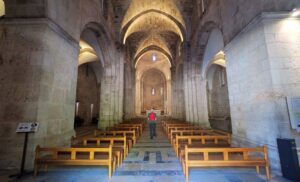
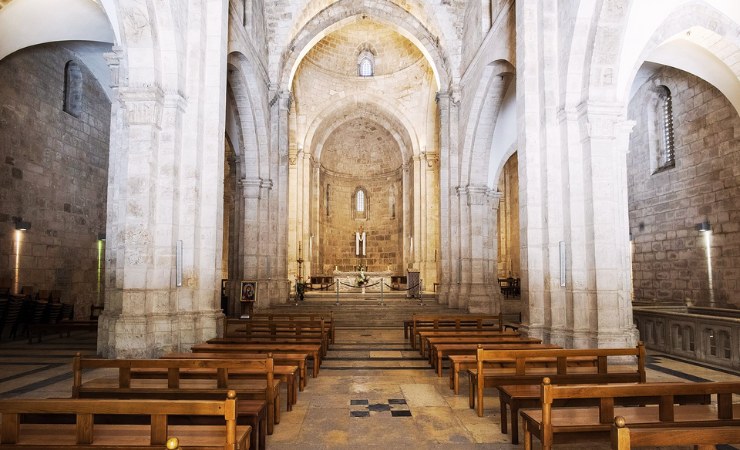
The main sanctuary displays classic Romanesque features: massive stone columns supporting rounded arches, minimal decoration that emphasizes spiritual contemplation, and soaring vaulted ceilings that create the church’s famous acoustics. Natural light filters through small windows, creating an atmosphere of reverent tranquility.
The Sacred Grotto: Beneath the main church lies the most significant feature for pilgrims, the grotto traditionally venerated as Mary’s birthplace. This underground chapel contains a simple altar marking the exact spot where tradition places the Virgin’s birth. Byzantine-era mosaics and ancient inscriptions discovered during restoration provide evidence of continuous veneration since the early Christian period.
Architectural Elements: The church’s exterior showcases typical Crusader construction techniques, with large stone blocks fitted without mortar. The entrance features a pointed arch topped by an Islamic inscription from the Ayyubid period, a unique reminder of the building’s seven centuries as a madrasa. Inside, visitors can observe the transition from Romanesque to early Gothic elements in the pointed arches of the side chapels.
The Courtyard Garden: The peaceful garden surrounding the church provides a welcome respite from the bustling Old City streets. Olive trees and flowering plants create a meditation space where visitors can prepare for their church visit. Archaeological remains visible throughout the garden hint at the site’s ancient origins.
Acoustic Phenomena: The church’s exceptional acoustic properties allow even whispered prayers to resonate clearly throughout the space. Many visitors experience the building’s famous eight-second reverberation by singing or clapping, creating an almost supernatural echo that enhances the sense of divine presence.
Practical Information
Opening Hours: St. Anne’s Church is open Monday through Saturday from 8:00 AM to 12:00 PM and 2:00 PM to 5:00 PM. The church closes on Sundays and major Christian holidays.
Admission: Entry fees are 10 NIS (approximately $3 USD) for adults. Children under 12 enter free when accompanied by adults.
Dress Code: Modest dress is required for entry. Visitors must cover shoulders and knees, and men should remove hats inside the church. Sleeveless shirts, shorts, and mini-skirts are not permitted.
Additional Information
Is St. Anne’s Church Jerusalem really where Mary was born?
While there is no archaeological evidence definitively proving Mary’s birth at this location, early Christian tradition dating back to the second century identifies this site as her birthplace. The Protoevangelium of James and other ancient texts support this tradition. Byzantine churches were built here from the 5th century onward, indicating continuous veneration of the site.
How old is the current St. Anne’s Church building?
The current church was constructed between 1130 and 1138 CE during the Crusader period, making it nearly 900 years old. It represents one of the best-preserved examples of Crusader architecture in Jerusalem. Archaeological evidence shows earlier Byzantine churches existed on the same site from the 5th century.
Is St. Anne’s Church connected to the Pool of Bethesda?
While located on the same archaeological complex, the church and pools are separate sites with distinct historical significance. The Pool of Bethesda, mentioned in John’s Gospel as a healing pool, lies adjacent to the church. Visitors can explore both sites during a single visit, as they share the same entrance ticket.
Nearby Sites
- The Pool of Bethesda: Located adjacent to St. Anne’s Church, the Pool of Bethesda marks that place where Jesus healed a paralyzed man at this pool. Visitors can explore the ruins of the ancient pool and reflect upon the healing power of faith.
- The Church of Flagellation: Located within the same complex as St. Anne’s Church, and part of the Via Dolorosa commemorates the flogging of Jesus before his crucifixion.
- Lions’ Gate: The Lions’ Gate is one of the eastern entrances to the Old City of Jerusalem. The gate is flanked by iconic lion sculptures, symbolizing the Mamluk Sultan Bybars.
- The Convent of the Sisters of Zion: This 19th-century complex houses the Ecce Homo Basilica, believed to be the location where Pontius Pilate presented Jesus to the crowd.