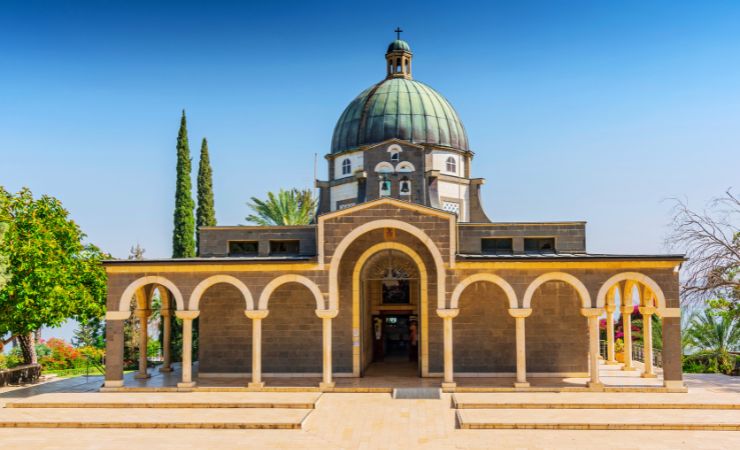
The Church of the Beatitudes marks the traditional site where Jesus delivered the Sermon on the Mount. Located 150 meters above the Sea of Galilee's northern shore, this octagonal church features eight-sided architecture symbolizing the eight Beatitudes. Built in 1938, it offers peaceful gardens and panoramic lake views.
The Church of Beatitudes sits high above the Sea of Galilee, marking the traditional location where Jesus delivered the Sermon on the Mount. This octagonal sanctuary, completed in 1938, embodies the peaceful message of the eight Beatitudes through its unique architectural design.
Location
The Church of the Beatitudes occupies an elevated hillside 150 meters above the northwestern shore of the Sea of Galilee, approximately three kilometers north of Capernaum in the Lower Galilee region. The strategic location provides sweeping views across the entire Sea of Galilee and the surrounding hills where Jesus conducted much of his ministry.
The Church of Beatitudes: Biblical Context
The Church of Beatitudes marks the traditional location where Jesus delivered his most famous discourse, recorded in Matthew chapters 5-7. According to the Gospel account, Jesus saw the crowds following him and went up on a mountainside, where he sat down and began teaching his disciples. The sermon opens with eight declarations of blessing, each beginning with “Blessed are,” which form the cornerstone of Christian ethical teaching.
These Beatitudes represent a radical departure from conventional wisdom of the time, blessing the poor in spirit, those who mourn, the meek, and the merciful. The sermon continued with teachings on salt and light, the fulfillment of the law, and instructions on prayer, including what Christians know as the Lord’s Prayer. Archaeological evidence suggests that this hillside, with its natural amphitheater formation, would have provided excellent acoustics for addressing large gatherings, making it a practical choice for such significant teaching.
“And seeing the multitudes, He went up on a mountain, and when He was seated His disciples came to Him. Then He opened His mouth and taught them, saying:
- Blessed are the poor in spirit, For theirs is the kingdom of heaven.
- Blessed are those who mourn, For they shall be comforted.
- Blessed are the meek, For they shall inherit the earth.
- Blessed are those who hunger and thirst for righteousness, For they shall be filled.
- Blessed are the merciful, For they shall obtain mercy.
- Blessed are the pure in heart, For they shall see God.
- Blessed are the peacemakers, For they shall be called sons of God.
- Blessed are those who are persecuted for righteousness’ sake, For theirs is the kingdom of heaven.
The Architectural Brilliance of Antonio Barluzzi
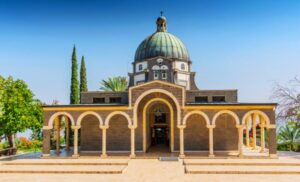
The Church of Beatitudes owes its distinctive design to the visionary Italian architect, Antonio Barluzzi, who specialized in creating sacred spaces throughout the Holy Land. Commissioned in 1936 by the Franciscan Sisters of the Immaculate Heart of Mary with funding from Italian leader Benito Mussolini, the church was completed in 1938 as a masterpiece of Neo-Byzantine architecture. Barluzzi deliberately chose an octagonal design to represent the eight Beatitudes, constructing the building from local black basalt stone with white stone accents that create striking visual contrasts against the Galilean landscape.
The Church of the Beatitudes features an innovative architectural approach that seamlessly blends spiritual symbolism with practical function. The octagonal floor plan, measuring approximately 24 meters in diameter, creates an intimate worship space while the central dome rises to symbolize heavenly aspirations. The building materials reflect Barluzzi’s commitment to using local resources, with the dark basalt providing structural strength and thermal mass suited to the regional climate, while the lighter stone trim adds elegance and definition to the building’s clean lines.
Internal Structure and Design
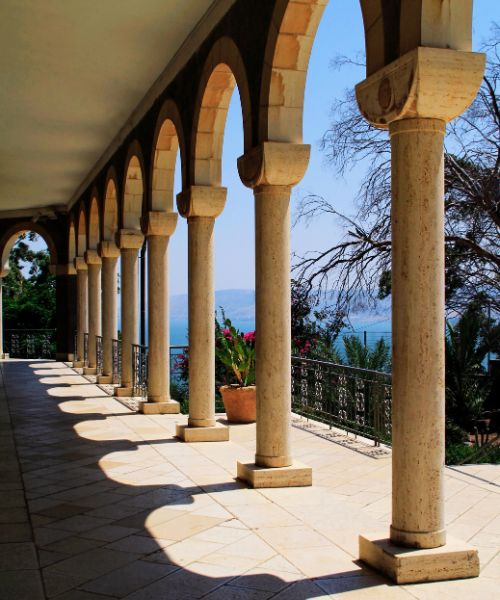
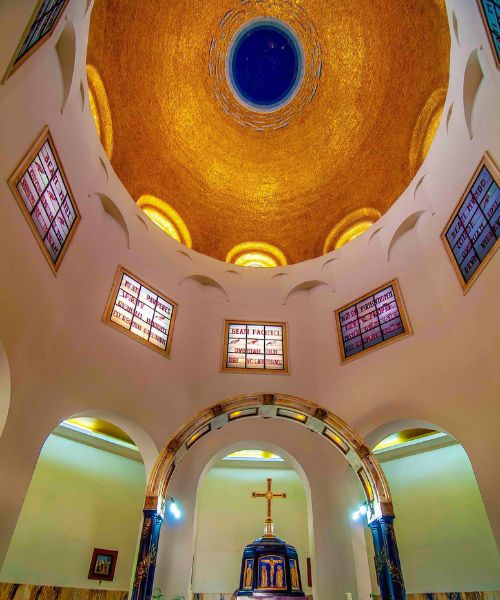
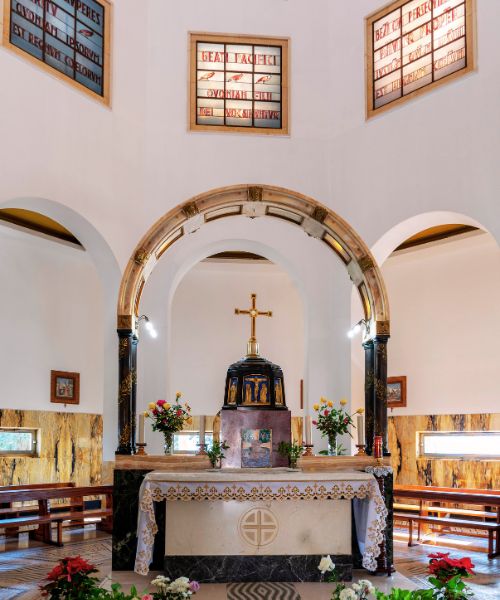
The interior of the Church of Beatitudes reflects careful attention to both spiritual atmosphere and natural beauty. Large windows positioned at eye level maintain visual connection with the surrounding landscape, allowing worshippers to see the very locations where Jesus conducted his ministry, including nearby Capernaum. The cloister features nine arches on most sides, with the northern side displaying seven arches centered around a taller, wider entrance arch that creates a formal processional approach.
The lower walls are clad in polished marble veneer that reflects natural light throughout the space, while the central dome features intricate gold mosaic work depicting the four evangelists. Around the altar, the mosaic pavement incorporates symbols representing the seven virtues: the four cardinal virtues of Justice, Prudence, Fortitude, and Temperance, alongside the three theological virtues of Faith, Hope, and Charity. Each of the eight Beatitudes appears inscribed in Latin in the upper windows, creating a continuous meditation on Christ’s teachings.
The central dome serves as both architectural focal point and spiritual symbol, its golden interior mosaics catching and reflecting light from eight windows at its base. The contrast between the darker basalt exterior and the luminous interior creates a powerful architectural metaphor for spiritual enlightenment. The craftsmanship of the mosaics follows Byzantine traditions, with skilled artisans creating detailed representations that have remained vibrant for nearly nine decades.
The church’s eight stained glass windows showcase exceptional craftsmanship, each featuring one of the Beatitudes inscribed in Latin script. These windows filter natural light into vibrant colors that change throughout the day, creating an ever-shifting spiritual atmosphere. The surrounding floor mosaic incorporates intricate geometric patterns alongside the symbolic representations of virtue, demonstrating the high level of artistic achievement that Barluzzi demanded for his sacred architecture.
External Gardens
The church sits within meticulously maintained gardens that provide multiple spaces for reflection and outdoor worship. Shaded pathways wind through carefully tended plantings that include native Mediterranean species alongside plants mentioned in biblical texts. Stone benches positioned throughout the gardens offer quiet spots for prayer and meditation, while three outdoor altars accommodate group worship services and special celebrations.
These gardens recently underwent significant changes due to security concerns and land disputes affecting Christian sites in the region. The outdoor altars were relocated closer to the sisters’ residential quarters and guesthouse to ensure better protection for worshippers and church property. This adjustment reflects the ongoing challenges faced by Christian communities in maintaining their historic presence in the Holy Land.
The landscaping includes cypress trees, olive groves, and seasonal flowers that bloom throughout the year, creating a peaceful environment that complements the church’s spiritual purpose. Stone retaining walls and terraced plantings work with the natural hillside topography, while modern irrigation systems maintain the gardens despite the semi-arid climate. The gardens also feature memorial areas where visitors can leave prayer requests and remember loved ones in this sacred setting.
Archeological findings at the Church of Beatitudes
While the current Church of Beatitudes sits on previously undisturbed ground, significant archaeological discoveries in the immediate vicinity provide important context for the site’s historical significance. Excavations conducted approximately 100 meters downhill from the present church revealed substantial remains of a 4th-century Byzantine church that operated until the 7th century CE. These ruins include foundation walls, mosaic floors, and architectural fragments that demonstrate continuous Christian veneration of this location from the early Byzantine period.
The Byzantine church remains feature typical early Christian architectural elements including a basilica floor plan with a central nave, side aisles, and an apsidal sanctuary facing east. Archaeologists have uncovered portions of elaborate mosaic pavements with geometric and floral designs characteristic of 4th to 6th-century Christian art in the region. Pottery sherds, coins, and liturgical objects found during excavations confirm active use of the site for religious purposes throughout the Byzantine period and into the early Islamic era.
These archaeological findings support the historical tradition that identifies this hillside as the location of Jesus’s teaching ministry, suggesting that early Christian communities specifically chose this site for church construction because of its association with the Sermon on the Mount.
Practical Information
The Church of Beatitudes is open to visitors daily from 8:00 AM to 5:00 PM (closes at 4:00 PM in winter months). Admission is free of charge, though donations are welcomed to support maintenance of the site and gardens.
Modest dress is required for entry to the church, with covered shoulders and knees for both men and women. The site is partially accessible to wheelchair users, with paved pathways leading to the church entrance and ground-level access to the main sanctuary.
Additional Information
4th Century CE: A Byzantine church is erected near the traditional site of the Sermon on the Mount. This church served the area until the 7th century, with its ruins later discovered downhill from the current Church of the Beatitudes.
7th Century CE: The original Byzantine church, built in the 4th century, is no longer in use.
1930s: Franciscan Sisters of the Immaculate Heart of Mary request assistance for a new church. The nuns seek help from Italian dictator Benito Mussolini to construct a new church on the Mount of Beatitudes. Mussolini provides financial support for the construction, seeking to gain support for his regime from the Church. Antonio Barluzzi is commissioned as the architect to design the Church of the Beatitudes.
1936-1938: Construction of the Church of the Beatitudes takes place. The elegant octagonal building with colonnaded cloisters is built on the Mount of Beatitudes.
March 2000: Pope John Paul II celebrates Mass at the Church of the Beatitudes. He delivers a sermon to a large crowd assembled on the hillside, echoing Jesus’s original teaching.
What are the eight Beatitudes commemorated at the Church of Beatitudes?
The eight Beatitudes are Jesus’s blessings from the Sermon on the Mount: blessed are the poor in spirit, those who mourn, the meek, those who hunger and thirst for righteousness, the merciful, the pure in heart, the peacemakers, and those persecuted for righteousness’ sake. Each of these blessings is represented by one side of the church’s octagonal design and inscribed in Latin in the upper windows.
How long does a typical visit to the Church of Beatitudes take?
Most visitors spend 30 to 60 minutes at the Church of Beatitudes, including time to explore the interior, walk through the gardens, and enjoy the panoramic views of the Sea of Galilee. Those seeking a more contemplative experience or participating in group prayer may spend up to 90 minutes on the site.
How does the Church of Beatitudes connect to other biblical sites in the area?
The Church of Beatitudes sits within walking distance of several other significant biblical sites, including Capernaum (Jesus’s base of operations), the Church of the Multiplication at Tabgha (site of the feeding of the 5,000), and Korazim (one of the cities mentioned in Jesus’s ministry). Many visitors combine these sites in a single day’s exploration of the northern Sea of Galilee region.
What historical evidence supports this location as the site of the Sermon on the Mount?
While the exact location of the Sermon on the Mount cannot be definitively proven, this hillside has been venerated by Christians since the Byzantine period, as evidenced by the 4th-century church remains found nearby. The natural amphitheater formation of the hillside, the commanding view over the Sea of Galilee, and the proximity to other confirmed sites of Jesus’s ministry support the traditional identification of this location.
Nearby Sites
- Church of the Multiplication, Tabgha: The Church of the Multiplication is traditionally believed to be the site where Jesus performed the miracle of feeding the 5,000 with five loaves and two fishes.
- Capernaum: Often referred to as “Jesus’ Own City,” Capernaum hosts impressive archaeological sites, including a well-preserved synagogue and the House of Saint Peter.
- Korazim (Corazim): Once a prosperous town, Korazim is now an archaeological site that offers a glimpse into the past. It is one of the “cursed” cities. The ruins, including an ancient synagogue.
- Magdala: Magdala is the home of Mary Magdalene. Excavations in Magdala have revealed a well-preserved first-century synagogue and a complete city infrastructure.
- ‘Jesus Boat‘ in Genosar: Discovered in the Sea of Galilee, the boat dates back to the 1st century AD, coinciding with the time when Jesus might have traversed these waters.
- Domus Galilaeae: A Christian site beckons seekers of spiritual enlightenment to its tranquil retreat.
Keep reading
Part of our Christian Pilgrimage Guide →