The Church of Saint Peter in Gallicantu commemorates Peter's three denials of Jesus after his arrest, as prophesied when the rooster crowed. Located on Jerusalem's Mount Zion, the church stands where tradition places the high priest Caiaphas's palace. The site includes ancient prison cells and cisterns where Jesus may have been held overnight.
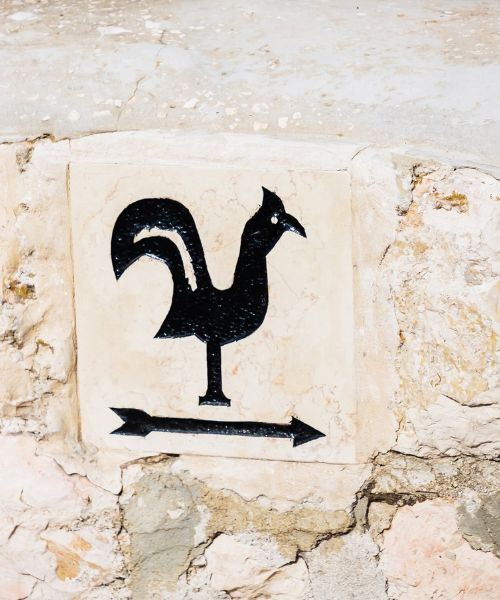
The Church of Saint Peter in Gallicantu commemorates one of the most poignant moments in the Passion narrative – Peter’s denial of Jesus. This Roman Catholic church stands on Mount Zion in Jerusalem, where tradition holds that the high priest Caiaphas maintained his residence. The name “Gallicantu” comes from Latin, meaning “cock’s crow,” directly referencing Jesus’ prophecy that Peter would deny knowing him three times before the rooster crowed at dawn.
Location
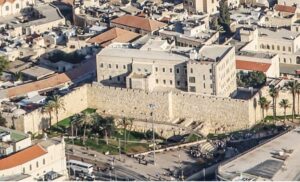
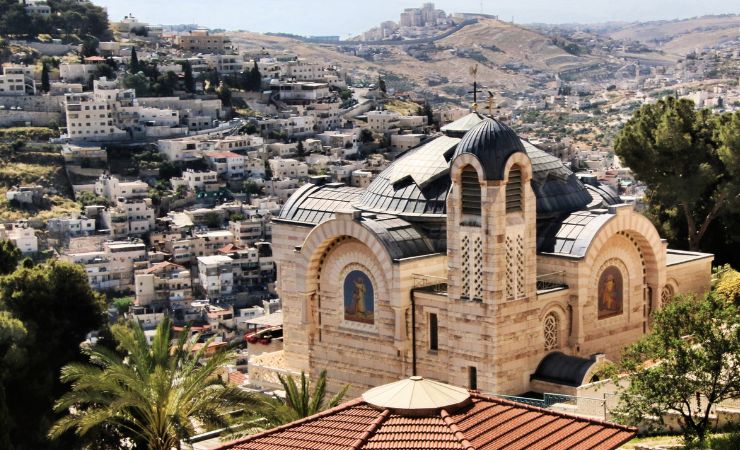
The Church of Saint Peter in Gallicantu sits on the eastern slope of Mount Zion, approximately 200 meters south of the Old City walls. The church overlooks the Kidron Valley and offers panoramic views of the City of David archaeological site.
Biblical Context
The Church of Saint Peter in Gallicantu occupies the traditional site of Caiaphas’s palace, where Jesus faced his first formal interrogation after his arrest in Gethsemane. According to the Gospel accounts, particularly Matthew 26:57-75, Jesus was brought before Caiaphas and the assembled Sanhedrin for an illegal nighttime trial. During this tense period, Peter followed at a distance and gained entry to the courtyard, where he warmed himself by a fire with servants and guards. Three separate individuals confronted Peter about his association with Jesus, and each time he vehemently denied knowing the Galilean teacher. The accounts describe how immediately after his third denial, a rooster crowed, triggering Peter’s devastating realization of his betrayal. Luke’s Gospel specifically mentions that Jesus turned and looked directly at Peter at this moment, adding profound emotional weight to the scene.
Then he began to call down curses, and he swore to them, ‘I don’t know the man!’ Immediately a rooster crowed.
Then Peter remembered the word Jesus had spoken: ‘Before the rooster crows, you will disown me three times.’ And he went outside and wept bitterly.”
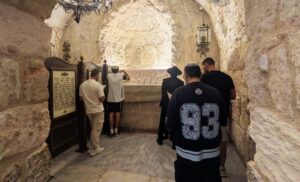
The church’s lower levels preserve what many scholars believe to be the actual dungeon where Jesus spent the night before his crucifixion. This bottle-shaped prison, carved from solid bedrock, represents one of the most authentic glimpses into the physical conditions of Christ’s suffering. The site also commemorates Peter’s eventual restoration, as referenced in John 21, where Jesus reinstated Peter with the threefold question “Do you love me?” – directly corresponding to the three denials. This theme of forgiveness and restoration makes Saint Peter in Gallicantu a particularly meaningful destination for pilgrims reflecting on redemption.
The History of the Church of Saint Peter in Gallicantu
Archaeological evidence and historical records document continuous Christian veneration at this site since the early fourth century. The Church of Saint Peter in Gallicantu has endured a remarkable cycle of construction, destruction, and renewal that mirrors the turbulent history of Jerusalem itself. Byzantine pilgrims reported visiting the location as early as 333 CE, making it one of the earliest documented Christian pilgrimage sites in the Holy Land.
The first substantial church rose on this site in 457 CE during the reign of Emperor Marcian, incorporating existing caves and Roman-period structures into its foundation. This Byzantine basilica served the growing Christian community until 529 CE, when it sustained damage during the Samaritan Revolt, a violent uprising that targeted Christian sites throughout Palestine. Persian forces under Khosrow II delivered the final blow in 614 CE, destroying the church during their devastating conquest of Jerusalem.
Reconstruction began around 628 CE under Emperor Heraclius, who initiated a broader effort to restore Christian sites throughout the recently recaptured Holy Land. However, this second church faced destruction in 1009 CE during the reign of the Fatimid Caliph Al-Hakim bi-Amr Allah, whose systematic persecution of Christians led to the demolition of numerous churches, including the Holy Sepulchre.
The Crusader period brought renewed construction in 1100 CE, with the Latin Kingdom of Jerusalem establishing a church that incorporated both Byzantine foundations and new Romanesque elements. Excavations have revealed distinctive Crusader masonry and architectural fragments from this period.
For over six centuries, only a small chapel marked the site, which itself was destroyed around 1300 CE during the Mamluk period. The location then remained in ruins until the late Ottoman period, when renewed Christian interest in Holy Land sites began to emerge.
The current Church of Saint Peter in Gallicantu was constructed between 1928 and 1931 by the Assumptionist congregation, a French religious order founded by Emmanuel d’Alzon in 1845. The Assumptionists purchased the property in 1888 and conducted extensive excavations before beginning construction. Their church deliberately preserves and incorporates ancient elements, including Byzantine mosaics, Roman-period caves, and first-century stepped streets.
Israel Antiquities Authority excavations investigations have uncovered a sophisticated water management system including multiple cisterns, a grain mill, storage chambers, and servants’ quarters that suggest this was indeed a wealthy residential complex during the Second Temple period. Among the most significant discoveries are a complete set of stone weights and measures conforming to Temple standards, along with a door lintel inscribed with the Hebrew word “Korban” (sacrificial offering), providing tangible links to the priestly class of first-century Jerusalem.
The stepped stone street north of the church represents one of Jerusalem’s best-preserved ancient thoroughfares. This 100-meter section, dating to the Roman and Byzantine periods, likely connected the Upper City with the lower Kidron Valley and may have extended to the Pool of Siloam. During the Second Temple period, this pathway would have provided direct access between the wealthy residential quarter and the Temple complex, making it a route that Jesus himself likely walked.
The Church's Multi-level Structure
The Church of Saint Peter in Gallicantu features a fascinating multi-level design that seamlessly integrates modern worship space with ancient archaeological remains. Each level reveals different aspects of the site’s rich history, creating a vertical journey through nearly two millennia of Christian devotion.
What Can Be Seen
Upper Church
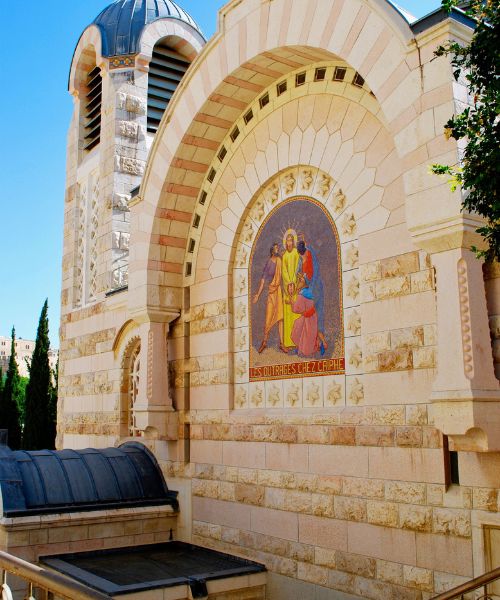
The upper church serves as the primary worship space, featuring contemporary design elements alongside ancient artistic treasures. The distinctive cross-shaped skylight dominates the ceiling, casting dramatic colored light throughout the sanctuary depending on the time of day. Three magnificent mosaics cover the rear and side walls, depicting crucial New Testament scenes including Peter’s denial, Christ’s trial before Caiaphas, and the resurrection appearance to the apostles. Two authentic Byzantine mosaics, discovered during excavations and dating to the fifth-century church, are displayed within protective glass cases. These floor fragments feature intricate geometric patterns and Christian symbols typical of early Byzantine ecclesiastical art.
Middle Church
The middle level contains multiple chapels dedicated to different aspects of Peter’s story. Icons above the altars illustrate the complete narrative cycle: Peter’s triple denial in the courtyard, his bitter weeping upon realizing his betrayal, and his reconciliation with Jesus on the shores of Galilee after the resurrection. French inscriptions throughout this level reflect the Assumptionist congregation’s origins, though Latin and Hebrew texts also appear. Ancient grottos are incorporated directly into the chapel walls, creating an atmospheric blend of natural rock formations and religious architecture. This level provides intimate spaces for private prayer and reflection.
Guardroom
Carved entirely from bedrock, this chamber preserves the most tangible evidence of first-century prison conditions. Iron rings embedded in the stone walls once held chains for restraining prisoners. Stone pillars contain deliberately carved holes positioned to secure a person’s hands and feet in painful positions. The floor features bowl-shaped depressions that archaeologists believe held salt and vinegar, substances used either to intensify suffering or to disinfect wounds. These brutal details provide visceral insight into Roman detention practices and the physical suffering endured by prisoners.
Dungeon
The lowest level contains the bottle-shaped cell known as “Christ’s Prison,” accessible only through a narrow opening in the ceiling. Prisoners would have been lowered and raised using rope harnesses, making escape impossible. Byzantine crosses carved into the stone walls indicate early Christian veneration of this space. A small window connecting to the guardroom served as an observation point for guards standing on a raised stone platform. The chamber’s dimensions – approximately 3 meters deep with a narrow neck – conform to descriptions of typical first-century detention cells used for high-profile prisoners. The overwhelming sense of isolation and confinement in this space powerfully conveys the psychological and physical ordeal Jesus endured during his final night before crucifixion.
Practical Information
The Church of Saint Peter in Gallicantu welcomes visitors Sunday through Saturday from 8:30 AM to 5:00 PM (closing at 4:30 PM from November through February). Admission costs 10 NIS (approximately $3 USD) for adults, with discounts available for students and groups.
Additional Information
Church of Saint Peter in Gallicantu – Wikipedia
Church of St Peter in Gallicantu – See The Holy Land
Saint Peter in Gallicantu Official site
What does “Gallicantu” mean and why is the church named this?
“Gallicantu” is Latin for “cock’s crow” or “rooster’s crow.” The church takes this name from the Gospel accounts where Jesus predicted that Peter would deny him three times before the rooster crowed. This prophecy was fulfilled during Jesus’ trial at the house of Caiaphas, which tradition places at this location.
Can visitors see the actual prison where Jesus was held?
Yes, visitors can descend to the lowest level of the church to view the ancient bottle-shaped dungeon known as “Christ’s Prison.” While it’s impossible to prove definitively that Jesus was held in this specific cell, archaeological evidence confirms it’s a first-century prison that matches the type described in historical sources. The cell was accessed only from above and carved from solid bedrock.
What archaeological evidence supports the church’s biblical claims?
Excavations have revealed a wealthy residential complex from the Second Temple period, including a sophisticated water system, storage facilities, and Temple-standard weights and measures. A door lintel inscribed with “Korban” (Hebrew for sacrificial offering) suggests priestly connections. While these finds support the presence of a high-status residence, they cannot definitively prove this was Caiaphas’s house.
Nearby Sites
- Mount Zion: Mount Zion is a historic site that holds religious significance for Jews, Christians, and Muslims. It is home to several other important landmarks, including the Tomb of King David and the Room of the Last Supper.
- Zion Gate: Also known as David’s Gate, Zion Gate is one of the eight gates in the walls of the Old City of Jerusalem.
- Dormition Abbey: This massive basilica marks the site where the Virgin Mary is said to have died, or “fell into eternal sleep”.
- Pool of Siloam: An ancient pool where, according to the Bible, Jesus healed a man who had been blind since birth.
Keep reading
Part of our Christian Pilgrimage Guide →