Magdala houses one of only eight first-century synagogues discovered in Israel, where Jesus likely preached. Located on the Sea of Galilee's western shore, this ancient town was Mary Magdalene's birthplace. The remarkably preserved synagogue, unearthed in 2009, features a unique stone carved with the Second Temple's menorah, providing extraordinary insight into Jewish life during Jesus's time.
Magdala, known in ancient times as Migdal, was a thriving commercial and religious center on the shores of the Sea of Galilee during the first century CE. The ancient fishing town is widely believed to be the birthplace of Mary Magdalene, one of Jesus’ most prominent followers and the first witness to his resurrection. Among the extraordinary archaeological discoveries at this site, researchers uncovered one of only a dozen synagogues from the Second Temple period in 2009. Magdala is part of the Jesus Trail.
Location
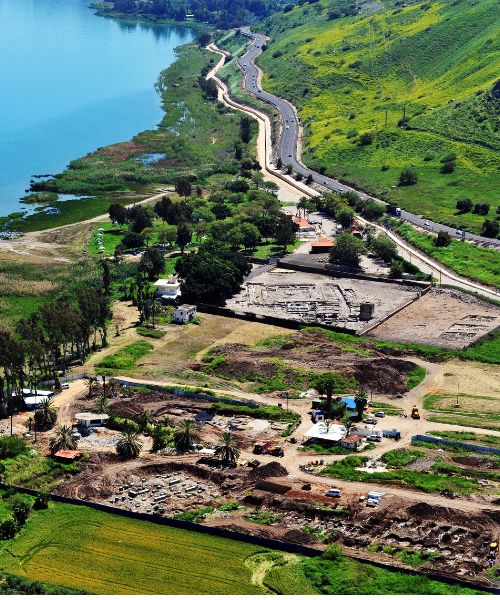
On the western shore of the Sea of Galilee, Magdala sits 5 kilometers north of Tiberias in the Galilee region of northern Israel. The town’s proximity to the lake made it an ideal location for fishing operations and the fish-processing industry that brought prosperity to the settlement.
Biblical Context of Magdala
Magdala holds a prominent place in Christian tradition as the presumed birthplace of Mary Magdalene, a devoted follower of Jesus and the first person to witness his resurrection. All four Gospels mention Mary Magdalene by name, and most Christian scholars connect her to this Galilean town. However, the exact relationship between Mary and Magdala remains a subject of scholarly debate.
The town appears in the New Testament, though with some textual variations. Matthew 15:39 refers to a region called “Magdala” or “Magadan,” while Mark 8:10 mentions “Dalmanutha.” Many scholars believe these references point to the same general area along the Sea of Galilee’s western shore, where Jesus traveled during his ministry.
Recent scholarship has challenged the traditional assumption about Mary’s origins. Elizabeth Schrader of Duke University and Joan Taylor of King’s College London propose that “Magdalene” may function as an honorific title rather than a geographical identifier. Drawing from Hebrew and Aramaic roots meaning “tower” or “magnified,” they suggest Mary could have earned the designation “the tower of faith” or “Mary the magnified” based on her spiritual prominence rather than her hometown.
The archaeological evidence from Magdala supports the town’s significance during Jesus’ era. The discovery of synagogues, residential quarters, and commercial areas confirms that this was a substantial Jewish community where religious and social life flourished, making it a plausible setting for the formation of early Christian disciples.
The History of Magdala
Magdala began as a modest settlement during the Hellenistic period (2nd-1st centuries BCE) and grew into a prosperous urban center by the first century CE. The town’s Greek name, Taricheae, meaning “place of salted fish,” reflects its primary industry. Archaeological evidence reveals extensive fish-processing facilities, including large storage pools and drying areas that supplied salted fish throughout the Roman Empire.
The settlement’s strategic location on the Via Maris, the ancient coastal highway connecting Egypt to Damascus, brought considerable wealth. Natural springs provided fresh water year-round, while the fertile Ginosar Valley offered agricultural opportunities beyond fishing. These advantages made Magdala one of three major administrative centers in Galilee during the late Second Temple period.
Magdala reached its zenith during the Early Roman period, with a population estimated between 15,000-20,000 residents. The town featured sophisticated urban planning, including residential neighborhoods, commercial districts, harbor facilities, and religious buildings. Archaeological excavations have revealed multiple mikvaot (ritual baths), indicating a religiously observant Jewish population that maintained strict purity laws.
The First Jewish-Roman War (66-73 CE) brought tragedy to Magdala. Historical accounts by Josephus Flavius describe how the town was fortified by Jewish rebels in 66 CE but fell to Roman general Vespasian in 67 CE. The siege resulted in massive casualties, with thousands of inhabitants killed or sold into slavery. The town continued as a smaller Roman and Byzantine settlement but never regained its former prominence.
After the Muslim conquest in the 7th century, an Arab village called al-Majdal (“the Tower”) preserved the ancient name while occupying part of the original site. This village existed until 1948, when its residents were displaced during the Arab-Israeli War. The buildings were subsequently demolished, clearing the way for modern archaeological excavations that began in the 1970s.
The systematic excavations starting in 2009 have transformed understanding of first-century Jewish life in Galilee. The discoveries include complete neighborhood layouts, craft workshops, synagogues, and the remarkable Magdala Stone, providing unprecedented insights into the religious and social world that Jesus and his followers inhabited.
The Migdal Synagogue: A rare finding in Israel
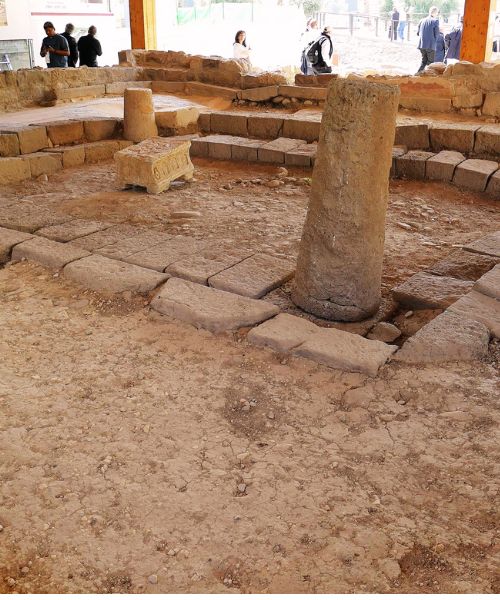
The Magdala synagogue, excavated in 2009 under the direction of archaeologist Dina Avshalom-Gorni, represents one of archaeology’s most significant discoveries for understanding first-century Jewish religious life. This rectangular structure measures approximately 11 by 11 meters and features architectural elements that define Second Temple period synagogues: stone benches built against three walls, a partial mosaic floor with geometric patterns, and walls decorated with colorful frescoes in red, yellow, and blue pigments.
The synagogue’s design follows the typical layout of its era, with the main entrance facing Jerusalem and stepped stone benches providing seating for worshippers. Archaeological analysis of pottery sherds and coins found in the building’s destruction layer dates its use to between 50 BCE and 100 CE, placing it squarely within the period of Jesus’ ministry and the early Christian movement.
This synagogue belongs to an elite group of only twelve confirmed synagogues from the Second Temple period discovered throughout Israel and the diaspora. The rarity of such structures reflects the religious practices of ancient Judaism, where synagogues primarily served as study houses and community meeting places rather than prayer centers. Formal prayer remained concentrated at the Jerusalem Temple until its destruction in 70 CE, when synagogues gradually assumed greater liturgical functions.
The building’s location within an industrial district, surrounded by fish-processing installations and craft workshops, suggests that religious and commercial life intertwined naturally in ancient Magdala. This placement differs markedly from later synagogue traditions that typically situated houses of worship in residential areas or town centers.
A second synagogue discovered at Magdala in 2021 reinforces the town’s religious significance. Built with local basalt and limestone, this structure included a main hall and two additional chambers. Its position near a residential street provides contrast to the first synagogue’s industrial setting, suggesting that multiple communities or religious needs existed within the same town.
The Migdal Stone: A glipmse of the Second Temple
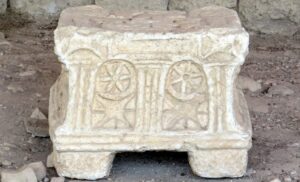
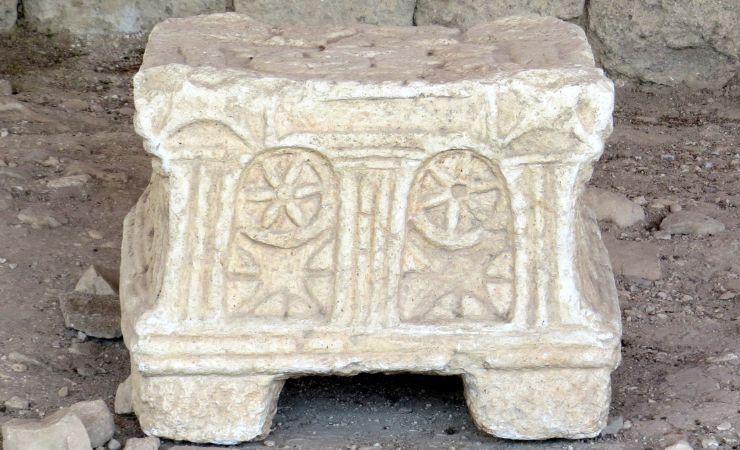
The Magdala Stone represents one of the most extraordinary artifacts from Second Temple Judaism. This carefully carved limestone block, measuring 60 centimeters long, 50 centimeters wide, and 40 centimeters high, was discovered positioned in the center of the Magdala synagogue, where it likely served as a reading platform or podium. The stone’s intricate decorations provide the earliest known synagogue depiction of Second Temple religious symbols.
The stone’s Jerusalem-facing facade features an architectural composition of remarkable detail: an arch supported by two columns frames a seven-branched menorah standing on a pedestal, flanked by pairs of two-handled amphora-style vessels. This menorah representation predates all other known synagogue examples by several decades and offers crucial evidence about Temple ritual objects as understood by first-century Jews.
Each side panel displays identical arcade designs with four arched openings. Archaeological interpretation suggests these carvings may represent the Temple’s architectural features, possibly the Holy of Holies entrance or courtyard colonnades. The artistic sophistication indicates the work of skilled craftsmen who possessed detailed knowledge of Jerusalem’s sacred architecture, supporting theories that the carver had personally witnessed the Temple before its destruction in 70 CE.
The stone’s central placement and appropriate height for seated use suggests it played an active role in synagogue functions, possibly supporting Torah scrolls during readings or serving as a focus point during study sessions. Its position facing Jerusalem aligns with Jewish prayer customs that oriented worship toward the Temple, even from distant locations.
Conservation concerns led to the original stone’s removal to climate-controlled storage facilities. Visitors now view a precise replica that preserves the visual impact while protecting the artifact. Advanced imaging techniques continue to reveal previously unnoticed details in the carvings, contributing to ongoing research about Second Temple period religious art and Temple symbolism.
Additional Archeological Findings
- Complete First-Century Jewish Quarter: Excavations have revealed an entire neighborhood of first-century Jewish residential and commercial buildings preserved just below the surface. The quarter includes courtyards, storage rooms, and workshops that demonstrate the sophisticated urban planning of the period.
- Ritual Bath Complex: Archaeologists discovered seven mikvaot throughout the site, indicating a religiously observant population that maintained strict purity laws. These stepped pools vary in size and construction, with some featuring elaborate plastered surfaces and water collection systems.
- Industrial Fish-Processing Center: Extensive installations for processing and preserving fish include large stone pools, drying areas, and storage facilities. Anchor weights and fishing implements found throughout the area confirm historical accounts of Magdala’s prominence in the fishing industry.
- Harbor and Dock Facilities: Underwater surveys have revealed stone quays and harbor structures extending into the Sea of Galilee, providing direct evidence of the town’s maritime infrastructure that supported both fishing and trade operations.
- Byzantine Monastery Complex: Later occupation layers contain the remains of a substantial Byzantine monastery, including chapel mosaics, living quarters, and administrative buildings that demonstrate Christian activity at the site from the 4th century onwards.
- Residential Architecture: Well-preserved house foundations reveal multi-room domestic structures with courtyards, cooking areas, and underground storage spaces. The quality of construction and imported pottery found within suggests a prosperous middle-class population.
Practical Information
Opening Hours: Sunday through Thursday 9:00 AM to 5:00 PM, Friday 9:00 AM to 2:00 PM. Closed on Saturdays and Jewish holidays.
Admission: Adults 35 NIS (approximately $10 USD), Students/Seniors 25 NIS ($7 USD), Children under 12 free. Group rates available for 15+ visitors.
Parking: Free parking available on-site. Large bus parking area provided for tour groups.
Accessibility: Wheelchair accessible paths to main synagogue and visitor center. Some archaeological areas have uneven surfaces requiring careful navigation.
Dress Code: Modest dress recommended. Comfortable walking shoes essential for exploring archaeological areas.
Additional Information
What makes the Magdala synagogue so historically significant?
The Magdala synagogue is one of only twelve confirmed synagogues from the Second Temple period discovered worldwide. It dates to the first century CE, making it contemporary with Jesus’ ministry. The synagogue contains the earliest known depiction of a menorah found in a synagogue setting, providing direct insight into Jewish religious practices during this crucial historical period.
Can visitors see the original Magdala Stone?
The original Magdala Stone has been moved to climate-controlled storage for preservation. Visitors view a precise replica displayed in the ancient synagogue’s original location. The replica maintains all the intricate details of the original carvings, including the menorah and architectural decorations that make this artifact so significant.
How long does a typical visit to the Magdala synagogue take?
A standard visit typically requires 1.5 to 2 hours to fully explore the archaeological site, synagogue remains, and visitor center. Guided tours last approximately 45 minutes, with additional time recommended for viewing exhibits and walking through the ancient town excavations at your own pace.
What other archaeological features can be seen at Magdala besides the synagogue?
Visitors can explore a complete first-century Jewish neighborhood, including residential houses, seven mikvaot (ritual baths), fish-processing installations, and harbor facilities. The site also contains remains of a later Byzantine monastery complex with beautiful mosaic floors and architectural elements from the Christian period.
Is there archaeological evidence connecting Mary Magdalene to this site?
While no direct archaeological evidence confirms Mary Magdalene’s presence at Magdala, the site’s extensive first-century remains demonstrate it was a thriving Jewish town during her lifetime. The discovery of synagogues, homes, and religious facilities supports the Gospel accounts of Jewish communities where Jesus’ followers would have lived and worshipped.
Nearby Sites
- Arbel National Park: A geologic formation that offers hiking trails and stunning views of the region. Includes an ancient synagogue from the fifth century.
- The Jesus Boat at Genosar: A specialty museum that houses a 2,000-year-old fishing boat discovered in the Sea of Galilee.
- Church of the Multiplication: A historic site where Jesus is believed to have performed the miracle of feeding 5,000 people.
- Capernaum: An ancient fishing village mentioned in the New Testament as a meeting place of Jesus and his disciples.
- Mount of Beatitudes: Believed to be the location where Jesus delivered the Sermon on the Mount. The Church of Beatitudes planned by architect Antonio Barluzzi is located on the mount.
Keep reading
Part of our Galilee & Northern Israel Guide →