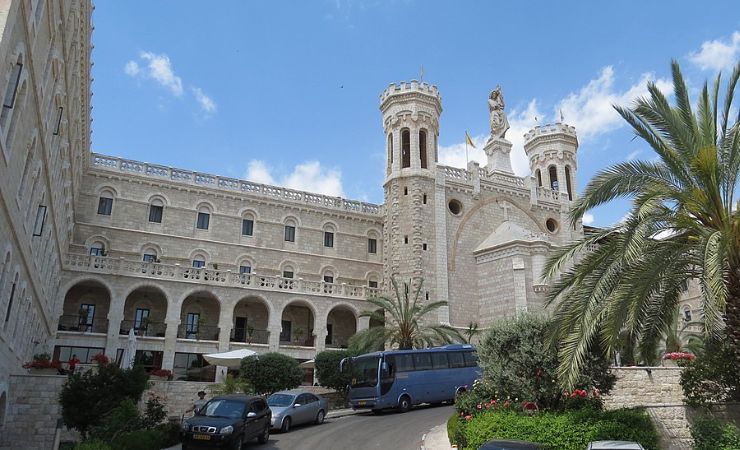
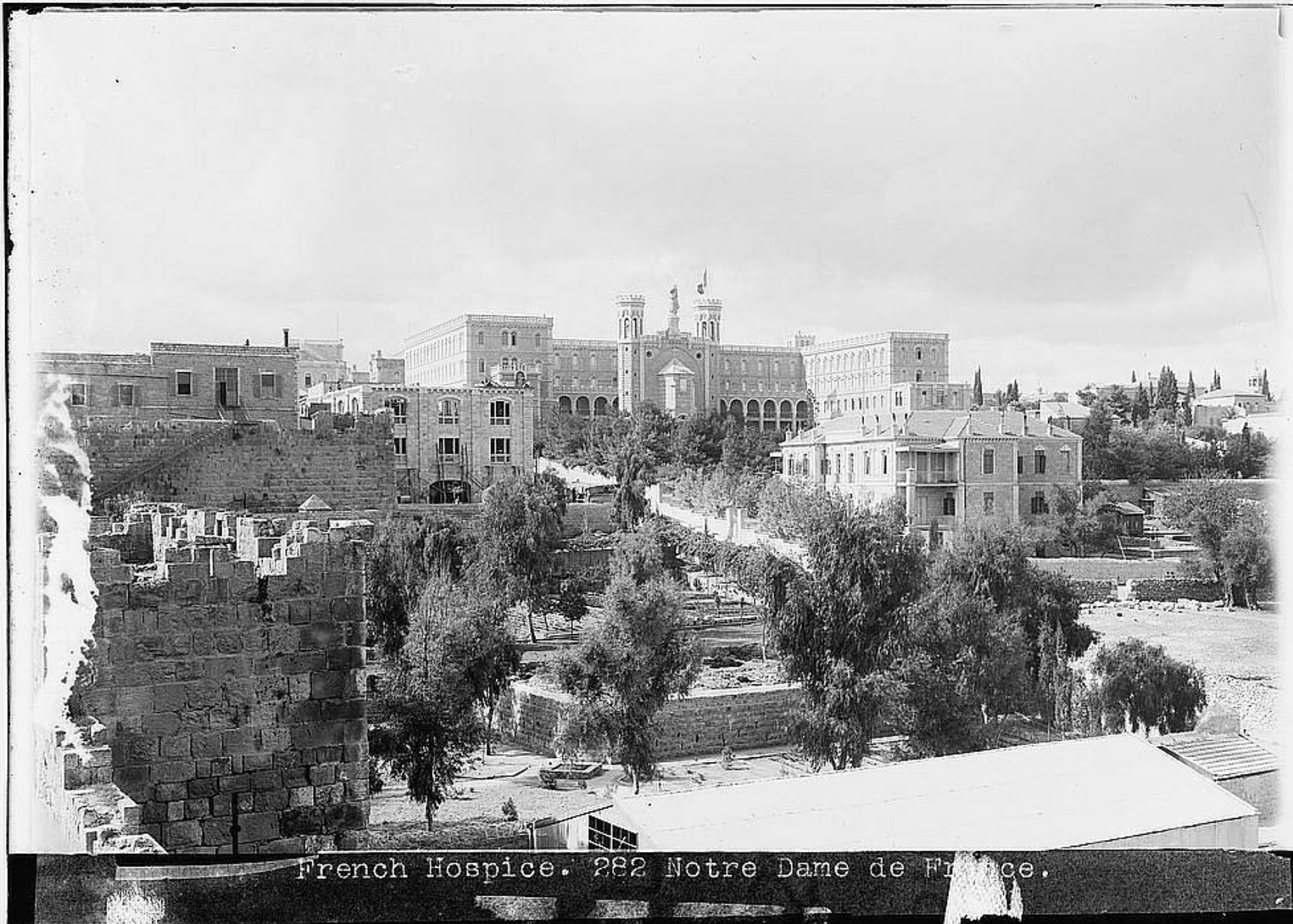
The Notre Dame French Compound is a historic French Catholic complex located just outside Jerusalem's Old City walls, near New Gate. Built in 1887 by the Assumptionist Order, it serves as a pilgrimage center featuring stunning architecture, a chapel, museum, guesthouse facilities, and a rooftop restaurant with panoramic Old City views.
The Notre Dame French Compound is a magnificent neo-Romanesque complex that has welcomed French pilgrims to Jerusalem for over a century. Located just outside the ancient walls of the Old City, this historic compound combines architectural grandeur with spiritual significance, offering visitors a unique blend of accommodation, dining, worship, and cultural experiences.
Location
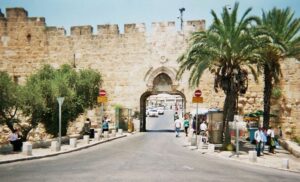
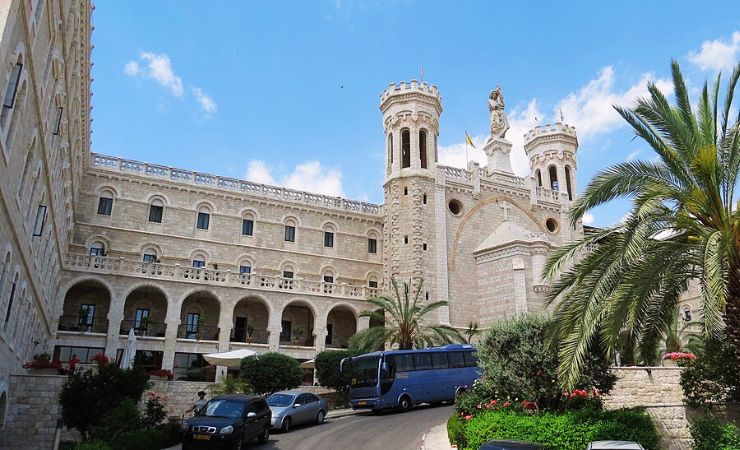
The Notre Dame French Compound occupies a prime position adjacent to the New Gate of Jerusalem’s Old City, at 3 Paratroopers Road. This strategic location places pilgrims and tourists within a five-minute walk of the Church of the Holy Sepulchre, Via Dolorosa, and Western Wall.
Historical Context
The construction of Notre Dame Jerusalem began in 1884 under the initiative of the Assumptionist Fathers, led by Father Marie-Alphonse Ratisbonne. The project represented France’s growing religious and cultural investment in the Holy Land during the late Ottoman period. The compound was inaugurated in 1904 by French Consul Paul Révoil, establishing it as the premier French Catholic pilgrimage center in Jerusalem’s history.
During World War I, the Ottoman authorities requisitioned the building as a military hospital, treating wounded soldiers from various armies fighting in the Palestine campaign. The British Mandate period saw the compound return to religious use, though it faced numerous challenges during the 1948 Arab-Israeli War when it served briefly as a refugee center. In 1972, the Vatican acquired the property from the Assumptionist Fathers, transforming it into an international pilgrimage center while maintaining its distinctly French character and architectural heritage.



Architectural Features
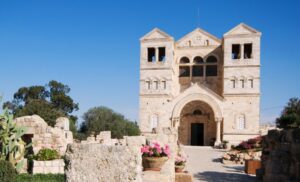
The Notre Dame French Compound exemplifies neo-Romanesque architecture adapted for the Jerusalem climate and landscape. Architect Julien Médecin designed the complex using local golden Jerusalem stone, creating a harmonious blend with the surrounding ancient architecture. The building’s robust proportions and ecclesiastical elements reflect 19th-century French religious architecture while incorporating Ottoman-era decorative motifs.
- Grand Facade: The main entrance features a massive pointed arch flanked by carved stone columns, with intricate reliefs depicting biblical scenes. The facade’s central rose window measures 4 meters in diameter and contains over 200 individual glass pieces.
- Stained Glass Windows: Master glazier Lucien Bégule of Lyon created the compound’s 47 stained glass windows between 1902 and 1904. The chapel windows illustrate the life of Christ, while corridors feature French saints and Notre Dame imagery in brilliant blues, reds, and golds.
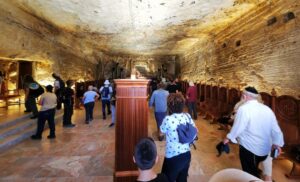
- High Vaulted Ceilings: The chapel’s ribbed vault soars 18 meters above the altar, supported by six massive stone pillars quarried from the Judean Hills. The acoustic properties of this space make it ideal for Gregorian chant and organ music.
- Bell Towers: Twin octagonal towers rise 35 meters above street level, housing four bronze bells cast in Annecy, France. The bells still chime daily at 6 AM, noon, and 6 PM, their sound carrying across the Old City walls.
- Courtyards and Gardens: Three internal courtyards feature Provençal-style gardens with olive trees, rosemary, and lavender imported from France. The central courtyard contains a replica of the Grotto of Lourdes, complete with spring water channeled through hidden pipes.
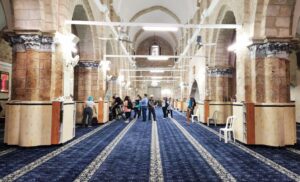
- Cloisters: The first-floor cloister walkway extends 120 meters around the main courtyard, with 32 stone arches providing shelter from Jerusalem’s intense summer sun while allowing cool breezes to circulate.
What Can Be Found at the Notre Dame French Compound
The compound functions as both a pilgrimage center and cultural institution, offering visitors multiple ways to engage with its history and mission:
- The Chapel: The sacred heart of the complex seats 200 worshippers and hosts daily Mass in French, English, and Arabic. The altar contains a relic of Saint Marie-Alphonse Ratisbonne, while the sanctuary features original 1904 liturgical furnishings.
- Accommodation Facilities: The guesthouse provides 150 rooms ranging from simple pilgrim quarters to deluxe suites with Old City views. All rooms feature air conditioning, private bathrooms, and modern amenities while preserving the building’s historic character through original tile work and wooden furnishings.
- Restaurants and Cafes: The Rooftop Restaurant offers French-Mediterranean cuisine with panoramic Jerusalem views, while the ground-floor café serves traditional French pastries and Middle Eastern specialties. The wine cellar stocks French vintages alongside Israel regional wines.
- Museum of the Shroud of Turin: This specialized exhibition occupies three floors and attracts researchers studying the intersection of Franciscan sanctuaries in the Holy Land faith and scientific inquiry. The museum houses one of only twelve full-size photographic reproductions of the Shroud worldwide.
- Panoramic Rooftop Terrace: The 400-square-meter terrace provides 360-degree views encompassing the Dome of the Rock, Church of the Holy Sepulchre, Mount of Olives, and modern Jerusalem neighborhoods. Professional telescopes allow detailed viewing of architectural features across the city.
- Conference Halls and Event Spaces: The compound’s three conference rooms accommodate groups from 20 to 150 participants, featuring modern audiovisual equipment and simultaneous translation facilities for international scholarly conferences and interfaith dialogue sessions.
Jesus Shroud Exhibition
The Museum of the Shroud of Turin represents one of the most comprehensive exhibitions devoted to this controversial relic outside of Turin itself. Established in 2001, the museum attracts over 25,000 visitors annually, including scientists, theologians, and curious tourists seeking to understand this enduring mystery of .
The Shroud of Turin: An Overview
The Shroud of Turin is a 14-foot linen cloth bearing the faint impressions of a crucified man, first documented in medieval Europe during the 14th century. Scientific analysis reveals the image was not painted but formed through an unknown process that created a photographic negative effect. Carbon dating conducted in 1988 suggested a medieval origin, but subsequent studies have challenged these findings, leaving the Shroud’s age and origin disputed among researchers.
The original Shroud remains in the Cathedral of Saint John the Baptist in Turin, displayed publicly only during special papal visits. The Notre Dame exhibition provides unprecedented access to examine this mysterious artifact through advanced reproduction techniques and scientific analysis.
Exhibition Highlights
Detailed Replica: The museum’s centerpiece is a full-size photographic reproduction created using specialized lighting techniques that reveal details invisible to the naked eye. The replica is displayed horizontally in a climate-controlled case, allowing visitors to walk around its entire perimeter and examine the front and back impressions simultaneously.
Historical Journey: Interactive timeline displays trace the Shroud’s documented history from its first appearance in Lirey, France in 1357 through its acquisition by the House of Savoy and eventual placement in Turin Cathedral. Historical documents, paintings, and artifacts illustrate how the Shroud influenced European art and devotional practices over six centuries.
Scientific Investigations: The exhibition features equipment replicas used in Shroud research, including polarized image overlay techniques, microscopic fiber analysis, and pollen identification studies. Visitors can operate simplified versions of scientific instruments to understand how researchers study the cloth’s composition and formation process.
Religious and Cultural Significance: Medieval manuscripts, Renaissance paintings, and contemporary artworks demonstrate the Shroud’s impact on Christian iconography. The exhibition includes works by artists from Dürer to Dalí who incorporated Shroud imagery into their religious compositions.
Interactive Displays: Digital microscopes allow visitors to examine Shroud fibers at 50x magnification, while computer simulations demonstrate various theories about image formation. Touch screens provide access to scholarly databases and research papers from leading Shroud investigators worldwide.
Practical Information: The museum opens daily from 9:00 AM to 6:00 PM, with extended hours until 8:00 PM during summer months.
Additional Information
How far is Notre Dame Jerusalem from major holy sites?
Notre Dame Jerusalem is ideally located for visiting major Christian sites. The Church of the Holy Sepulchre is a 5-minute walk through the New Gate, while the Via Dolorosa begins just 300 meters away. The Western Wall is approximately 15 minutes on foot through the Old City. The Mount of Olives and Garden of Gethsemane require a 20-minute walk or short taxi ride.
Can I visit the Notre Dame Jerusalem Museum of the Shroud without staying at the guesthouse?
Yes, the Museum of the Shroud of Turin is open to all visitors regardless of whether they are staying at the guesthouse. The museum operates independently with separate admission fees and opening hours. Many visitors combine their museum visit with lunch at the rooftop restaurant or explore the compound’s chapel and courtyards as part of a day trip to Jerusalem’s Christian sites.
Can I stay overnight at the Notre Dame Jerusalem guesthouse?
Yes, the Notre Dame guesthouse offers accommodation to pilgrims, tourists, and visitors throughout the year. Rooms range from basic pilgrim quarters at $80 per night to deluxe suites with Old City views at $200 per night. All rates include breakfast and access to common areas. Reservations should be made well in advance, especially during Christian holidays and Jewish festivals when demand is highest.
Is Notre Dame Jerusalem accessible for visitors with disabilities?
The compound provides wheelchair accessibility through ramps and an elevator system installed in 2018. Accessible restrooms are available on each floor, and the chapel has designated seating areas for wheelchair users. However, the historic rooftop terrace remains accessible only via stairs. Staff members are available to provide assistance and alternative viewing areas for visitors who cannot access upper levels.
Nearby Sites
- Tancred’s Tower: An important Crusader-era fortification, this tower offers a glimpse into the medieval history of Jerusalem and provides panoramic views of the city.
- Damascus Gate: One of the main entrances to the Old City, Damascus Gate is a bustling hub of activity and a gateway to the vibrant markets and historical sites within.
- Garden Tomb: Believed by some to be the site of Jesus’ burial and resurrection, the Garden Tomb is a peaceful and contemplative space, offering an alternative to the Church of the Holy Sepulchre.
- Jaffa Gate: Another prominent entrance to the Old City, Jaffa Gate is surrounded by historical landmarks and offers easy access to the Armenian and Christian Quarters.
- Mamilla Pool: An ancient reservoir dating back to the Second Temple period, Mamilla Pool is an archaeological treasure that sheds light on Jerusalem’s ancient water management systems.
Keep reading
Part of our Christian Pilgrimage Guide →