Tel Lachish is a major archaeological site in Israel's Shephelah region that preserves remains of an ancient Judahite fortress city. The tel features impressive fortifications, a massive gate complex, and evidence of Assyrian King Sennacherib's brutal siege in 701 BCE, making it one of Judah's most important and well-documented ancient cities.
Tel Lachish is one of Israel’s most significant archaeological sites, rising from the Judean foothills with a history that stretches across more than three thousand years. The second most important city in the ancient Kingdom of Judah after Jerusalem, it was besieged twice by world empires, rebuilt from rubble, and eventually abandoned. Few sites in Israel combine such rich biblical drama with such well-preserved physical evidence of the ancient world.
Location
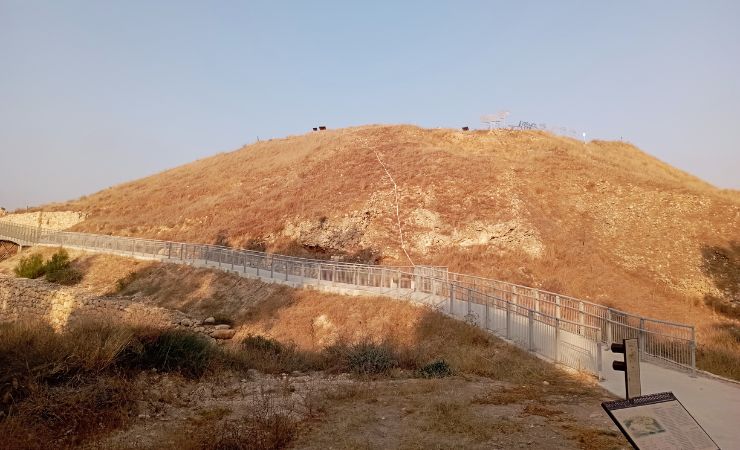
Tel Lachish sits in the Shephelah, the low rolling foothills that form the transition zone between the Judean highlands and the coastal plain. The site lies roughly 40 kilometers southwest of Jerusalem and about 25 kilometers from the Mediterranean coast, placing it squarely on the ancient road corridor that connected Egypt to Mesopotamia.
Biblical Context
Lachish appears repeatedly in the Hebrew Bible, and its role is never peripheral. In 2 Kings 18, it is the city where Sennacherib set up his field headquarters during his invasion of Judah in 701 BCE, the place from which he sent his commanders to demand Jerusalem’s surrender. The passage details how King Hezekiah attempted to appease Sennacherib by paying a heavy tribute, only for the Assyrians to continue their advance. Joshua 10 records an earlier chapter, when the Israelites under Joshua defeated a Canaanite coalition and captured Lachish. The prophet Micah (Micah 1:13) later rebukes Lachish directly, calling it “the beginning of sin” for Judah, a reference scholars link to Lachish’s role in spreading foreign religious practices.
In the fourteenth year of King Hezekiah’s reign, Sennacherib king of Assyria attacked all the fortified cities of Judah and captured them. So Hezekiah king of Judah sent this message to the king of Assyria at Lachish
2 Kings 18:13-14



The Site's History
Tel Lachish’s origins reach back to the Canaanite period of the Middle Bronze Age, around 1800 BCE, when the city first rose to regional prominence. Its inhabitants fortified it heavily, built a grand palace-temple complex, and tapped into trade routes running between Egypt and the northern Levant. Artifacts from this period, including ivory objects and imported Cypriot pottery, confirm that Lachish was a genuinely cosmopolitan city by ancient standards. An extraordinary ivory comb discovered at the site, inscribed with a plea to eradicate lice, carries what researchers believe is the earliest complete alphabetic sentence yet found, written in the Canaanite language around 1700 BCE.
During the Late Bronze Age, Lachish flourished under Egyptian hegemony, appearing in the Amarna letters as a loyal vassal city. Three successive Canaanite temples, known as the Fosse Temples, were built in a ditch outside the main city walls and destroyed by fire around 1200 BCE, likely during the period of upheaval associated with the Sea Peoples. The city was rebuilt, only to be destroyed again around 1130 BCE.
With the consolidation of the Israelite monarchy, Lachish became part of the Kingdom of Judah and grew into its most important city after Jerusalem. By the 9th century BCE it had been massively refortified, with a double city wall and a large gate complex. King Hezekiah, aware of the growing Assyrian threat, reinforced those defenses further in the late 8th century BCE, expanding the walls and stockpiling supplies, as the abundance of LMLK storage jars found at the site confirms. The threat materialized in 701 BCE, when Sennacherib besieged and destroyed the city. Despite that catastrophe, Lachish was rebuilt in the late 7th century BCE and served again as a regional center until the Babylonians, under Nebuchadnezzar, destroyed it in 588 or 586 BCE, this time for good as a major city. Limited occupation continued under Persian and Hellenistic rule, but the once-great fortress never recovered its former status and gradually faded from the map.
Lachish's Assault by King Sennacherib
The Historical Background
In the late 8th century BCE, the Assyrian Empire was at the height of its power, with Sennacherib among its most formidable rulers. He inherited the throne in 705 BCE following the death of his father, Sargon II, and immediately faced the challenge of consolidating Assyrian control over its vast territories, which stretched from Mesopotamia to the Levant. Sennacherib moved quickly and decisively, campaigning in multiple directions within the first years of his reign to suppress revolts before they could coalesce into a broader threat.
During this period, the Kingdom of Judah, under King Hezekiah, joined a broader coalition of Levantine states, including Sidon and Ashkelon, that rebelled against Assyrian dominance with Egyptian encouragement. Hezekiah had already been preparing for conflict, investing in Jerusalem’s fortifications and its water supply. Sennacherib responded in 701 BCE with a full military campaign designed to crush the uprising and make an example of its leaders. The Biblical Archaeology Society’s account of Sennacherib’s siege of Lachish traces how the campaign unfolded across the region, drawing on both Assyrian annals and excavated evidence.
The Campaign Against Judah
Sennacherib’s campaign in the Levant is documented in the Bible and in Assyrian royal records. According to 2 Kings 18:13-19:37, Sennacherib captured numerous fortified cities in Judah, most notably Lachish, before moving toward Jerusalem.
Siege and Capture of Lachish
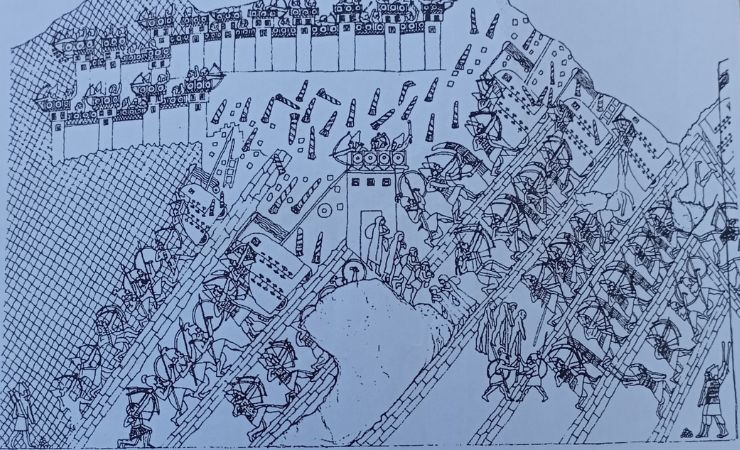
Lachish was the second most important city in Judah after Jerusalem, and its fall was a severe blow to Hezekiah. The conquest is depicted in extraordinary detail in the Lachish Reliefs, a series of carved stone panels discovered in Sennacherib’s palace at Nineveh (modern-day Iraq) and now housed in the British Museum. These panels portray the Assyrian siege ramp being constructed against the southwest corner of the city wall, battering rams grinding against the fortifications, Judean soldiers fighting from the walls, and prisoners being impaled or marched into exile. Archaeologists excavating Tel Lachish found the physical siege ramp beneath the relief’s depiction, including hundreds of arrowheads, sling stones, and chain mail links scattered across the destruction layer, confirming the reliefs’ accuracy with striking precision. The depiction of this battle functioned as royal propaganda, displaying Sennacherib’s power to any visitor who walked through his throne room.
The Siege of Jerusalem that Followed
After the fall of Lachish, Sennacherib’s army advanced toward Jerusalem. The Bible records that Hezekiah fortified Jerusalem and sought divine intervention through the prophet Isaiah. Some of these fortifications included the building of the Broad Wall and Hezekiah’s Tunnel. According to the biblical narrative, a miraculous event occurred, an angel of the Lord struck down 185,000 Assyrian soldiers, forcing Sennacherib to retreat. While this miraculous account is a matter of faith, the Assyrian records tell a different story.
In Sennacherib’s annals, particularly the “Taylor Prism,” discovered in Nineveh and now housed in the British Museum, the Assyrian king boasts of trapping Hezekiah in Jerusalem “like a bird in a cage.” However, the record does not mention the capture of Jerusalem or Hezekiah’s death, suggesting that the city was spared, possibly through a negotiated settlement or tribute payment. This discrepancy between the biblical account and the Assyrian records has been the subject of extensive scholarly debate among historians and archaeologists studying Tel Lachish and its destruction layers.
Archaeological Findings at the Site
- The Lachish Siege Ramp: The remains of the Assyrian siege ramp are still visible at Tel Lachish, built against the city’s southwest corner in 701 BCE. It is the only siege ramp from the ancient Near East that has been both excavated and confirmed through its depiction in contemporary art, the Lachish Reliefs. Archaeologists found sling stones, iron arrowheads, and chain mail scales concentrated at the ramp’s crest, physical proof of the ferocious defense Judah’s soldiers mounted before the wall was breached. The ramp was constructed from an estimated 13,000 to 19,000 tons of stone and fill, an engineering feat that speaks to the scale of Sennacherib’s military machine.
- Lachish Reliefs (Replica): Although the original reliefs are in the British Museum, a replica of the Lachish Reliefs can be seen at the Israel Museum in Jerusalem. These detailed carvings offer a rare visual representation of an ancient battle, capturing the siege’s progression panel by panel, from the ramp construction to the torture of prisoners and the deportation of survivors into Assyrian exile.
- Lachish Letters: A series of ostraca, inscribed pottery shards, found at Tel Lachish and known as the Lachish Letters, provide a remarkable window into the city’s final weeks before the Babylonian conquest. The letters were discovered in 1935 and 1938, written in Paleo-Hebrew script. They record communications from Hoshaiah, a military officer at an outpost near Lachish, addressed to Yaush (or Ya’osh), likely the commanding officer at the city. Letter Number 4 is particularly gripping: the writer reports that he can no longer see the signal fires of Azekah, implying the city had already fallen. Jeremiah 34:7 corroborates that Azekah and Lachish were the last two cities standing before the Babylonians reached Jerusalem. Letter Number 9 contains a request for bread and wine, a mundane detail that makes the desperation of the moment all the more vivid.
- LMLK seals: Stamped jar handles bearing the inscription meaning “of the king” were found at Tel Lachish in larger numbers than at any other site in Israel except Jerusalem, with over 400 examples recovered. Most came from surface contexts, but examples were also found in stratigraphic levels associated with the reign of Hezekiah, shortly before the Assyrian conquest of 701 BCE. Eight restored stamped jars were studied to understand production standards and the administrative system they represent.
- A toilet installation: Excavators uncovered a stone toilet seat installed inside what had been a shrine, a rare and deliberate act of desecration consistent with Hezekiah’s religious reforms described in 2 Kings 18. Two altars in the same shrine had their horns deliberately broken off, further evidence of a systematic effort to suppress local cultic practices.
Practical Information
Tel Lachish is managed by the National Parks and Nature Reserves in Israel. Opening times are 8AM to 5PM during summer months and 8AM to 4PM during the winder. The site closes an hour earlier on Saturdays and Sundays.
Additional Information
Canaanite Period:
- Middle Bronze Age (c. 1800 BCE): Tel Lachish rises to prominence as a fortified Canaanite city, becoming a hub of political and economic power with trade routes crisscrossing the land. Imposing walls, a grand palace, and a Canaanite temple are built.
- c. 1700 BCE: An ivory comb inscribed with a plea to eradicate lice, the first complete sentence ever written in the Canaanite language using the alphabet, is created.
- Late Bronze Age (1550-1200 BCE): Lachish is re-established and develops into a large and prosperous city in the Southern Levant. It is mentioned in Egyptian New Kingdom texts and the Amarna letters as a loyal city under Egyptian hegemony.
- 14th Century BCE (Amarna Period): Shipti Ba’al, ruler of Lachish, corresponds with the Egyptian Pharaoh (Amenhotep III or Akhenaten), assuring his loyalty.
- 13th Century BCE: Canaanites rebuild Lachish after a period of decline. The Fosse Temple III is constructed. The Lachish Ewer and Lachish Bowl are created.
- c. 1200 BCE: The Late Bronze Age Canaanite Fosse Temples are destroyed by fire.
- 12th Century BCE: Lachish is rebuilt by Canaanites who construct two new temples. A Canaanite temple dating to this period is later excavated, revealing a layout similar to other northern Canaanite temples and artifacts including a gold-plated bottle inscribed with the name Ramses II and the oldest known example of the letter “samek” in Canaanite script. This settlement is soon destroyed by another fire around 1130 BCE. The Lachish Bowl Fragment and Lachish Jar Sherd with early alphabetic inscriptions date to this period.
- 1150-1130 BCE: Lachish experiences destruction by fire, potentially due to rebellions and invasions by the Sea Peoples, leading to a period of sparse occupation (Level V).
Kingdom of Judah Period:
- Iron Age (Levels II-IV): Lachish becomes a fortified city in the Kingdom of Judah, second in importance only to Jerusalem.
- Late 8th Century BCE (Reign of Hezekiah): Lachish is a major city in Judah. Archaeological evidence suggests a planned city from the time of Rehoboam (post-kingdom partition). LMLK seals are stamped on storage jar handles during Hezekiah’s reign. Hezekiah revolts against the Neo-Assyrian Empire.
- 701 BCE: Sennacherib, the king of Assyria, launches a campaign against Judah and lays siege to Lachish. Despite determined resistance, the Assyrian army conquers the city after constructing a large siege ramp (the only one excavated in the ancient Near East). The event is famously depicted on the Lachish reliefs found in Sennacherib’s palace in Nineveh. Archaeological excavations reveal evidence of a fierce battle, including numerous arrowheads and skulls.
- Late 7th – Early 6th Century BCE (Reign of Zedekiah): Lachish remains an important Judean city.
- 588/586 BCE: During the reign of Zedekiah, King Nebuchadnezzar II of Babylon attacks Judah. The Lachish Letters, written shortly before the city’s fall, reveal communication between Judean military officers, with Hoshaiah reporting to Ya’ush, possibly the commander at Lachish. One letter mentions that the beacon of Azekah is no longer visible, indicating its fall. Lachish, along with Azekah, is one of the last Judean cities to fall before the Babylonian conquest of Jerusalem. The city is destroyed by the Babylonian army.
What can you see at Tel Lachish today?
Visitors can walk across the large tel and view the remains of the Assyrian siege ramp, one of the best-preserved examples of ancient military engineering anywhere in the world. The outline of the city gate complex, sections of the double city wall, and the excavated palace-fort area are also accessible. An explanatory signboard near the parking area provides a site overview, and informational panels are placed at key points around the tel.
Where are the original Lachish Reliefs displayed?
The original Lachish Reliefs, a remarkable set of carved limestone panels depicting Sennacherib’s siege of the city in 701 BCE, are on permanent display at the British Museum in London in Room 10b. A high-quality replica is exhibited at the Israel Museum in Jerusalem, allowing visitors to study the panels in the country where the events took place. The reliefs remain one of the most detailed visual records of ancient warfare ever discovered.
What are the Lachish Letters, and why are they important?
The Lachish Letters are a group of inscribed pottery shards, or ostraca, discovered at Tel Lachish in 1935 and 1938, written in Paleo-Hebrew script dating to around 588 BCE. They record military communications between a field officer named Hoshaiah and his commanding officer at Lachish during the final Babylonian siege of Judah. Letter Number 4, in which Hoshaiah reports that the signal fires of Azekah can no longer be seen, directly corroborates Jeremiah 34:7 and gives the letters exceptional biblical and historical weight.
Was Tel Lachish more important than Jerusalem in any period?
Lachish was never more powerful than Jerusalem as a capital city, but its strategic military importance sometimes rivaled Jerusalem’s in practice. Sennacherib chose to besiege Lachish first and to establish his command post there, rather than marching directly on Jerusalem, suggesting he viewed it as the key to breaking Judah’s defenses. During the Babylonian campaign, Lachish and Azekah are named in the Lachish Letters as the last two cities holding out before Jerusalem itself fell.
Nearby Sites
- Tel Azekah: Another ancient fortified city mentioned in the Bible, offering stunning views of the Elah Valley, where David famously fought Goliath.
- Bet Guvrin–Maresha National Park: A UNESCO World Heritage site, this park features impressive caves, underground complexes, and the remains of ancient cities.
- Beit Shemesh: A city with significant biblical history, including connections to the story of Samson, located just a short drive from Tel Lachish.
- Khirbet Qeiyafa: An archaeological site overlooking the Elah Valley, believed by some to be the biblical city of Sha’arayim mentioned in the story of David and Goliath.
Keep reading
Part of our Shephelah & Central Israel Guide →