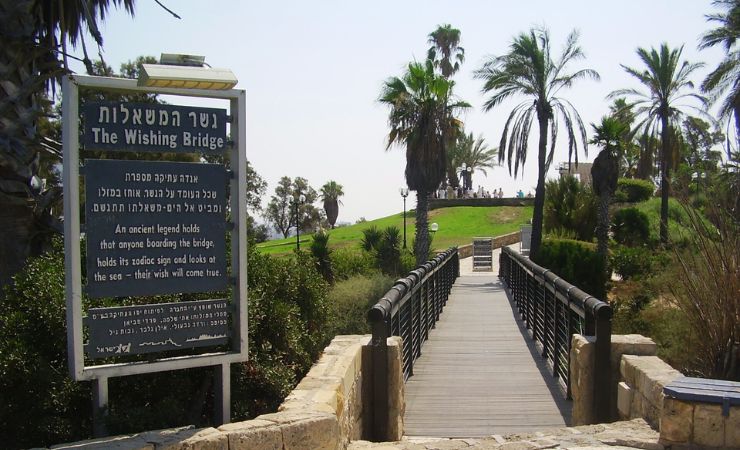
The Wishing Bridge is a wooden pedestrian footbridge in Old Jaffa, Israel, connecting Kedumim Square with HaPisga Garden. Built in the 1960s and renovated in 2016, it features twelve bronze zodiac reliefs. Local legend says wishes made while grasping your zodiac sign and gazing at the sea will come true.
The Wishing Bridge is a wooden pedestrian footbridge in Old Jaffa, connecting Kedumim Square with HaPisga Garden at the northern edge of the historic district. Built in the early 1960s and renovated in 2016, the bridge is decorated with twelve bronze zodiac reliefs and is associated with a local wish-making tradition. Known in Hebrew as Gesher HaMish’alot (גשר המשאלות — Bridge of Wishes), it is managed by the Old Jaffa Development Company.
Overview
The Wishing Bridge spans a road in Old Jaffa, linking two of the district’s most visited public spaces: Kedumim Square to the south and HaPisga Garden (also known as Abrasha Park or Peak Park) to the north. The bridge is part of a broader zodiac-themed urban landscape in Old Jaffa, where the streets themselves are named after the twelve astrological signs. At roughly 20 metres in length, the bridge is modest in scale but carries considerable symbolic weight for visitors who come specifically to perform the wishing ritual.
According to local legend, a wish made while standing on the bridge, grasping one’s own zodiac sign on the railing, and gazing out toward the Mediterranean Sea will come true. This tradition, draws visitors of all backgrounds — tourists, locals, pilgrims, and diaspora Jews who arrive at the bridge at all hours of the day and night. The artistic lighting installed during the 2016 renovation makes the bridge particularly atmospheric after dark, and it regularly appears in travel itineraries for Old Jaffa alongside the Zodiac Fountain and St. Peter’s Church.
The bridge sits within one of the oldest continuously inhabited port cities in the world. It stands within this layered context, on a site where archaeological evidence suggests a much older tradition of water and wishing.
Historical Background
The Wishing Bridge was originally constructed in wood in the early 1960s as part of a municipal plan to renovate and revitalize the then-derelict historic district of Old Jaffa. The initiative was led in part by a group of artist-enthusiasts associated with Abraham (Abrasha) Schechterman, who played a central role in repopulating and reimagining the neighbourhood. It was this same group that established the zodiac street-naming convention still in use today, giving the district its distinctive astrological identity.
The decision to decorate the bridge with twelve bronze zodiac reliefs was made from the outset, and local Jaffa artists were commissioned to sculpt them.
The bridge’s site carries additional historical resonance. Local legend holds that it was built on the location of an old fountain considered a wishing well, and archaeological excavations nearby have uncovered remnants of an Ottoman-period water reservoir that may corroborate this tradition. Research published by the Biblical Archaeology Society on excavations in Late Bronze Age Jaffa underscores how deeply layered the ground beneath Old Jaffa is — Egyptian administrative buildings, Canaanite remains, and successive occupation layers lie within metres of where visitors walk today.
By 2011, the original wooden bridge had deteriorated significantly. Structural imbalance caused by erosion and natural frequency issues forced its closure, despite a steel reinforcement cable that had been added in an earlier intervention. The bridge remained closed for five years. In August 2016, following a comprehensive renovation project carried out by specialist bridge engineers ViaBridges, the Wishing Bridge reopened to the public. The weathered timber planks were fully renewed, and a new structural framework of brass and stainless steel was installed. The steel cable was removed to restore the bridge’s original visual character. During the same renovation, some of the bronze zodiac reliefs were re-commissioned for renewal by the original sculptors more than half a century after they had first created them. New handrails were added, and artistic lighting designed by Micha Margalit was installed for the first time, transforming the bridge’s appearance after sunset.
Inside Wishing Bridge Jaffa: What to See
The Wishing Bridge rewards visitors who take time to examine its details rather than simply crossing it. From the entrance mosaic underfoot to the bronze reliefs at hand level and the Mediterranean horizon beyond, every element of the bridge was deliberately designed. The following features make up the complete experience at the bridge and its immediate surroundings.
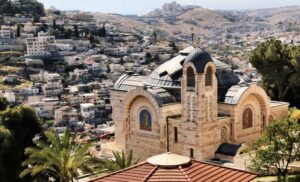
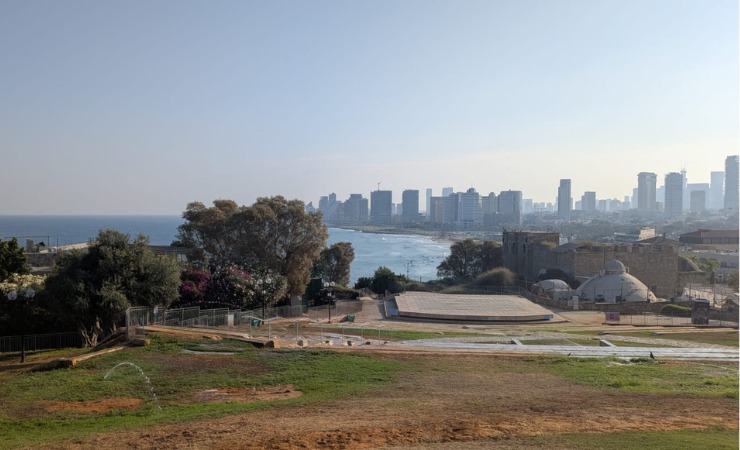
The Wooden Bridge Structure — The bridge itself is a wooden pedestrian footbridge, rebuilt with renewed timber planks during the 2016 renovation and supported by an internal framework of brass and stainless steel. Crossing it takes under a minute, but most visitors pause midway, drawn by the views opening to the west. From the bridge deck, you can see the Tel Aviv coastline stretching northward, the dome and bell towers of St. Peter’s Church directly below, and the open Mediterranean beyond the seawall. The bridge spans a road connecting two elevated sections of Old Jaffa, and the drop below gives the crossing a genuine sense of height and openness.
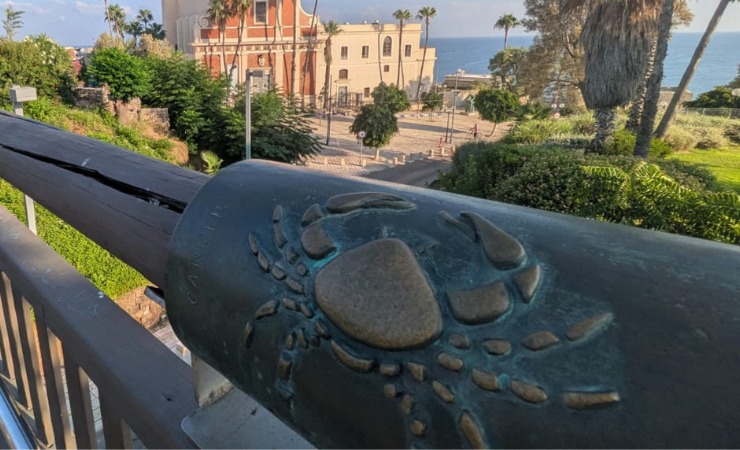
Twelve Bronze Zodiac Reliefs — Set into the bridge’s wooden railings at regular intervals are twelve thick bronze circles, each bearing the relief image of one astrological sign. Sculpted originally by Jaffa artists Esther Shlomo and Freddy Fabian in the 1960s, several of the reliefs were re-created by the same artists during the 2016 renovation — an unusual continuity of artistic authorship across more than fifty years. These reliefs are the physical centrepiece of the wishing ritual: visitors locate their own sign, place a hand on it, face the sea, and make their wish. The bronzes are worn smooth in places from decades of contact, which gives them an authenticity that reproductions rarely achieve.
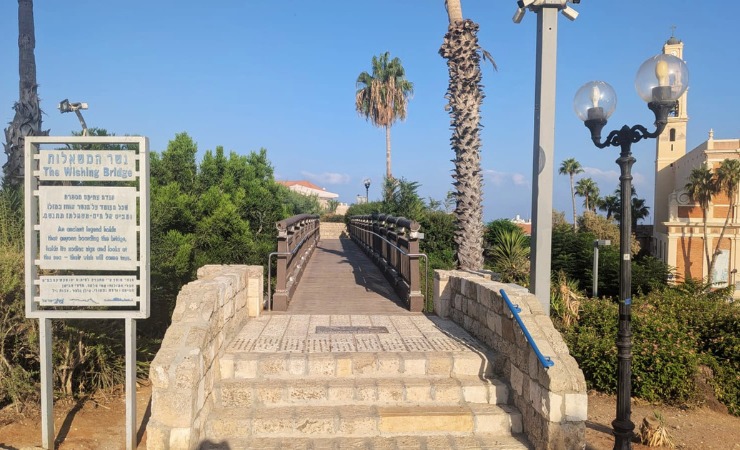
Zodiac Stone Mosaic at the Bridge Entrance — Before stepping onto the bridge, look down. Set into the stone paving at the entrance is a detailed mosaic depicting all twelve zodiac signs, created by three Old Jaffa residents: Varda Ghivoly, Ilan Gelber, and Navot Gil. The mosaic functions both as a decorative threshold and as a visual introduction to the astrological theme that runs throughout the neighbourhood.
Artistic Lighting by Micha Margalit — After dark, the bridge is transformed by a lighting installation designed by artist Micha Margalit, added during the 2016 renovation. The lighting illuminates the structure from below and highlights the bronze zodiac reliefs, making the bridge one of the most photogenic spots in Old Jaffa at night. Visitors who have already seen the bridge during daylight will find the evening version a genuinely different experience.
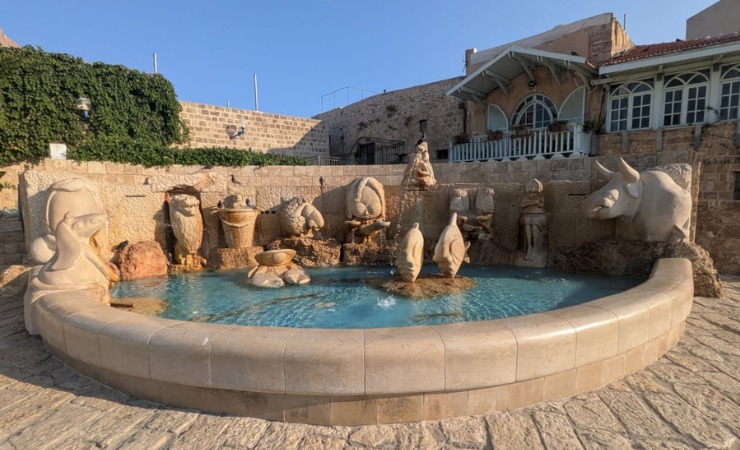
Zodiac Fountain at Kedumim Square — At the southern foot of the bridge, in Kedumim Square, stands a separate limestone fountain featuring all twelve zodiac signs. Created in 2011, the Zodiac Fountain continues the astrological motif from the bridge into the square below. Archaeological excavations beneath and around Kedumim Square have uncovered the remnants of an Ottoman-era water reservoir, which lends credibility to the legend that the area was historically a site of water and wishing.
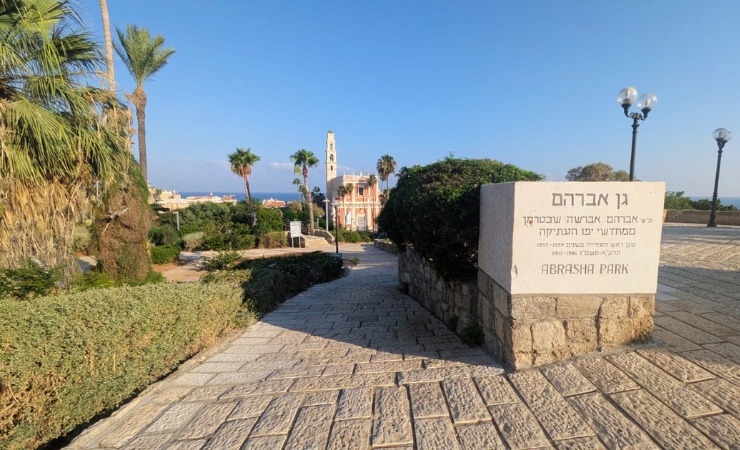
HaPisga Garden (Abrasha Park) — Directly connected to the northern end of the Wishing Bridge is HaPisga Garden, also called Abrasha Park in honour of Abraham Schechterman, whose vision helped transform Old Jaffa from a neglected neighbourhood into the artists’ quarter it became. The garden sits at the highest point of the Old City promontory and contains Napoleonic-era iron cannons, archaeological excavation areas, a Statue of Faith sculpture, and what are arguably the finest panoramic views of the Mediterranean coastline and Tel Aviv skyline available anywhere in the city.
Visiting Wishing Bridge Jaffa: Practical Information
The Wishing Bridge is an open outdoor site with no admission charge and no ticketing. Access is free at all hours, and the bridge is illuminated at night by Micha Margalit’s lighting installation, making evening visits fully viable. The bridge is located in Old Jaffa, connecting Kedumim Square with HaPisga Garden.
Additional Information
What is the wishing ritual at the Wishing Bridge?
According to local legend, visitors who stand on the bridge, place a hand on the bronze relief of their own zodiac sign, and gaze out toward the Mediterranean Sea will have their wish granted. The twelve bronze zodiac signs are set into the railings at regular intervals, making it easy to locate your sign. The ritual is informal and open to anyone, regardless of belief. The bridge is free to access at any time of day or night, and many visitors come specifically in the evening when the zodiac reliefs are illuminated by Micha Margalit’s lighting installation, which was added during the 2016 renovation.
When was the Wishing Bridge built, and has it been renovated?
The bridge was originally constructed in wood in the early 1960s as part of Old Jaffa’s municipal redevelopment programme. By 2011 it had deteriorated to the point of closure, due to structural imbalance from erosion and natural frequency issues. It remained closed for five years before a comprehensive renovation by specialist engineers ViaBridges was completed in August 2016. The renovation renewed the timber planks, installed a new brass and stainless steel framework, removed a previous steel cable reinforcement, and added new handrails and artistic lighting. Some of the original bronze zodiac reliefs were re-commissioned and renewed by the same artists who sculpted them in the 1960s.
Who created the artistic decorations on the Wishing Bridge?
The twelve bronze zodiac reliefs set into the railings were sculpted by Jaffa-based artists Esther Shlomo and Freddy Fabian. They created the originals in the 1960s and were brought back during the 2016 renovation to re-create several of the reliefs — more than fifty years after their first commission. The stone mosaic of the zodiac signs at the bridge entrance was created by three Old Jaffa residents: Varda Ghivoly, Ilan Gelber, and Navot Gil. The artistic lighting that illuminates the bridge after dark was designed by artist Micha Margalit and installed as part of the same 2016 renovation project.
Is there an admission fee to visit the Wishing Bridge?
There is no admission fee. The Wishing Bridge is an open outdoor pedestrian structure, accessible without charge at any hour. The bridge is managed by the Old Jaffa Development Company, a state-linked preservation body, which also oversees the surrounding streets and public spaces of Old Jaffa. Visitors can combine a visit to the bridge with the adjacent HaPisga Garden, Kedumim Square, and the Zodiac Fountain — all of which are also free to access. The only cost associated with visiting is any transport required to reach Old Jaffa from elsewhere in Tel Aviv.
What is the zodiac theme in Old Jaffa, and how does the bridge relate to it?
Old Jaffa has a neighbourhood-wide zodiac motif that dates to the 1960s urban revival led by Abraham (Abrasha) Schechterman and a group of artist-enthusiasts. The streets of Old Jaffa are named after the twelve astrological signs, and the Zodiac Fountain in Kedumim Square — created in 2011 by Varda Ghivoly and Ilan Gelber — continues the theme at ground level. The Wishing Bridge fits within this framework through its bronze zodiac reliefs and entrance mosaic, all of which were created by local Jaffa artists. The wishing ritual itself is built around the zodiac theme, requiring visitors to identify and touch their own sign.
What can I see from the Wishing Bridge?
From the middle of the bridge, the view opens westward toward the Mediterranean Sea, with the Tel Aviv coastline visible stretching northward. Directly below and to the south, the dome and bell towers of St. Peter’s Church — a Franciscan landmark built on a site associated with the apostle Peter — are clearly visible. The bridge connects two elevated areas of the Old City promontory, so there is a genuine sense of height and open space. At night, the combination of sea views, illuminated zodiac bronzes, and the lit facades of Old Jaffa makes the bridge one of the more photogenic spots in the neighbourhood.
Nearby Sites
- St. Peter’s Church in Jaffa: The Franciscan church visible directly from the Wishing Bridge, built on the site associated with the apostle Peter’s vision and his raising of Tabitha, and one of the defining landmarks of Old Jaffa’s skyline.
- St. Nicholas Armenian Church in Jaffa: A historic Armenian church a short walk from Kedumim Square, reflecting Jaffa’s multi-communal past and the Armenian presence in the Levant over many centuries.
- HaPisga Garden (Abrasha Park): The hilltop summit garden connected directly to the northern end of the Wishing Bridge, offering panoramic Mediterranean views, Napoleonic-era cannons, and archaeological remains at the highest point of Old Jaffa.
- Kedumim Square: The central square at the foot of the Wishing Bridge, home to the 2011 Zodiac Fountain by Varda Ghivoly and Ilan Gelber and the visitor centre built above Ottoman-period archaeological excavations.
Keep reading
Part of our Tel Aviv & Jaffa Guide →