Hezekiah's Tunnel is an 8th-century BCE underground aqueduct carved through 533 meters of solid rock beneath Jerusalem's City of David. King Hezekiah commissioned this engineering marvel to secure Jerusalem's water supply from the Gihon Spring during the Assyrian siege of 701 BCE. Visitors can wade through the tunnel today, experiencing ancient Jerusalem's ingenious water system firsthand.
Hezekiah’s Tunnel stands as one of Jerusalem’s most remarkable archaeological sites, an underground aqueduct carved through solid rock during the 8th century BCE. King Hezekiah of Judah commissioned this extraordinary engineering feat around 701 BCE as Jerusalem faced the approaching Assyrian army under King Sennacherib.
Location
Located within the City of David archaeological park, Hezekiah’s Tunnel connects the Gihon Spring to the Pool of Siloam in ancient Jerusalem’s southern quarter. The tunnel runs beneath the ancient city walls, invisible from above ground, which was crucial to its defensive purpose.
Biblical Context
Hezekiah’s Tunnel occupies a prominent place in biblical history, representing King Hezekiah’s preparations for the Assyrian siege of 701 BCE. The tunnel project fulfilled dual strategic objectives: ensuring Jerusalem’s inhabitants maintained access to fresh water while simultaneously cutting off the Gihon Spring from enemy forces positioned outside the city walls. Biblical accounts record this monumental undertaking in Jewish history in Israel sources:
As for the other events of Hezekiah’s reign, all his achievements and how he made the pool and the tunnel by which he brought water into the city, are they not written in the book of the annals of the kings of Judah?
2 Kings 20:20
Historical Background to Hezekiah's Tunnel
Historical Backdrop
The construction of Hezekiah’s Tunnel unfolded against the backdrop of Assyrian imperial expansion under Sennacherib. In 701 BCE, as Assyrian forces swept through the Kingdom of Judah, capturing 46 fortified cities according to Assyrian records, King Hezekiah implemented comprehensive defensive measures. The tunnel project formed part of broader fortification efforts that included strengthening Jerusalem’s walls and creating additional water storage facilities. Archaeological excavations confirms the urgency of these preparations, with construction debris and tool marks indicating rapid, intensive work by skilled laborers working around the clock.
Technical Aspects of the Tunnel
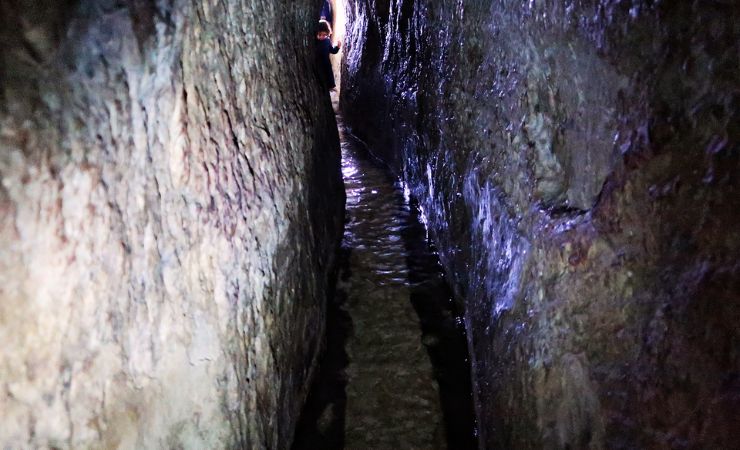
Hezekiah’s Tunnel extends 533 meters (1,750 feet) through the limestone bedrock beneath ancient Jerusalem, representing one of the ancient world’s greatest engineering achievements. Two teams of workers began excavation simultaneously from opposite ends, using iron picks, chisels, and oil lamps to carve through solid rock in complete darkness. The tunnel’s serpentine path, which includes several sharp turns and elevation changes, suggests the workers followed natural fissures and softer rock formations to minimize excavation time.
The tunnel maintains a remarkably precise gradient of just 0.06 degrees over its entire length, ensuring steady water flow from the higher Gihon Spring to the lower Pool of Siloam. This minimal elevation difference of only 30 centimeters (12 inches) demonstrates the sophisticated surveying techniques employed by ancient engineers. Modern calculations estimate the project required removing approximately 2,800 cubic meters of rock, with construction time debated among scholars as ranging from nine months to four years depending on workforce size and working conditions.
The Siloam Inscription
The Siloam Inscription, discovered in 1880 by Jacob Eliahu, a local youth exploring the tunnel, provides the only contemporary written account of the tunnel’s construction. Carved into the tunnel wall approximately 20 meters from the Pool of Siloam exit, this six-line Hebrew inscription describes the dramatic moment when the two excavation teams met underground. The text reads: “And this is the story of the boring through: while [the quarrymen were lifting] the pick, each man toward his fellow, and while there were yet three cubits to be bored through, [there was heard] the voice of a man calling to his fellow…”
The inscription reveals that workers used acoustic signals, likely hammer blows against rock faces, to coordinate their approach and avoid missing each other in the darkness. Written in classical Hebrew script dating to the 8th century BCE, the inscription matches perfectly with biblical chronology and writing styles from Hezekiah’s reign. Ottoman authorities removed the inscription in 1890 and transported it to the Istanbul Archaeological Museum, where it remains despite decades of requests for its return to Jerusalem.
Additional Information
How long does it take to walk through Hezekiah’s Tunnel?
Walking through Hezekiah’s Tunnel typically takes 30 to 45 minutes, depending on group size and water levels. The 533-meter journey requires careful footing on uneven rock surfaces while wading through knee to hip-deep water. Visitors should allow additional time for orientation at the entrance and exit points.
What should I wear when visiting Hezekiah’s Tunnel?
Visitors should wear quick-drying clothing, waterproof footwear, and bring a reliable flashlight or headlamp. The City of David provides waterproof boots and plastic bags for belongings, but personal waterproof clothing is recommended. Avoid wearing white clothing as the tunnel walls can leave stains.
Is Hezekiah’s Tunnel suitable for children and elderly visitors?
The tunnel requires moderate physical fitness and is not recommended for young children, elderly visitors with mobility issues, or anyone with claustrophobia. The narrow passages, uneven footing, and deep water present challenges for those with limited mobility. Alternative dry routes through the City of David are available for visitors who cannot navi
How was Hezekiah’s Tunnel discovered and excavated?
British explorer Charles Warren first surveyed Hezekiah’s Tunnel in 1867, though local residents had known of its existence for centuries. Systematic archaeological excavation began in the early 20th century, with major projects led by Israel Antiquities Authority excavations teams documenting the tunnel’s construction techniques, water flow systems, and historical context through careful study of tool marks and rock formations.
What is the connection between Hezekiah’s Tunnel and the Pool of Siloam?
Hezekiah’s Tunnel terminates at the Pool of Siloam, which served as Jerusalem’s primary water reservoir during the First Temple period. The tunnel channeled water from the Gihon Spring directly into this pool, ensuring the city’s water supply remained secure within the defensive walls. Recent excavations have revealed the pool’s full dimensions and its role in ancient Jerusalem’s hydraulic system.
gate the tunnel.
Practical Information
Walking through Hezekiah’s Tunnel provides an immersive historical experience, though visitors must prepare for challenging conditions. The tunnel remains flooded with spring water that reaches knee to hip depth depending on seasonal flow rates. The passage narrows to as little as 60 centimeters (24 inches) in width at certain points, with ceiling heights varying from 1.5 to 5 meters. The complete journey takes 30 to 45 minutes for most visitors, requiring waterproof footwear and flashlights or headlamps.
The City of David archaeological park provides waterproof boots, flashlights, and plastic bags for personal belongings. Visitors with claustrophobia, mobility limitations, or young children should consider alternative routes through the site. The tunnel maintains a constant temperature of 18°C (64°F) year-round, offering relief during Jerusalem’s hot summers but requiring light jackets in winter.
Nearby Sites
Pool of Siloam: An ancient reservoir in Jerusalem that is linked to biblical rituals and miracles. The entire pool is being uncovered in 2023.
City of David: The birthplace of Jerusalem, this ancient city predates even the Old City walls. It is rich in archaeological finds from the Israelite history.
- Jerusalem Archaeological Park: A treasure trove showcasing Jerusalem’s millennia-old history. Offers a close glimpse into the wall and structures of the Second Temple.
Western Wall: The holiest site in Judaism, a remnant of the ancient Second Temple. Pilgrims from around the world visit to pray and place notes between its ancient stones.
Dung Gate: A significant entrance gate to the Old City‘s Jewish Quarter. Historically named for its proximity to waste disposal.
Keep reading
Part of our Jewish Heritage Guide →