Emmaus Nicopolis is an archaeological site in central Israel identified as the biblical Emmaus where the resurrected Jesus appeared to two disciples according to Luke's Gospel. The ruins include a Byzantine basilica, Roman baths, and Crusader church. Located near Latrun, the site features extensive remains from Roman, Byzantine, and Crusader periods, though its biblical identification remains debated among scholars.
Emmaus Nicopolis is one of the most intriguing and debated sites in Christian pilgrimage history. Mentioned in the Gospel of Luke as the village where the resurrected Jesus appeared to two of his disciples, Emmaus has drawn pilgrims and scholars for nearly two millennia. The exact location of Emmaus remains contested, with several sites proposed on the basis of biblical distances, early Christian writings, and physical archaeological evidence. Of all the candidates, Emmaus Nicopolis carries the strongest historical pedigree.
Location
Emmaus is generally believed to lie west of Jerusalem, along the ancient road that descends through the Shephelah foothills toward the coastal plain. The distance and phrasing in the Gospel of Luke have led scholars to propose multiple sites as the true location. The three main contenders are Emmaus Nicopolis (modern Imwas), Qalunya/Motza, and El Qubeibeh. Each sits at a different distance from Jerusalem, and that discrepancy alone accounts for much of the ongoing debate. Emmaus Nicopolis, located roughly 30 kilometers (about 19 miles) by road from central Jerusalem, sits near the junction of Route 1 and Route 3, making it straightforward to reach by car from either Jerusalem or Tel Aviv.
Biblical Context
The story of Emmaus appears in the Gospel of Luke, chapter 24:13-35. On the afternoon of the resurrection, two disciples are walking from Jerusalem to Emmaus, a village Luke places about 60 stadia away, roughly 11 kilometers or 7 miles. A stranger joins them on the road and explains the scriptures as they walk, though they do not recognize him. When they arrive at Emmaus and sit down to eat, the stranger takes bread, blesses it, and breaks it. At that moment the disciples recognize Jesus, and he vanishes. Shaken and joyful, they return immediately to Jerusalem to tell the other disciples. The scene has been central to Christian reflection on the Eucharist since at least the 2nd century, with the “breaking of bread” read as a direct foreshadowing of the sacrament. Some ancient manuscripts give the distance as 160 stadia rather than 60, a variant that actually brings Emmaus Nicopolis closer to the biblical measurement and has fueled scholarly arguments in its favor.
Now that same day two of them were going to a village called Emmaus, about seven miles from Jerusalem. They were talking with each other about everything that had happened. As they talked and discussed these things with each other, Jesus himself came up and walked along with them; but they were kept from recognizing him.
Luke Luke 24:13-16



The Debate Over Emmaus' Location
Pinning down the biblical Emmaus has occupied scholars, church historians, and archaeologists for centuries. The core problem is the distance: Luke gives 60 stadia, but some manuscripts read 160 stadia, and the two figures point toward entirely different places. The three main contenders each have genuine supporting arguments and genuine weaknesses.
Emmaus Nicopolis
Location: Approximately 25 kilometers (15 miles) west of Jerusalem, near the modern interchange of Routes 1 and 3.
Support: Traditionally identified by Eusebius of Caesarea, Origen, and other early Christian writers, Emmaus Nicopolis carries the oldest documented identification. The site has extensive Roman and Byzantine ruins, including a large basilica and a monastery. The name “Nicopolis” was added after the Romans rebuilt the city following the Bar Kokhba revolt of 132-136 CE. If the 160-stadia manuscript variant is accepted, the distance fits this location precisely. The site was also identified by Miriam Bawardi (1846-1878), a Carmelite nun born in the Galilee, following a vision she reported of this place.
Challenges: Under the more widely cited 60-stadia reading, Emmaus Nicopolis is roughly double the distance described in Luke’s Gospel, which has led some scholars to question whether it can be the village in the story.
2. Qalunya/Motza
Location: About 5.5 kilometers (3.5 miles) west of Jerusalem, near the modern community of Mevasseret Zion.
Support: Some scholars link Qalunya/Motza to Emmaus partly on linguistic grounds: the Talmud records Motza as a place where willow branches were cut for the Sukkot festival, and Josephus mentions a colony of veterans settled there. Its proximity to Jerusalem fits a round trip on foot in a single day, which is implicit in Luke’s account. Recent archaeological surveys have added this area to the discussion.
Challenges: At roughly 5.5 kilometers, Motza falls well short of even the 60-stadia figure, and no early Christian tradition connects it specifically to the Emmaus of Luke. The identification remains speculative and lacks the patristic support that Nicopolis enjoys.
3. El Qubeibeh
Location: Approximately 11 kilometers (7 miles) northwest of Jerusalem.
Support: El Qubeibeh has been a recognized pilgrimage destination since at least the Crusader period. A Franciscan church marks the site, and the walking distance from Jerusalem matches the 60-stadia reading quite closely, making it geographically plausible.
Challenges: No pre-Crusader written source names El Qubeibeh as Emmaus. Archaeological evidence for a significant ancient settlement at the site is thin, and the tradition associating it with the Gospel account only solidifies in the Middle Ages. Most early Christian historians make no mention of it.
Emmaus Nicopolis: Historical Background
Ancient Origins and Roman Era
Emmaus Nicopolis began as a small village whose name derives from the Hebrew word hammat, meaning “hot springs,” pointing to the presence of thermal waters in the area. During the Hellenistic period it gained strategic importance, particularly during the Maccabean Revolt, when the Seleucid general Bacchides fortified it around 160 BCE. The site already appears in 1 Maccabees as a staging ground for military campaigns, which reflects its position on the main road connecting the coastal plain to Jerusalem.
In 4 BCE, following the death of Herod the Great, a Jewish uprising led by Judas son of Hezekiah broke out, and the Romans destroyed Emmaus in their response. The town was later rebuilt and, after the First Jewish-Roman War of 66-73 CE, Emperor Vespasian settled 800 Roman veterans there. In approximately 220 CE the city was formally elevated and renamed Nicopolis, meaning “City of Victory,” commemorating Rome’s military supremacy in the region. By the 3rd century it had grown into one of the principal urban centers of the Judean lowlands, with a forum, bathhouse, and substantial civic infrastructure.
Byzantine Period
The Byzantine era transformed Emmaus Nicopolis into a significant Christian pilgrimage destination. Eusebius of Caesarea, writing in the early 4th century, explicitly identified it as the biblical Emmaus, and Origen had made a similar identification before him. By the late 4th century a large basilica had been constructed over what was believed to be the house of Cleopas, one of the two disciples in Luke’s account. The church was expanded in the 5th and 6th centuries, eventually comprising three naves, multiple chapels, and a baptistery, making it one of the more substantial ecclesiastical complexes in Byzantine Palestine. Emmaus Nicopolis also held a bishop’s seat during this period, confirming its standing within the broader church hierarchy.
Islamic and Crusader Periods
Following the Islamic conquest of the Levant in 636 CE, Emmaus Nicopolis gradually declined as an urban center, though it retained religious memory. A severe plague ravaged the area in 638-639 CE, killing thousands including the Arab commander Abu Ubayda ibn al-Jarrah, which gave the site a somber reputation in early Islamic sources. During the Crusader period, the Knights Hospitaller took an interest in the location, and a Crusader church was built on the ruins of the earlier Byzantine structures, incorporating some of the original stonework.
Mamluk and Ottoman Periods
Mamluk control from the 13th through early 16th centuries brought little investment to the site. The ruins remained visible but largely unattended. Under the Ottomans, travelers and scholars began documenting what they found at the place then known as Amwas, recognizing it as a ruin of considerable antiquity. Edward Robinson, the American biblical geographer, visited and described the site in the 1830s, helping to bring it to the attention of the wider academic world.
The State of Israel Era
Following the 1948 Arab-Israeli War the Arab village of Imwas was depopulated, and the area eventually became part of Canada Park, a forested recreational zone maintained by the Jewish National Fund. The archaeological site of Emmaus Nicopolis sits within the park and is currently under the care of the Catholic Community of the Beatitudes, a charismatic religious community that has managed the site since the 1990s. The community has undertaken restoration work on the Byzantine basilica and related structures, and operates a small guesthouse and spiritual center on the grounds. The combination of a working pilgrimage center and a public park makes the site accessible to a broad range of visitors, from Christian pilgrims to Israeli hikers.
Archaeological Discoveries
Edward Robinson first drew scholarly attention to the Amwas ruins in 1838, correctly linking them with ancient Emmaus Nicopolis. Systematic excavations followed in the late 19th and early 20th centuries, led primarily by French Dominican scholars associated with the École Biblique in Jerusalem, revealing the footprint of a major Byzantine ecclesiastical complex. Additional campaigns in the mid-20th century extended the picture to include Roman-period civic structures, streets, and Jewish funerary remains. The site has been studied by archaeologists tracking the full arc of Emmaus history from the Hellenistic period through the Crusades. What follows summarizes the principal categories of finds.
Byzantine Basilica
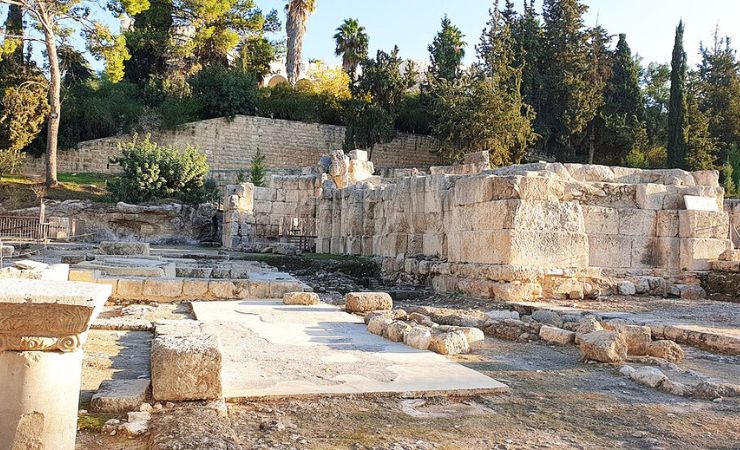
The most substantial structure uncovered at Emmaus Nicopolis is a large Byzantine basilica dating to the 5th century CE, built to commemorate the appearance of the risen Jesus to his disciples. The basilica follows a classic three-nave plan, with a broad central nave flanked by two side aisles and terminating in a large semicircular apse at the eastern end. Fragments of geometric and floral mosaic pavements survive on portions of the floor, executed in the detailed style typical of late Byzantine ecclesiastical art in the region. The complex also included at least two side chapels, a baptistery, and what appears to have been a martyrium. Sections of the standing walls reach several meters in height, giving visitors a genuine sense of the building’s original scale. An earlier, smaller church from the 4th century was found beneath the 5th-century structure, suggesting the site was venerated from the earliest decades of Byzantine rule in Palestine.
Roman Bathhouse
Excavations have uncovered a well-preserved Roman bathhouse at the site, a clear marker of Emmaus Nicopolis’s prosperity during the imperial period. The bathhouse includes intact hypocausts, the pillar-and-channel systems used to circulate hot air beneath the floors and heat the bathing rooms. Plastered walls, evidence of lead piping, and the sequence of cold, warm, and hot rooms (frigidarium, tepidarium, caldarium) are all identifiable. The structure is consistent with public bathhouses found across Roman cities in the eastern Mediterranean and underlines the town’s status as an organized urban center rather than a minor village.
Inscriptions and Mosaics
Several inscriptions in Greek and Latin have been recovered from the site, some containing religious dedications that help confirm the location’s identity as Emmaus Nicopolis and mark its prominence in both the Roman and Byzantine periods. The mosaics extend beyond those in the basilica and include both religious and secular imagery. One particularly notable mosaic features Eucharistic symbols, a direct visual link to early Christian liturgical practice and to the central act of the Emmaus story itself, the breaking of bread. These finds are consistent with what the textual sources on the biblical town of Emmaus describe regarding its religious character.
Crusader-Era Remains
During the Crusader period the site experienced renewed activity. Crusader builders erected a new church directly over the ruins of the Byzantine basilica, reusing blocks of earlier stonework in its construction. Foundations and partial wall sections from this Crusader church remain visible, alongside architectural details such as carved capitals that reflect the Romanesque style the Crusaders brought from western Europe. These remains document a continuous Christian interest in the site across radically different political eras.
Jewish Graves
Among the most historically layered finds at Emmaus Nicopolis are Jewish burial remains, dating primarily to the Roman period and connected to the town’s role as a significant Jewish settlement, particularly during the Bar Kokhba revolt of 132-136 CE. Excavators found limestone ossuaries, the small bone-boxes used in Second Temple-period Jewish burial practice once the body had decomposed, several of which carry inscriptions in Hebrew or Aramaic naming the deceased. Menorah carvings appear on some of the ossuaries and on the walls of burial caves, immediately identifying the occupants as Jewish. The burial caves themselves, cut into the local limestone, contained multiple loculi, the individual shelf-niches where bodies or ossuaries were laid. Together these finds confirm that a substantial Jewish community lived and died at Emmaus during the Roman centuries, adding a Jewish layer to what is primarily known as a Christian pilgrimage site.
Practical Information
Emmaus Nicopolis is located inside Canada Park, off Route 3 (Ayalon Highway) near the Latrun interchange, approximately 30 kilometers west of central Jerusalem and 35 kilometers southeast of Tel Aviv. The site is managed by the Community of the Beatitudes and is open to individual visitors and pilgrimage groups.
Opening Hours: The site is generally open Sunday through Friday, 8:00 a.m. to 5:00 p.m. Hours may vary on Catholic feast days and during retreat periods. Visitors are strongly advised to confirm current hours by contacting the Community of the Beatitudes directly before their visit, as the site is a functioning religious community and not a standard tourist attraction.
Parking: Free parking is available at the Canada Park lot adjacent to the site entrance. The lot accommodates private cars and buses.
Dress Code: Modest dress is expected as a matter of respect within the religious community’s grounds. Shoulders and knees should be covered when entering the church and monastic areas.
Additional Information
What is Emmaus Nicopolis and why is it significant?
Emmaus Nicopolis, located near the Latrun interchange roughly 25 kilometers west of Jerusalem, is the site most consistently identified by early Christian historians as the biblical Emmaus of Luke 24. It preserves substantial ruins from Roman, Byzantine, and Crusader periods, including a large 5th-century basilica, a Roman bathhouse, and Jewish burial caves. For Christian pilgrims, it marks the place where, according to the Gospel, the risen Jesus revealed himself to two disciples through the breaking of bread.
How far is Emmaus Nicopolis from Jerusalem, and can I visit it on a day trip?
Emmaus Nicopolis is approximately 25 kilometers west of Jerusalem by road, a drive of roughly 30 minutes under normal traffic conditions. It is easily combined with a visit to the Latrun Monastery and Armored Corps Museum into a comfortable half-day excursion from either Jerusalem or Tel Aviv. The surrounding Canada Park offers walking trails, making it a pleasant place to spend several hours.
Why do scholars debate the location of biblical Emmaus?
The central problem is the distance Luke records. The most common manuscript tradition gives 60 stadia (about 11 kilometers), which aligns with El Qubeibeh but not with Nicopolis. However, several ancient manuscripts read 160 stadia (about 30 kilometers), which fits Emmaus Nicopolis precisely. Since Eusebius and Origen, two of the most authoritative early Christian geographers, both named Nicopolis, the debate ultimately turns on which manuscript reading you accept and how much weight you give to patristic authority versus strict distance calculation.
Who manages the archaeological site at Emmaus Nicopolis today?
The site is administered by the Community of the Beatitudes, a Catholic charismatic religious community that has operated there since the 1990s. The community conducts restoration work on the Byzantine and Crusader remains, welcomes pilgrimage groups, and runs a modest guesthouse and spiritual retreat center on the grounds. The forested land around the ruins forms part of Canada Park, which is managed by the Jewish National Fund and is open to the general public free of charge.
Nearby Sites
- Latrun Monastery: A peaceful Trappist monastery known for its serene environment and historical significance.
- Abu Ghosh: A village with ancient churches such as the Church of Resurrection, and a rich cultural history, often associated with the biblical Emmaus.
- Ein Karem – A picturesque, historic village. Home to different improtant site for Christianity such as Mary’s Spring, The Church of Visitation, John Be’Harim Church, and the .
- Yad Hashmona Biblical Village: A reconstructed biblical village offering an immersive experience into ancient Israelite life.
Keep reading
Part of our Shephelah & Central Israel Guide →