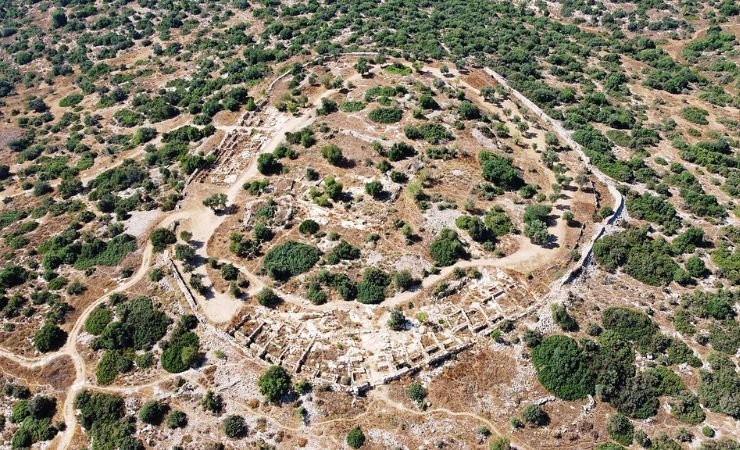
Khirbet Qeiyafa is an ancient fortified city perched above the Elah Valley in Israel, dating to the late 11th-early 10th century BCE. Archaeologists discovered massive fortifications, gates, and inscriptions that provide evidence for the early Kingdom of Judah during the biblical period of King David, making it a significant site for understanding ancient Israelite history.
Khirbet Qeiyafa, a fortified hilltop site above the Elah Valley in Israel, has emerged as one of the most significant biblical archaeology discoveries of the past two decades. Excavated primarily between 2007 and 2013 under the direction of Hebrew University professor Yosef Garfinkel, the site has shed extraordinary light on the early days of the Kingdom of Judah. Its findings have sparked considerable debate among scholars, particularly regarding its connection to the biblical King David and whether a centralized Judahite kingdom existed during the early 10th century BCE.
Location
Khirbet Qeiyafa sits on a hill overlooking the Elah Valley, approximately 30 kilometers southwest of Jerusalem. The hilltop rises about 370 meters above sea level, giving it commanding views in every direction. Whoever controlled this ridge could monitor movement through the entire valley below, including the road toward Gath, the nearest major Philistine city.
Biblical Context
Khirbet Qeiyafa is often associated with the biblical city of Sha’arayim, mentioned in the account of David and Goliath (1 Samuel 17:52). The site’s proximity to the Elah Valley, the traditional location of that battle, strengthens the association, and the discovery of two city gates at the site provides a striking physical parallel to the name Sha’arayim, which means “two gates” in Hebrew. Having two gates in a city of this size was highly unusual for the period, since most Iron Age settlements of comparable scale had only one. This architectural peculiarity suggests the city had a specific function that required two controlled entry points, possibly to manage traffic between Judahite and Philistine territories. Standing at Khirbet Qeiyafa with the Elah Valley spread out below gives the David and Goliath narrative a vivid geographical reality that no museum can replicate.
Then the men of Israel and Judah surged forward with a shout and pursued the Philistines to the entrance of Gath and to the gates of Ekron. Their dead were strewn along the Shaaraim road to Gath and Ekron.
1 Samuel 17:52
Is the Site Connected to the Kingdom of David?
Khirbet Qeiyafa presents a planned urban layout unlike any other Iron Age I site found in the region. Two city gates, monumental casemate walls built from massive limestone blocks averaging two to three tons each, and streets laid out in a consistent pattern all point to centralized planning rather than organic village growth. The discovery of a pottery shard inscribed with one of the oldest known Hebrew or proto-Canaanite texts at the site further suggests that literacy, and by implication administrative organization, existed here at a remarkably early period.
The ostracon, found in 2008 near the southwestern gate, bears five lines of text written in ink. Scholars have proposed several readings, with many linking its content to themes of justice, protection of the poor, and proper governance. These are themes consistent with what the biblical tradition attributes to early Israelite law and royal administration, as recorded in Jewish historical sources about the Davidic period.
Carbon-14 Dating
One of the most compelling pieces of evidence comes from Carbon-14 dating of olive pits found at Khirbet Qeiyafa, which places the site’s occupation between 1020 and 980 BCE. This window aligns closely with the biblical chronology of David’s reign. Crucially, the site appears to have been occupied for a single, short period, perhaps no more than a generation or two, before being abandoned. The absence of later occupation layers removes much of the interpretive ambiguity that complicates other ancient sites, making Khirbet Qeiyafa unusually clean evidence for its specific historical moment.
The Debate
The findings at Khirbet Qeiyafa have intensified the debate over the existence of a United Monarchy under King David. Archaeologist Yosef Garfinkel argues that the site’s fortifications, inscriptions, and urban planning are evidence of an early Judean state operating under royal authority. His position challenges the minimalist view, which characterizes David as a tribal chieftain rather than the ruler of a territorially organized kingdom.
Critics, including archaeologists such as Israel Finkelstein, argue that the site could have belonged to a different political entity, perhaps a North Israelite or Canaanite polity, rather than a Judahite one under David. They point to similarities with neighboring sites and argue that the evidence from Khirbet Qeiyafa alone cannot confirm the scale of kingdom described in the biblical narrative. The debate remains unresolved, and that scholarly tension is part of what makes visiting the site intellectually compelling.
Khirbet Qeiyafa is Considered to be a Jewish Settlement
Several converging lines of evidence lead most excavators to conclude that Khirbet Qeiyafa was inhabited by an early Judean, or broadly Israelite, population. No single piece of evidence is definitive on its own, but the combination is striking.
Hebrew Inscriptions: The ostracon discovered near the southwestern gate contains one of the earliest known examples of Hebrew or proto-Hebrew writing. The text is believed to reflect social and legal concerns typical of a Judean society, with themes related to justice, the treatment of servants, and the rights of widows and orphans. These themes align closely with the values expressed in early biblical legal texts.
Urban Planning Consistent with Judean Sites: The city’s layout, including houses built directly into the inner face of the casemate wall, is characteristic of early Judean urban construction. This so-called “four-room house” tradition, combined with casemate wall construction, appears at confirmed Judahite sites across the region and suggests a shared architectural culture.
Absence of Idolatrous Artifacts: Unlike contemporaneous Canaanite and Philistine sites, Khirbet Qeiyafa yielded no figurines of foreign deities, no altars dedicated to multiple gods, and no temples serving a polytheistic cult. Three small shrine models were found, but they match cultic furniture associated with Israelite religious practice rather than Canaanite or Philistine traditions.
Kosher Animal Remains: Zooarchaeological analysis of the animal bones recovered from the site found an overwhelming proportion of sheep and goat remains, with cattle represented in smaller numbers. Pig bones, which appear regularly at Philistine sites such as nearby Gath (Tell es-Safi), are essentially absent at Khirbet Qeiyafa. This pattern closely mirrors dietary restrictions observed at other Israelite settlements and distinguishes the site from its non-Israelite neighbors.
What Can Be Found at the Site
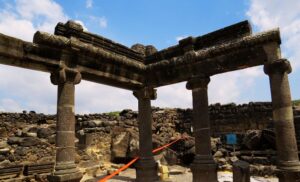
- Fortified Walls: Visitors can walk alongside the remains of the city’s casemate walls, which originally stretched for about 700 meters and enclosed the entire hilltop settlement. Many of the stone blocks remain in place, and the scale of the construction is immediately apparent on-site.
- The Two Gates: The most architecturally distinctive feature of Khirbet Qeiyafa, the two city gates are preserved well enough to walk through. The southwestern gate, near which the ostracon was found, is particularly well exposed. Signage at the site explains their significance in relation to the name Sha’arayim.
- Ostracon Replicas: The original inscribed pottery shard is housed in the Israel Antiquities Authority collection. On-site displays include replicas and explanatory panels that describe the text and its scholarly interpretations, making this find accessible to visitors without a background in epigraphy.
- Residential Structures: The excavated foundations of Iron Age houses, several built directly into the casemate wall, give a clear picture of how densely the city was inhabited. The typical layout follows the four-room house plan common across Judahite sites of this period.
- Public Spaces: A large structure near the center of the site has been interpreted by Garfinkel as either an administrative building or a palace-like residence, possibly a governor’s residence. Its size and construction quality set it apart from the domestic structures surrounding it.
Practical Information
The site is open to visitors and requires no admission fee. There are no formal facilities on-site, so bring water, sunscreen, and sturdy shoes, as the terrain is uneven and exposed. T
Additional Information
What is Khirbet Qeiyafa and why is it significant?
Khirbet Qeiyafa is a fortified Iron Age site perched above the Elah Valley in Israel, dated by Carbon-14 analysis to roughly 1020 to 980 BCE. Excavations led by Hebrew University professor Yosef Garfinkel beginning in 2007 revealed monumental casemate walls, two city gates, and one of the oldest known Hebrew inscriptions, making the site central to the ongoing scholarly debate about whether an organized Judahite kingdom existed during the time of King David.
Where exactly is Khirbet Qeiyafa located?
The site is located in the Judean foothills, approximately 30 kilometers southwest of Jerusalem and about 25 kilometers northeast of the Philistine city of Gath (modern Tell es-Safi). It sits at the edge of the Elah Valley along Route 383, near Kibbutz Netiv HaLamed-Heh.
What is the Khirbet Qeiyafa ostracon, and where can I see it?
The Khirbet Qeiyafa ostracon is a pottery shard inscribed with five lines of early Hebrew or proto-Hebrew text, discovered in 2008 near the southwestern city gate. Scholars interpret its content as relating to social justice, the welfare of the poor, and royal governance, themes consistent with early Judahite legal tradition. The original is held in the Israel Antiquities Authority collection.
Why does Khirbet Qeiyafa have two gates instead of one?
Having two city gates in a settlement of this size is exceptionally rare for the Iron Age I period in the southern Levant. Excavators suggest the dual-gate design may reflect the city’s role as a border post between Judahite and Philistine territories, requiring separate controlled entry points for different types of traffic.
How does Khirbet Qeiyafa relate to the story of David and Goliath?
The Elah Valley directly below the site is the traditional location of the battle between David and Goliath described in 1 Samuel 17. The biblical text mentions the Philistines fleeing along the road to Sha’arayim after the battle, and Khirbet Qeiyafa’s position overlooking that exact route, combined with its two gates, has led many scholars to identify it as the Sha’arayim of the biblical account.
Nearby Sites
- Tel Azekah: Located nearby, Tel Azekah offers panoramic views of the Elah Valley and holds its own historical significance as another ancient fortified city.
- Beth Shemesh: An ancient city with biblical ties, just a short drive to the north. The place is tied to the stories of Samson.
- Elah Valley: The very site of David and Goliath’s legendary battle, perfect for a scenic hike or a reflective moment.
- Tel Lachish: Another key site from the Kingdom of Judah, known for its impressive fortifications and rich history.
Keep reading
Part of our Shephelah & Central Israel Guide →