The Tomb of Benei Hezir is a Second Temple period burial site in Jerusalem's Kidron Valley, belonging to an influential priestly family. Dating to the 2nd century BCE, it features a distinctive rock-cut facade with Doric columns and a Hebrew inscription identifying the family. The tomb served multiple generations of priests who officiated in the Jerusalem Temple.
The Tomb of Benei Hezir represents one of Jerusalem’s most significant archaeological treasures from the Second Temple period. Located in the Kidron Valley, this monumental burial complex belonged to a prominent priestly family who served in the Temple and left behind the oldest known Hebrew funerary inscription in the region. Archaeological evidence places the tomb’s construction in the second century BCE, making it the earliest of the valley’s famous rock-cut tombs.
Location
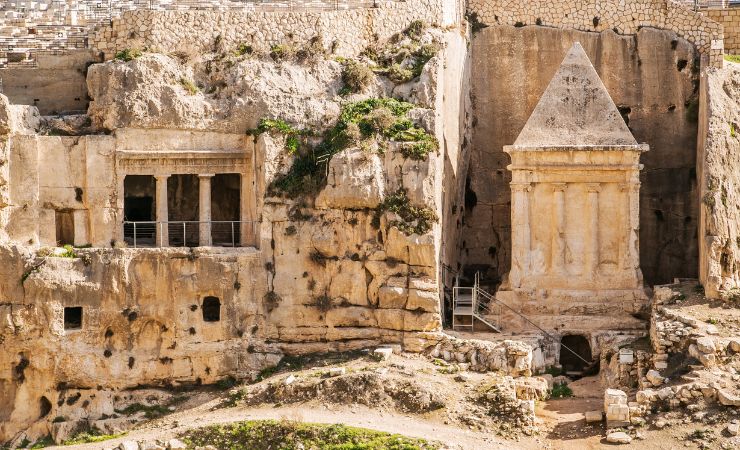
The Tomb of Benei Hezir occupies a commanding position in the Kidron Valley, directly facing the Temple Mount’s eastern wall at a distance of approximately 100 meters southeast. This strategic placement demonstrates the family’s elevated status in ancient Jerusalem society, as proximity to the Temple Mount reflected religious and social importance during the Second Temple period. The tomb sits adjacent to the distinctive pyramid-topped Tomb of Zechariah and within clear sight of the Tomb of Absalom.
Biblical Context
The name Hezir in the Bible
The name Hezir appears twice in the Hebrew Bible, establishing the family’s ancient religious credentials that span from the First Temple through the post-exilic periods. In 1 Chronicles 24:15, one Hezir founded the seventeenth priestly division during King David’s organization of Temple service: “The seventeenth to Hezir, the eighteenth to Happizzez.” This biblical reference demonstrates the family’s formal role in Temple worship dating back to approximately 1000 BCE, when David systematized the priestly rotations. Another Hezir appears among the leaders who sealed the covenant with Nehemiah in the post-exilic period, as recorded in Jewish history in Israel Nehemiah 10:20, showing the family’s continued religious leadership across centuries of Jewish history.
Who were the Benei Hezir?
The Benei Hezir family maintained their priestly status through multiple generations during the turbulent Hellenistic period, serving in the restored Second Temple while navigating the complex political landscape of Greek rule and eventual Hasmonean independence. The Hebrew inscription carved into their tomb reveals specific family members across at least two generations: Eliezer, Hanya, Yoazar, Yehuda, Shimon, Yochanan, Yosef, and Elazar, indicating their wealth and social position allowed them to commission this elaborate burial complex. Archaeological analysis suggests they were among Jerusalem’s wealthiest families, with resources sufficient to quarry and decorate their monumental tomb in the expensive Doric architectural style imported from the Hellenistic world. Their association with the Second Temple placed them at the center of Jewish religious life during the Hasmonean monarchy, when political independence and religious revival intersected in ancient Israel. The family’s ability to construct such an elaborate monument during this period reflects both their inherited priestly status and their successful adaptation to the changing political and cultural landscape of Hellenistic Judea.
Priestly Divisions in Ancient Israel
The priestly divisions, known as mishmarot in Hebrew, organized Temple service into a systematic rotation that functioned throughout the Second Temple period. These twenty-four divisions descended from Aaron’s surviving sons, Eleazar and Ithamar, after their brothers Nadab and Abihu died before having descendants. Each division traced its lineage back through carefully maintained genealogical records that validated their right to serve in the Temple, making priestly heritage one of the most closely guarded aspects of ancient Jewish identity.
Organization and Temple Service: King David established this system by appointing Zadok from Eleazar’s line and Ahimelech from Ithamar’s descendants to organize the priestly families through a carefully conducted lottery process. Sixteen divisions came from Eleazar’s more numerous descendants, while eight emerged from Ithamar’s line. Each division served for one week twice yearly, plus during the three major pilgrimage festivals when all twenty-four divisions participated simultaneously in Temple rituals. The Hezir division, as the seventeenth in order, would have served during specific weeks of the Jewish calendar year, maintaining the sacred fire, offering daily sacrifices, and conducting the intricate ceremonies prescribed in biblical law.
Duties and Responsibilities: Each priestly division managed daily sacrificial offerings including the morning and evening tamid offerings, maintained Temple rituals such as the burning of incense and the arrangement of showbread, and delivered the Priestly Blessing to assembled worshippers during festival gatherings. The divisions rotated according to a carefully maintained schedule that ensured continuous Temple service throughout the year while preventing any single priestly family from monopolizing the lucrative and prestigious Temple duties. Priests also served as teachers of biblical law, judges in ritual matters, and keepers of the Temple treasury, making their role central to both religious and civil life in ancient Israel.
Post-Temple Legacy: Following the Temple’s destruction in 70 CE, many priestly families including descendants of the Hezir division relocated to Galilee where they maintained their divisional organization for several centuries. Historical records from the Byzantine period indicate they preserved their rotational system in anticipation of the Temple’s eventual reconstruction, with synagogue inscriptions in Galilee identifying communities by their priestly divisions. This demonstrates the profound importance of these ancient arrangements in Jewish religious life and the enduring hope for Temple restoration that characterized Jewish communities throughout the diaspora period.
Architecture of the Tomb of Benei Hezir
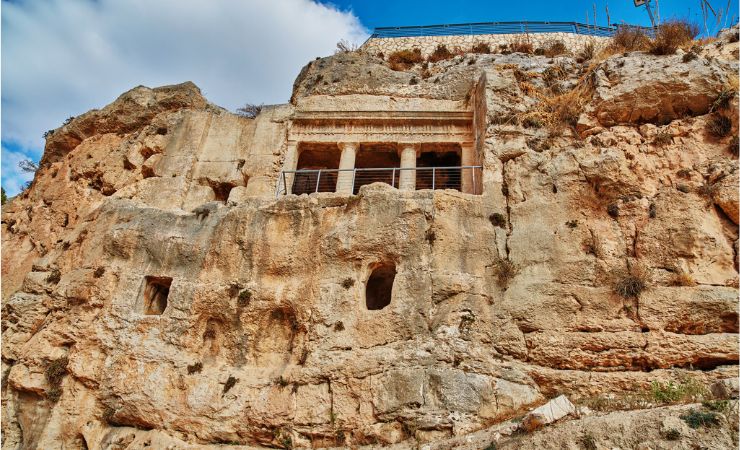
The Tomb of Benei Hezir demonstrates sophisticated Hellenistic architectural techniques adapted for Jewish burial customs, representing one of the finest examples of cultural synthesis during the Second Temple period. Carved directly from the Kidron Valley’s limestone bedrock using advanced quarrying methods, this complex tomb predates its famous neighbors and showcases the technical skill of Jerusalem’s Second Temple period stonemasons working under Hasmonean patronage.
Façade and Classical Elements: The tomb’s façade features two precisely carved Doric columns positioned between matching pilasters, each measuring approximately 3.5 meters in height and exhibiting the characteristic fluted design of classical Greek architecture. These columns support an undecorated architrave bearing the tomb’s Hebrew inscription, the earliest such funerary inscription discovered in the Jerusalem region. The architectural style reflects strong Hellenistic influence while maintaining Jewish burial traditions that prohibited figurative decoration, demonstrating the cultural synthesis characteristic of the Hasmonean period. The stonework displays exceptional craftsmanship, with perfectly aligned joints and smooth surfaces that have weathered remarkably well over more than two millennia.
Construction and Access: Original access required descending a rock-cut stairwell from the north, carved at a gentle angle to accommodate funeral processions and ceremonial visits by family members and mourners. The stairway descended approximately 4 meters below ground level, indicating the tomb’s builders planned for elaborate burial ceremonies befitting a prominent priestly family. Later modifications included a tunnel connection to the adjacent Tomb of Zechariah, which now serves as the primary entrance for modern visitors. This secondary access, carved through solid limestone, suggests ongoing use and maintenance of the burial complex across multiple generations, with the tunnel possibly dating to the Roman period when the original northern entrance may have become blocked.
The Sacred Inscription: The Hebrew inscription, carved in elegant script above the entrance, identifies specific family members across two generations: “This is the grave and the nefesh of Eliezer, Hanya, Yoazar, Yehuda, Shimon, Yochanan sons of Yosef son of Oved, Yosef and Elazar sons of Hania, kohanim of the Hezir family.” The mention of a nefesh (soul monument) suggests the adjacent Tomb of Zechariah may have served as the commemorative monument for this priestly family, a theory supported by recent archaeological research analysis of both structures’ construction periods and architectural relationship. The inscription’s paleographic style dates to the late Second Temple period, confirming the tomb’s use during the height of Hasmonean power in Jerusalem.
Interior Chamber Design: Inside the tomb, multiple burial chambers fan out from a central courtyard, with loculi (burial niches) carved into the walls to accommodate individual interments according to Jewish custom. The chambers feature vaulted ceilings and carefully smoothed walls, demonstrating the considerable investment the family made in their eternal resting place. Stone benches line some chambers, likely used for ceremonial purposes or temporary placement of bodies during the decomposition process before final bone collection.
Dating and Historical Context: Carbon dating of organic materials found in the tomb chambers and architectural analysis of the stonework techniques place the tomb’s construction in the second century BCE during the Hasmonean kingdom, specifically during the reigns of John Hyrcanus or Alexander Jannaeus. For approximately 100 years, this remained the only monumental tomb facing the Temple Mount, emphasizing the Benei Hezir family’s exceptional status in Jerusalem’s religious hierarchy during this pivotal period of Jewish independence and cultural flowering.
Practical Information
The Tomb of Benei Hezir is accessible 24 hours daily as part of the Kidron Valley archaeological area, with no admission fee required for exterior viewing and photography. The tomb complex can be reached on foot from the Old City’s Dung Gate by descending into the Kidron Valley, approximately a 10-minute walk on a paved path suitable for most visitors.
Additional Information
What makes the Tomb of Benei Hezir unique among Jerusalem’s ancient tombs?
The Tomb of Benei Hezir is the oldest monumental rock-cut tomb in the Kidron Valley, dating to the second century BCE. It contains the earliest known Hebrew funerary inscription in the Jerusalem area and remained the only elaborate tomb facing the Temple Mount for nearly a century after its construction, indicating the exceptional status of this priestly family.
Can visitors enter the Tomb of Benei Hezir?
While the tomb’s exterior façade and inscription are freely accessible for viewing in the Kidron Valley, interior access requires special permission from archaeological authorities. Most visitors appreciate the architectural details and historical significance from the exterior courtyard area, with access possible through the tunnel connecting to the Tomb of Zechariah.
Who were the specific individuals buried in the Tomb of Benei Hezir?
The tomb’s Hebrew inscription identifies multiple family members across two generations: Eliezer, Hanya, Yoazar, Yehuda, Shimon, Yochanan (sons of Yosef son of Oved), and Yosef and Elazar (sons of Hania). All are specifically identified as kohanim (priests) of the Hezir family, confirming their priestly lineage and Temple service roles.
What is the connection between this tomb and biblical history?
The Hezir family traced their lineage to the seventeenth priestly division established during King David’s reign, as recorded in 1 Chronicles 24:15. Another Hezir appears in Nehemiah 10:20 among leaders who sealed the covenant, showing the family’s continuous religious leadership across centuries of biblical history from the First Temple through the post-exilic period.
Why does the tomb feature Greek architectural elements?
The tomb’s Doric columns and classical design reflect the Hellenistic period’s cultural influence during the second century BCE when it was built. This architectural synthesis demonstrates how wealthy Jewish families adopted Greek artistic styles while maintaining their religious traditions, characteristic of the Hasmonean era’s cultural flowering.
Nearby Sites
Tomb of Absalom: An iconic ancient monument in the Kidron Valley, traditionally ascribed to Absalom, the rebellious son of King David. Its unique design combines a conical roof atop a square structure.
Tomb of the Virgin Mary: Located at the foot of Mount of Olives in the Kidron Valley, it’s a revered Christian site believed by many to be the burial place of Mary, the mother of Jesus.
Kidron Valley: A significant biblical site, this valley separates the Temple Mount from the Mount of Olives in Jerusalem. It has been a burial place since ancient times, housing numerous historic tombs.
The Church of All Nations: Also known as the Basilica of the Agony, this church, built by architect Antonio Barluzzi, is situated next to the Garden of Gethsemane. It commemorates the spot where Jesus is believed to have prayed before his arrest.
Keep reading
Part of our Jerusalem Travel Guide →