Mount Tabor is a 575-meter cone-shaped mountain in Lower Galilee traditionally identified as the site of Jesus's Transfiguration. This significant biblical landmark offers panoramic views and hosts two churches commemorating the event where Jesus appeared in radiant glory alongside Moses and Elijah before his disciples.
Mount Tabor is a 575-meter cone-shaped limestone mountain in Lower Galilee, about 17 kilometers west of the Sea of Galilee, traditionally identified as the site of Jesus’s Transfiguration. Its summit plateau holds two ancient churches, sweeping views over the Jezreel Valley, and layers of military, tribal, and prophetic history stretching back more than three thousand years.
Where is Mount Tabor?
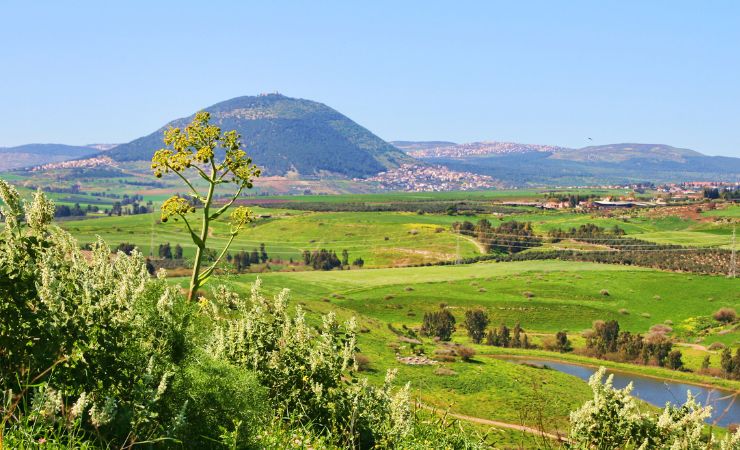
Mount Tabor sits in the northeastern part of Israel, roughly 17 kilometers west of the Sea of Galilee. The isolated hill rises approximately 575 meters above sea level from the flat floor of the Jezreel Valley, making it visible from a remarkable distance in every direction. That isolation is precisely what made it strategically valuable for armies and spiritually compelling for pilgrims across millennia.
The Meaning of Mount Tabor in Hebrew
The Hebrew name Har Tavor (הַר תָּבוֹר) is ancient and its exact etymology is debated. The name appears in the Hebrew Bible as a boundary point shared by the tribes of Issachar (Joshua 19:22), Naphtali (Joshua 19:34), and Zebulun (Joshua 19:12), suggesting it functioned as a recognized geographical landmark long before the biblical accounts were written down.
What Happened at Mount Tabor in the Bible?
Mount Tabor carries three overlapping reputations: a tribal boundary marker in the Hebrew Bible, a battlefield in the Book of Judges, and the mountain most widely identified by Christian tradition as the site of the Transfiguration of Jesus.
Mount Tabor marked a boundary between the tribes of Issachar (Joshua 19:22), Naphtali (Joshua 19:34), and Zebulun (Joshua 19:12). It is home to many stories in the bible.
Deborah, Barak, and the Battle Against Sisera
The Book of Judges, chapters 4 and 5, records one of the mountain’s most dramatic moments. The Israelites, suffering under Canaanite king Jabin and his army commander Sisera, sought guidance from the prophetess Deborah. She directed Barak to gather ten thousand men from the tribes of Naphtali and Zebulun and descend from Mount Tabor toward the River Kishon.
Deborah’s prophecy came with a condition: the honor of defeating Sisera would belong to a woman, not Barak. The battle unfolded as predicted. The Kishon River swelled, rendering Sisera’s iron chariots useless. Sisera fled on foot and was later killed by Jael, fulfilling the prophecy to the letter.
Deborah’s prophecy was clear: the battle would be won, but the honor of defeating Sisera would go to a woman. As foretold, the Israelites lured Sisera’s chariots to the River Kishon’s banks, near Mount Tabor. With divine intervention, the river’s waters swelled, rendering the chariots useless and leading to a decisive Israelite victory. Sisera fled but was later killed by Jael, fulfilling Deborah’s prophecy.
The kings came and fought; then the kings of Canaan fought at Taanach, by the waters of Megiddo; they got no spoils of silver.
Judges 5:19
Mount Tabor in the Psalms
The psalmists used Mount Tabor as a symbol of God’s creative power and majesty. In Psalm 89:12, Tabor appears alongside Mount Hermon in a song of praise:
The north and the south, you have created them; Tabor and Hermon joyously praise your name.
Psalms 89:12
The Transfiguration of Jesus
The Gospel of Matthew describes Jesus leading Peter, James, and John up a high mountain, where his face shone like the sun and his clothes became dazzling white. Moses and Elijah appeared beside him. The event signifies Jesus’s divine nature and the fulfillment of both the Law and the Prophets.
And he was transfigured before them, and his face shone like the sun, and his clothes became dazzling white.
Matthew 17:2
None of the Gospels explicitly name which mountain this was. Mount Tabor became the preferred identification because of its prominent, isolated profile in Galilee and the approximate travel time from Caesarea Philippi. The earliest explicit written link appears in the writings of Cyril of Jerusalem in 348 CE, though earlier hints exist in works possibly attributed to Origen and in the second-century Gospel of the Hebrews. Eusebius of Caesarea proposed Mount Hermon as an alternative; a smaller peak near Mount Hermon has also been suggested.
What Can Be Seen at Mount Tabor?
Church of the Transfiguration
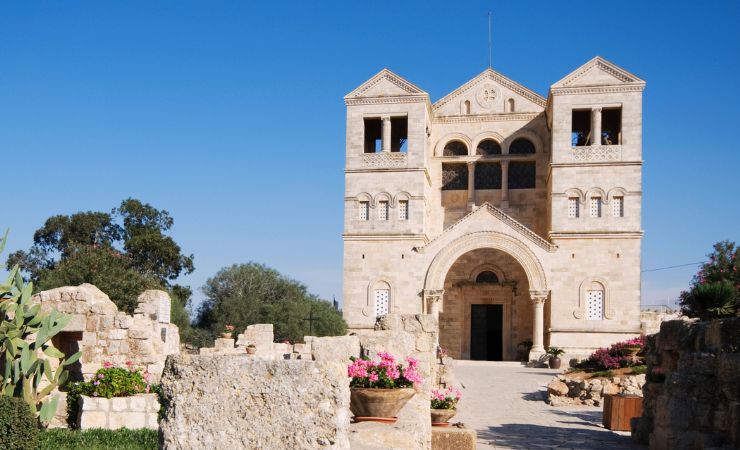
Consecrated in 1924 and designed by Italian architect Antonio Barluzzi, who described his work as “poetry through architecture,” this Syro-Roman style basilica stands on the eastern side of the summit plateau directly above the ruins of Byzantine churches from the 4th to 6th centuries and a 12th-century Crusader chapel. Barluzzi shaped the facade to suggest three tents, echoing Peter’s offer to build shelters for Jesus, Moses, and Elijah. He originally planned an alabaster roof to flood the nave with golden light, but practical considerations led to a different solution. Remnants of the earlier Byzantine and Crusader structures are preserved inside the modern building.
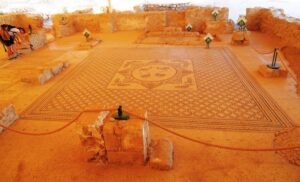
- The Two Tower Chapels — Flanking the main entrance, two front towers each contain a small chapel. The north tower (left) is dedicated to Moses; the south tower (right) is dedicated to Elijah and retains its original Byzantine mosaic floor underfoot, a detail easy to miss if you walk straight to the altar. The towers rise above the ancient oratories and are connected by a Byzantine-style arch.
- The High Altar and Transfiguration Mosaic — The main interior divides into three naves. At the upper level, the High Altar is used only on rare liturgical occasions. Above it, a large gold-ground mosaic portrays the exact moment of the Transfiguration, with Peter, James, and John watching as Jesus, Moses, and Elijah appear together. The gold background catches candlelight in a way that changes the mood of the whole space depending on the time of day.
- The Crypt and Lower Altar — A wide 14-step staircase descends from the nave into the crypt, which preserves the ancient Byzantine apse and holds a Crusader-period altar used regularly for Holy Mass. The vaulted ceiling and walls carry mosaics depicting three angels, the Lamb of God, the Eucharist, the Resurrection, and scenes from the life of Christ. The air down here is noticeably cooler and quieter than the main church above.
Greek Orthodox Monastery of the Transfiguration
On the northern side of the summit, this monastery was completed in 1862. It marks a separate but equally ancient tradition of Christian veneration on the mountain and remains an active religious community today.
Panoramic Views of the Jezreel Valley
From the summit, the Jezreel Valley spreads out in every direction below. On a clear morning you can trace the line of Mount Carmel to the southwest and pick out the hills of the Galilee to the north. The view explains immediately why every army that passed through this region wanted to hold this hill.
Archeological Findings on Mount Tabor
The summit and slopes of Mount Tabor preserve an unusually complete sequence of human occupation, with material remains from nearly every major period of the region’s history. Canaanite and Israelite layers have yielded bronze-age pottery sherds, evidence of early shrine activity, and the kinds of tactical earthworks consistent with the military landscape described in the Book of Judges.
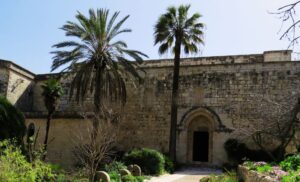
During the Hasmonean and Roman periods, the summit was developed into a serious military installation. Josephus records fortification work here, and excavations have confirmed the remains of defensive walls and structures associated with the Jewish revolts and the late Second Temple period. The Byzantine monastic remains tell a quieter story: cave systems carved into the rock, small prayer spaces, and the earliest architectural foundations beneath the present churches point to generations of Christian ascetics who settled here before larger communities were established.
How Do You Get to Mount Tabor?
Mount Tabor is accessible from Nazareth (approximately 18 kilometers to the northwest) or from Tiberias (approximately 25 kilometers to the northeast). The winding road to the summit is narrow, and private vehicles are generally required to use a shuttle taxi service from the base during peak visiting hours. The shuttle departs from the village of Shibli-Umm al-Ghanam at the mountain’s foot. Hikers can also ascend on marked trails from the base, a climb of roughly 350 meters of elevation gain.
Walking Trails and Hiking Routes
Several marked hiking routes lead up Mount Tabor from the surrounding area. The main trail from the western side follows a shaded path through oak and carob forest before opening onto the summit plateau. The ascent takes approximately 1 to 1.5 hours on foot at a moderate pace. Trail conditions are best between October and May; summer heat on the exposed upper slopes can be intense.
Opening Hours and Visitor Information
The Church of the Transfiguration is generally open to visitors daily, with a midday closure for prayer and rest. Hours can vary by season and religious observances, so confirming directly with the Franciscan monastery before your visit is advisable. There is no national park entry fee for the summit area itself, though donations are welcomed at the churches.
Additional Information
Detailed Timeline
- Time of Joshua: Mount Tabor is mentioned for the first time in the Hebrew Bible (Joshua 19:22) as a border marker for the tribes of Zebulun, Issachar, and Naphtali.
- Time of the Judges:The people of Israel do evil in the sight of the Lord after Ehud dies, and are sold into the hand of Jabin, king of Canaan, who reigns in Hazor. Sisera is the commander of Jabin’s army. The Israelites are cruelly oppressed for twenty years (Judges 4:1-3).
- Deborah, a prophetess and judge in Israel, summons Barak of the tribe of Naphtali and gives him God’s command to go to Mount Tabor with ten thousand men of Naphtali and Zebulun (Judges 4:4-6). Barak and the Israelites descend from Mount Tabor and attack and vanquish Sisera and the Canaanites at the Kishon River (Judges 4:7-16).
- Circa 30-33 CE: The Transfiguration of Jesus is believed to have occurred on a high mountain. According to the Synoptic Gospels (Matthew 17:1-9, Mark 9:2-10, Luke 9:28-36), Jesus takes Peter, James, and John up a mountain. His appearance changes, and his face shines like the sun and his clothes become dazzling white. Moses and Elijah appear and talk with him. A bright cloud overshadows them, and a voice from the cloud declares, “This is my beloved Son, with whom I am well pleased; listen to him.”
- Late 4th or 5th Century CE: Mount Tabor is first identified as the location of the Transfiguration. (Earlier traditions, such as that of the Bordeaux Pilgrim in the 4th century, identified the Mount of Olives).
- Byzantine Period: Mount Tabor becomes a center of pilgrimage due to its identification with the Transfiguration. By the late 6th century, three churches are located on the summit. By the 8th century, four churches and a monastery exist there.
- Early Crusader Period: Tancred, Prince of Galilee, establishes a Benedictine monastery on Mount Tabor and fortifies the summit.
- 1113: The fortifications on Mount Tabor prove ineffective, and the Benedictine monks are killed by Muslims.
- Shortly after 1113: The structures on Mount Tabor are rebuilt, and the Benedictine presence is renewed.
- During the 12th Century: Remains of the Byzantine church are removed, and a Romanesque Crusader church is built on the site, divided into three parts (two chapels for Moses and Elijah and a crypt symbolizing the Transfiguration).
- 1187: Saladin conquers Mount Tabor.
- 1212: The Ayyubid Sultan al-Malik al-Adil builds a fortress on Mount Tabor only to be reoccupied in 1229 by the Christians.
- 1263: The Mamluk ruler Baibars conquers Mount Tabor, destroys the structures on the summit, and confiscates it from the Christians.
- Mid-17th Century: The Franciscans are allowed to return to the site.
- 18th Century: The Franciscans build a small chapel on Mount Tabor.
- 1873: Construction of the current Franciscan monastery on Mount Tabor begins.
- 1919-1924: The current Catholic Church of the Transfiguration is designed by Antonio Barluzzi and built over the remains of the Crusader church, incorporating elements of the older structures.
- Present Day: The summit of Mount Tabor is home to the Catholic Church of the Transfiguration and a Franciscan monastery, as well as a Greek Orthodox monastery also dedicated to the Transfiguration. The area has been reforested with native tree species since the 1960s/70s as part of Jewish National Fund efforts. Mount Tabor is a popular destination for pilgrims and visitors, with specific opening hours for the churches and summit area.
Where is Mount Tabor today?
Mount Tabor is in Lower Galilee, northern Israel, about 17 kilometers west of the Sea of Galilee. It rises 575 meters from the Jezreel Valley floor and is accessible by road from Nazareth or Tiberias, with a shuttle taxi serving the final winding ascent to the summit.
Why is Mount Tabor famous?
Mount Tabor is famous as the site Christian tradition identifies with the Transfiguration of Jesus, first linked explicitly to the event by Cyril of Jerusalem in 348 CE. It is also the battlefield where Deborah and Barak defeated Sisera in the Book of Judges and a tribal boundary marker for Issachar, Naphtali, and Zebulun.
What happened at Mount Tabor in the Bible?
Two major biblical events are set here: the Israelite victory over Sisera’s Canaanite army under the prophetess Deborah (Judges 4 to 5), and the Transfiguration of Jesus, where his face shone like the sun and Moses and Elijah appeared beside him (Matthew 17:2).
What does Mount Tabor mean in Hebrew?
The Hebrew name is Har Tavor. Its exact etymology is debated, but the name appears in Joshua as a boundary point shared by three Israelite tribes, indicating it was a recognized landmark long before the events recorded in Judges or the New Testament.
How do you get to Mount Tabor from Nazareth or Tiberias?
From Nazareth (18 km) or Tiberias (25 km), drive to the village of Shibli-Umm al-Ghanam at the mountain’s base, then take a shuttle taxi up the narrow summit road. Hikers can walk marked trails from the base in roughly 1 to 1.5 hours.
What are the opening hours for the churches on Mount Tabor?
The Church of the Transfiguration opens daily with a midday closure for prayer. Hours vary by season and religious observance. Confirm current times directly with the Franciscan monastery before visiting, as schedules shift around major Christian feast days.
Nearby Sites
- Nazareth: The childhood home of Jesus, this city offers a deep dive into early Christian history with sites like the Basilica of the Annunciation, the Church Synagogue, and Mount Percipice.
- Yardenit: A serene baptismal site on the Jordan River, frequented by pilgrims wishing to retrace the steps of Jesus.
- Megiddo: An ancient city with layers of history, it’s believed to be the prophesied location of the final battle, Armageddon.
- Sea of Galilee: A tranquil freshwater lake surrounded by historical and religious sites such as Capernaum, the Church of the Multiplication, Magdala, and the Church of Beatitudes.
Keep reading
Part of our Galilee & Northern Israel Guide →