Nebi Samuel (Nabi Samwil) is a historical and religious site located a few kilometers northwest of Jerusalem. Revered by Jews, Muslims, and Christians, it is traditionally identified as the burial place of the prophet Samuel. The hilltop location offers panoramic views of Jerusalem and served as a strategic landmark throughout history.
Nebi Samuel (Nabi Samwil) is an extraordinary historical and religious site perched on a commanding hilltop just northwest of Jerusalem. Revered by Jews, Muslims, and Christians for over a millennium, this sacred mountaintop holds layers of biblical tradition, archaeological wonder, and profound spiritual significance.
Location
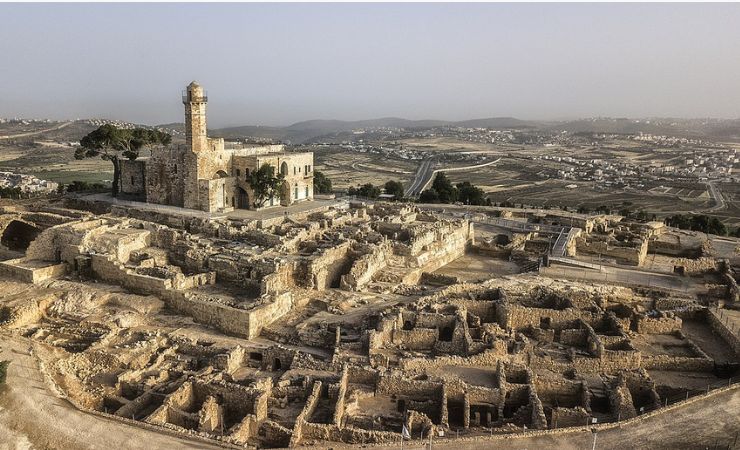
Nebi Samuel is located c. 7 km northwest of Jerusalem and is located at an elevation of 908 m, overlooks the main road from the Coastal Plain and western Samaria to Jerusalem.
This commanding position provides panoramic views stretching from the Mediterranean coast to the Jordan Valley, making it one of the most strategically important vantage points around the Holy City.
Biblical Context: Samuel’s Tomb and the Sacredness of Ramah
Samuel holds a unique position in biblical history as the last judge of Israel and the prophet who anointed both King Saul and King David. His influence shaped the transition from Israel’s tribal confederation to its united monarchy, making him one of the most pivotal figures in the Hebrew Bible. Samuel served as judge, priest, and prophet, establishing schools for prophets and overseeing the spiritual life of the nation.
According to a biblical tale, Samuel’s mother, Hannah, was bereft of children for many years, and gave birth to her only son only after she pledged to enlist him in the service of God at the Tabernacle in Shiloh.
Now Samuel died, and all Israel assembled and mourned for him, and they buried him at his home in Ramah. Then David moved down into the Desert of Paran.
1 Samuel 25:1
The identification of the site of Nebi Samwil with biblical toponyms has been a matter of dispute.
Medieval Jewish sources identified the site as Rama, the burial place of the Prophet Samuel (1 Sam. 25:1; 28:3), though the Bible tells us that the prophet Samuel was buried in Ramah, probably an Arab village 5 kilometers north of Jerusalem.
Nevertheless, a stubborn tradition dating back to the Byzantine era places his burial site at Nebi Samuel, and over the centuries this identification became deeply rooted in popular religious tradition across three faiths. The Hebrew name “Ramah” means “high place,” making the elevated site of Nebi Samuel an appealing candidate for the prophet’s hometown and final resting place.


The Site's History: Layers of Civilizations
All of the finds from both the Iron Age and Persian period were found in fills in the southern Hellenistic quarter. There are no walls or structures unequivocally attributable to these two periods, as part of the site was cleared to bedrock during the Hellenistic period and again during the Byzantine and Crusader periods.
Archaeological evidence reveals continuous occupation and religious significance spanning over two millennia.
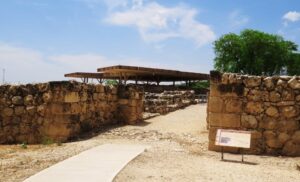
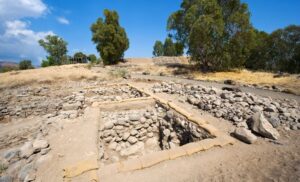
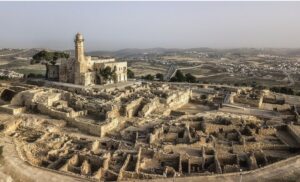
Excavations revealed two rows of buildings which are part of a street in a large residential quarter dating to Hasmonean times (2nd century BCE). The buildings have been preserved to a rare height: around 4 m, and the quarter also includes later buildings.
This Hellenistic settlement represents one of the most substantial archaeological discoveries at the site, demonstrating Nebi Samuel’s importance as a fortified position during the Hasmonean kingdom’s expansion. The exceptional preservation allows visitors to walk through actual ancient streets and enter rooms that housed Jewish families over 2,000 years ago.
Since the Byzantine period, Christian tradition has identified this site with Ramah, the place where the prophet Samuel was buried. This is a tradition accepted by Jews and Muslims alike.
The Byzantine monastery established here became a major pilgrimage destination, with Christian visitors traveling from across the Mediterranean world to honor the prophet Samuel.
The Crusader period marked the site’s most dramatic transformation.
Jerusalem and numerous Crusader fortresses are visible from Nebi Samwil, which, as mentioned, controlled the main road from the Coastal Plain and Samaria to Jerusalem. The Crusader fortress built at the site is divided into several parts.
Surrounding the church is a sturdy fortress surrounded by a moat. To the north are cisterns, stables, a tower, a pilgrims’ hostel, and large open spaces to accommodate pilgrims arriving to Jerusalem.
In 1730, the Jerusalem Mufti Sheikh Muhammad al-Khalili appropriated the tomb from the Jews and forbade them from praying there. He built a mosque at the site.
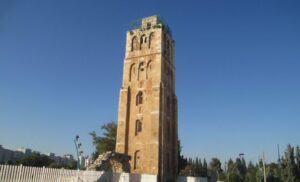
This Ottoman-era mosque, constructed using stones from the Crusader fortress, remains active today and represents the site’s final major architectural phase.
Nebi Samuel operates as a national park under Israeli administration, recognizing its archaeological significance and shared religious importance. The site demonstrates the rare phenomenon of a single location maintaining continuous sacred status across Judaism, Christianity, and Islam for over 1,500 years.
The Crusaders and the Story of Mons Gaudii
The most famous moment in Nebi Samuel’s history occurred on dawn broke on June 7, 1099, 40,000 weary men climbed a mountain and gazed wearily towards the southeast. What they saw in the distance brought them rapidly to their knees. Tears streaming down their faces, they thanked God for listening to their prayers and allowing them to gaze upon their hearts’ desire: Jerusalem.
After nearly three years of arduous campaigning across Europe and the Middle East, the First Crusade had finally reached its goal. So uplifted were the Crusaders on that occasion, that they renamed the hill Montjoie (mount of joy) and members of the newly founded monastic Premonstratensian order built a monastery on its peak.
The French name “Montjoie” translates as
“mount of joy”, capturing the overwhelming emotion these medieval warriors felt when Jerusalem first came into view. This moment became legendary in Crusader chronicles and poetry, cementing Nebi Samuel’s place in European medieval literature.
Central to the monastery was a church, built in 1157 and called St. Samuel. Numerous pilgrims stopped at the monastery on a route that led from Jaffa to Emmaus, Samuel’s Tomb and the Holy City. The fortress complex included an enormous stable complete with troughs, feed bins, and three square-topped stones from which riders mounted their horses.
The unfinished moat probably means that the monks were preparing for invasion when Muslim ruler Saladin was on the warpath in 1187. Obviously, his troops captured the monastery before the moat was completed.
Although Muslim conquerors eventually leveled the monastery, they turned the church into a mosque.
What can be Found at Sebi Samuel?
Nebi Samuel presents a unique architectural complex where Jewish, Muslim, and Christian sacred spaces coexist within the same structure:
The Ottoman Mosque:
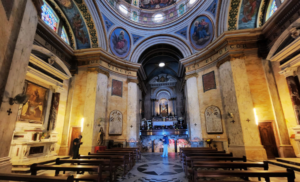
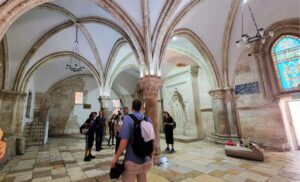
The central building is part of the church of the fortress built by the Crusaders in the 12th century. In the church hall, the domes and the massive walls typical of the Romanesque building style used by the Crusaders still stand. Incorporated in the church building is a mosque from the Mameluke period (14th century).
The Muslim prayer site is in a hall behind the vestibule.
The mosque’s minaret offers spectacular 360-degree views encompassing Jerusalem, the Mediterranean coast, and the Jordan Valley.
Samuel’s Tomb and Jewish Prayer Area:
Its tomb/crypt is a vaulted structure measuring 11.5 by 5 m, with two niches next to its western side. At the western end of the vault is the traditional tomb of the Prophet Samuel.
The Jewish prayer site is in the cave containing the monument marking the grave of the prophet Samuel.
Jewish visitors particularly gather here during the commemoration of Samuel’s death on the 28th of Iyar, which remarkably coincides with Jerusalem Day celebrations.
Crusader Fortress Remains:
The Crusader church at the center of the site, its highest point, is the most prominent structure of Nebi Samwil. It measures 39 by 29 m and was built upon high man-made terraces. Visitors can explore the fortress walls, defensive positions, and archaeological remains that demonstrate medieval military architecture.
Hasmonean Residential Quarter: The exceptionally preserved Hellenistic-era buildings allow visitors to walk through authentic 2,000-year-old streets and rooms. The preserved walls reach approximately 4 meters in height, offering a rare glimpse into ancient Jewish domestic life during the Hasmonean period.
What can be Found at Sebi Samuel?
Hours: The site is open year-round from 8 A.M. to 4 P.M. Summer hours extend until 5 P.M.
Admission: This is a free entry National Park.
Dress Code: Modest dress required for entry to religious areas. Shoulders and knees must be covered when visiting the mosque and tomb areas.
Accessibility: The main mosque and upper areas are accessible, but the underground tomb requires navigating stairs. The site involves significant walking on uneven terrain.
Facilities: There are restrooms on the site.
Additional Information
Is Nebi Samuel the actual burial place of the prophet Samuel?
While the Bible states that Samuel was buried in Ramah, the exact location remains uncertain among scholars. The identification of Nebi Samuel with Samuel’s tomb developed during the Byzantine period and became accepted by Jewish, Christian, and Muslim traditions. Whether historically accurate or not, the site has maintained profound religious significance for over 1,500 years across all three Abrahamic faiths.
Can visitors of all religions enter Nebi Samuel?
Yes, Nebi Samuel welcomes visitors of all faiths and backgrounds. The site uniquely houses both a mosque and Jewish prayer areas within the same structure, demonstrating remarkable interfaith coexistence. However, modest dress is required when entering religious areas, and visitors should be respectful of worshippers who may be praying at the site.
What makes Nebi Samuel historically significant beyond Samuel’s tomb?
Nebi Samuel served as the vantage point where Crusaders first glimpsed Jerusalem in 1099, earning the name “Mons Gaudii” (Mountain of Joy). The site contains exceptional archaeological remains from the Hasmonean period, including well-preserved 2,000-year-old residential quarters. Its strategic location made it a crucial fortress controlling the main approach to Jerusalem throughout history.
What should I know about the Hasmonean ruins at Nebi Samuel?
The Hasmonean-era residential quarter represents one of Israel’s best-preserved ancient Jewish settlements from the 2nd century BCE. Visitors can walk through actual ancient streets and enter rooms where Jewish families lived over 2,000 years ago. The buildings are preserved to an exceptional height of 4 meters, providing rare insights into daily life during the Hasmonean kingdom.
Sources and Additional Information
Nearby Sites
Ammunition Hill: A national memorial site dedicated to one of the fiercest battles during the Six-Day War. Located in Jerusalem, it offers visitors a chance to walk through bunkers and see exhibits about the battle.
Ein Kerem: This beautiful village, southwest of Jerusalem, is traditionally known as the birthplace of John the Baptist. It boasts several historic churches and monasteries, including the Church of St. John the Baptist and the Church of the Visitation.
Rockefeller Museum: Situated in East Jerusalem, this museum is an architectural gem housing a vast collection of artifacts from archaeological digs across Israel.
Keep reading
Part of our Jewish Heritage Guide →