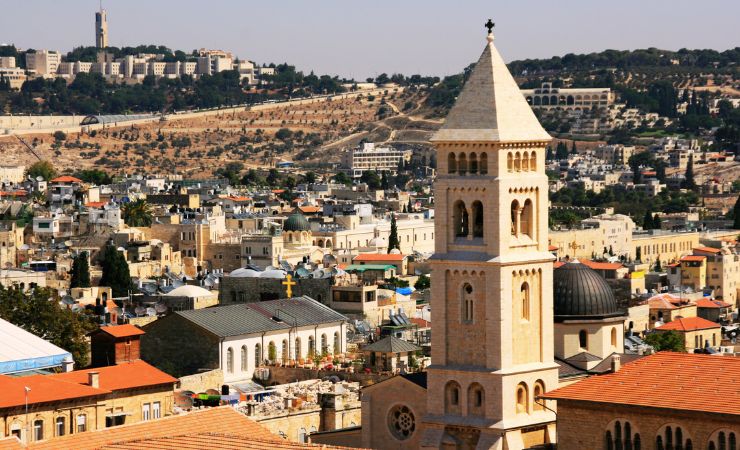
The Church of the Redeemer is a Protestant church in Jerusalem's Old City that was inaugurated in 1898. Located near the Church of the Holy Sepulchre, it features a distinctive bell tower offering panoramic views of Jerusalem and stands on the site of an 11th-century Crusader church.
The Church of the Redeemer Jerusalem stands prominently in the Christian Quarter of Jerusalem’s Old City, serving the German Lutheran congregation since 1898. This Protestant church connects modern pilgrims to centuries of Christian history, built directly above the ruins of the medieval Crusader church of Santa Maria Latina and preserving archaeological findings that span from ancient Jewish quarries to Byzantine mosaics.
Location
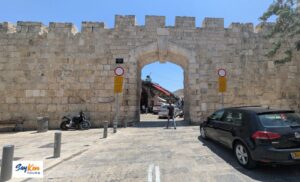
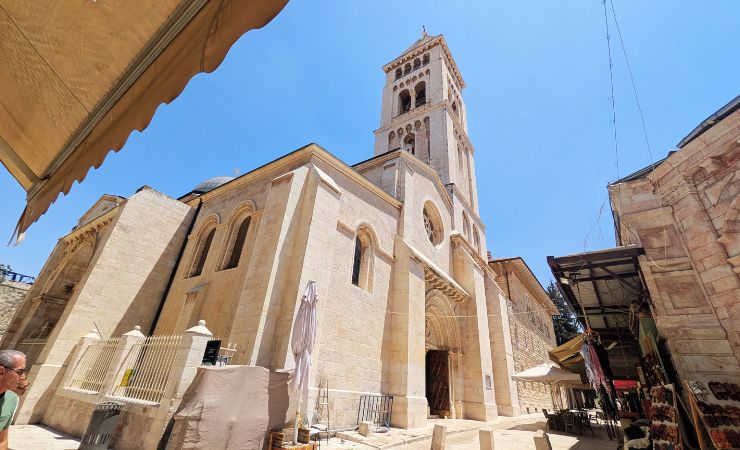
The Church of the Redeemer Jerusalem occupies a central position in the Christian Quarter’s Muristan area, approximately 100 meters northwest of the Church of the Holy Sepulchre. The church sits on Muristan Street, accessible through the Jaffa Gate or Damascus Gate entrances to the Old City.
The Church of the Redeemer: Historical Context
Built on the remains of the Santa Maria Latina Church
The Ottoman Empire’s 19th-century Tanzimat reforms opened Jerusalem to increased European religious and cultural presence. Kaiser Wilhelm I of Prussia received the eastern portion of the Muristan as a gift from Sultan Abdülaziz in 1869, creating the opportunity for German Protestant establishment in the Holy Land.
German architect Friedrich Adler initially planned to reconstruct the medieval Santa Maria Latina, but archaeological investigations led by Conrad Schick revealed that building a new structure would be more practical while preserving the discovered remains below. Paul Ferdinand Groth designed the final Neo-Romanesque structure, which began construction in 1893.
The church was consecrated on Reformation Day, October 31, 1898, with Kaiser Wilhelm II and Kaiserin Augusta Victoria presiding over the ceremony. For this occasion, the Ottoman authorities specially widened the Jaffa Gate to accommodate the imperial procession’s carriages, permanently altering this ancient entrance to Jerusalem’s Old City.
The Architecture of the Church of the Redeemer in Jerusalem: Blending History and Modernity
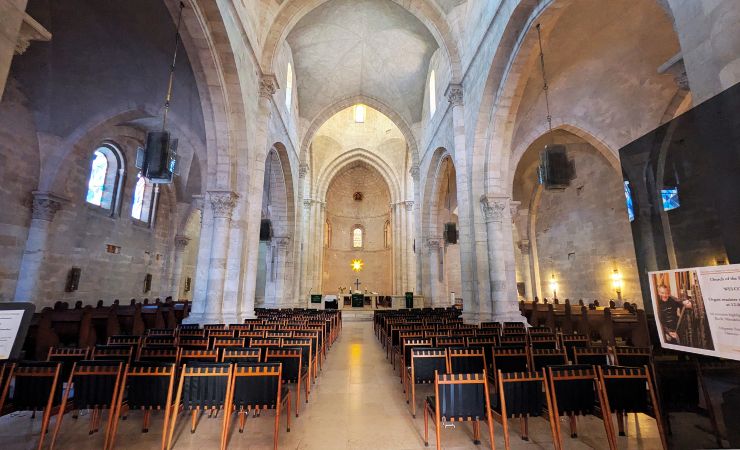
The Church of the Redeemer Jerusalem exemplifies 19th-century Neo-Romanesque architecture while incorporating elements from the medieval Crusader structure beneath it. The building harmoniously combines German Protestant architectural traditions with the ancient Jerusalem landscape.
Exterior Architecture
The Church of the Redeemer Jerusalem displays classic Romanesque Revival characteristics in its cruciform layout and Jerusalem limestone facade. The structure measures approximately 40 meters in length, designed to accommodate the growing German Protestant community while respecting the architectural scale of the surrounding Old City.
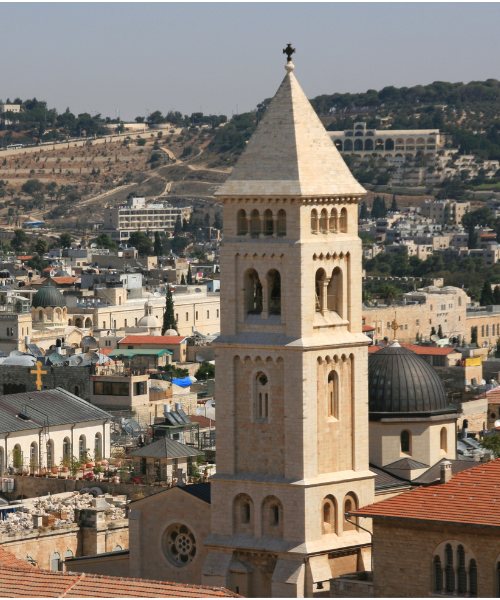
The 48-meter bell tower dominates the structure, providing panoramic views across Jerusalem to the Mount of Olives, Temple Mount, and modern western neighborhoods. The tower incorporates medieval building techniques with 19th-century engineering, creating structural stability while maintaining visual continuity with historic Jerusalem architecture.
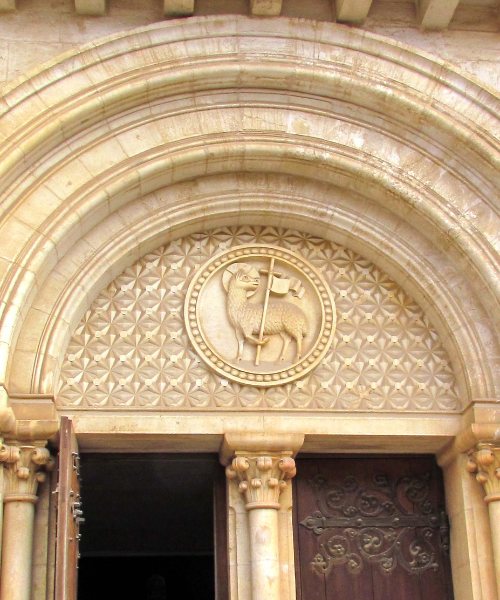
Three carved symbols adorn the western entrance: the Lamb of God representing Christian sacrifice, the Prussian eagle symbolizing German imperial patronage, and the Maltese cross honoring the site’s connection to the Knights Hospitallers. These elements reflect the church’s unique position as both a spiritual sanctuary and diplomatic statement during the era of European competition for influence in the Holy Land.
Interior Design
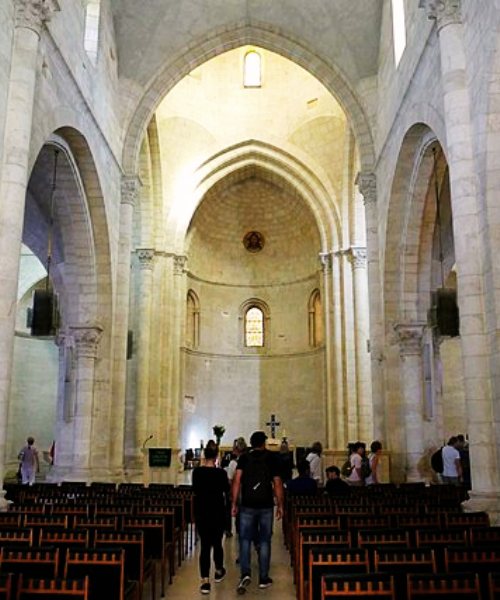
The church interior underwent significant transformation during 1970s renovations supervised by architect Ernst W. Krueger. These modifications stripped away most original decorative elements, exposing the stone walls and creating a minimalist worship space aligned with contemporary Lutheran aesthetics.
The nave extends 30 meters from the western entrance to the semicircular apse, flanked by side aisles that create an intimate worship environment. Original features include a Christ mosaic in the apse and medieval calendar fragments preserved from the Crusader church, providing tangible connections to centuries of Christian worship on this site.
Anna Andersch-Marcus designed the current stained glass windows using fused glass techniques, incorporating themes from Psalm 130:1-2. These windows filter Jerusalem’s intense sunlight into soft illumination that supports contemplation and prayer. The organ, installed during the 1970s renovation, occupies a loft above the main entrance and serves both German and Arabic-language the Holy Land services.
Archaeological Integration: “Durch die Zeiten” (Through the Centuries)
Archaeological excavations conducted beneath the church revealed 14 meters of stratified history, from bedrock to the present structure. The “Through the Centuries” archaeological park, accessible via stairs from the nave, displays these discoveries in their original context.
Visitors can observe a Herodian-period quarry that provided stones for Second Temple construction, Roman-era buildings from Emperor Hadrian’s rebuilding of Jerusalem as Aelia Capitolina, and spectacular mosaic floors from the original Santa Maria Latina church. These remains demonstrate the continuous sacred use of this location across nearly two millennia.
Integrating Medieval Elements
The Church of the Redeemer Jerusalem preserves and displays significant architectural elements from its Crusader predecessor. A complete Romanesque arch from Santa Maria Latina, featuring carved agricultural calendar months including legible November and December inscriptions, remains visible near the north entrance.
Architect Friedrich Adler deliberately incorporated the medieval church’s footprint and surviving structural elements into the 19th-century design, creating architectural continuity across seven centuries. The modern church floor sits approximately two meters above the medieval level, allowing preservation of the earlier structure while providing contemporary worship space above.
Practical Information
The Church of the Redeemer Jerusalem welcomes visitors Monday through Saturday from 10:00 AM to 5:00 PM, closed on Sundays during morning worship services until 12:00 PM. Entry to the main church sanctuary is free, encouraging exploration of the architectural details and historical displays.
Tower climbing access requires a fee of 15 NIS (approximately $4.50 USD) for adults and 10 NIS ($3.00 USD) for students and seniors. The narrow spiral staircase consists of 178 steps, recommended for visitors with moderate physical fitness.
Parking availability in the Old City is extremely limited. Visitors should use public transportation or park outside the city walls near Jaffa Gate. The nearest accessible parking is at the Mamilla Mall, about 10 minutes on foot through Jaffa Gate.
Modest dress is required: covered shoulders and knees for all visitors.
Additional Information
Circa 1100 BCE: Area where the Church of the Redeemer now stands is outside the city walls, the traditional site of Golgotha (the crucifixion and burial site of Jesus).
2nd Century AD: The Roman Forum is constructed in the area by the Roman Emperor Hadrian. This becomes the religious and political center of the Roman city of Aelia Capitolina (Jerusalem).
Circa 1070 CE: The Church of the St. Mary of the Latins is first built.
1099: Italian church and hospice in the area function as a hostel and hospital for wounded Crusaders during the conquest of Jerusalem. Monks from the Benedictine order tend to the sick and wounded.
12th Century: The Benedictine group evolves into the Knights Hospitallers of St. John (the Hospitallers), officially established in 1113. They purchase and renovate the nearby Church and monastery of St. John the Baptist. Their headquarters in the Holy Land, including living quarters and hospital structures, are located around the area known as “Muristan” (based on the Persian word for hospital). The Hospitallers become an important military order.
Circa 1150 CE: The Church of the St. Mary of the Latins is rebuilt by the Crusaders, becoming the monastic church of the Hospitallers.
1187 CE: Jerusalem falls to Saladin. The Hospitaller’s headquarters in the Holy Land cease to function.
1267: The “Hospitallers quarter” (the Muristan area) is ruined after the Mamlukes conquest.
1839: The monastery of St. John the Baptist is renovated by the Greek Orthodox church.
Mid-19th Century: Liberal reforms begin in the Ottoman Empire. Missionary societies settle in Jerusalem. Protestant movements show renewed interest in the Holy Land.
1852: A pastor begins serving the German-speaking Protestant congregation in Jerusalem.
1857: Prussian King Friedrich Wilhelm IV, who had revived the Protestant branch of the Knights of St. John, expresses interest in acquiring the Muristan, the founding place of the Order of St. John.
1865: A photograph shows some walls and apses of the medieval Saint Mary of the Latins church still standing.
1869: Crown Prince Friedrich Wilhelm Nikolaus of Prussia (later King Friedrich III) oversees activity in Jerusalem. Sultan Abdülaziz of the Ottoman Empire gifts the eastern part of the Muristan to the friendly Crown Prince Friedrich Wilhelm. King Wilhelm I of Prussia (later Kaiser Wilhelm I) receives this land from Sultan Abdülhamid on the occasion of the inauguration of the Suez Canal. Friedrich commissions architect Friedrich Adler to plan the reconstruction of the Church of S. Maria Latina as the church of the newly founded Order of St. John. Crown Prince Friedrich Wilhelm visits Jerusalem and the eastern area of the Muristan is given to him as a present.
1871: The first chapel (St. John) is erected at the site. The German-speaking Protestant congregation begins convening in the Muristan Chapel. Carl Hoffmann is ranked provost.
1892-1898: The German Protestant Church of the Redeemer is constructed on the gifted land in the Muristan, designed by Paul Ferdinand Groth following designs by Friedrich Adler. Initially, the decision was made to reconstruct the Crusader-period Church of St. Maria Latina, but excavations led by Conrad Schick and others determined a new building was more feasible.
1893: The cornerstone for the new Church of the Redeemer is laid on behalf of the German Kaiser. Conrad Schick finds a wall under the name of St. Maria Latina that he interprets as the city wall from the time of Herod the Great, and the foundation stone is set on this. Construction of the Church of the Redeemer begins.
Reformation Day, October 31, 1898: Kaiser Wilhelm II personally dedicates the new Church of the Redeemer in the presence of the imperial family. The Kaiser and his wife enter the Old City through specially made ceremonial arches, including one from the Ottoman Empire, and via the newly renovated Jaffa Gate. Paul Hoppe is ranked provost since this year.
Ongoing: The Church of the Redeemer houses Lutheran congregations worshipping in Arabic, German, Danish, and English. It serves as the seat of the Provost of the German Protestant Ministries in the Holy Land and the headquarters of the Bishop of the Evangelical Lutheran Church in Jordan and the Holy Land.
What denomination is the Church of the Redeemer Jerusalem?
The Church of the Redeemer Jerusalem belongs to the Evangelical Lutheran Church in Jordan and the Holy Land. It serves German-speaking, Arabic-speaking, Danish, and English-speaking Lutheran congregations, and functions as the seat of the Bishop of the regional Lutheran church as well as the Provost of German Protestant Ministries in the Holy Land.
What archaeological discoveries exist beneath the Church of the Redeemer?
Excavations beneath the church revealed 14 meters of stratified history, including a Herodian-period stone quarry, Roman-era buildings from Emperor Hadrian’s reconstruction of Jerusalem as Aelia Capitolina, and spectacular mosaic floors from the original Crusader Church of Santa Maria Latina. These remains are displayed in the “Through the Centuries” archaeological park accessible from the main church.
What is the connection between the Church of the Redeemer and Kaiser Wilhelm II?
Kaiser Wilhelm II personally consecrated the Church of the Redeemer Jerusalem on Reformation Day, October 31, 1898. The Ottoman authorities specially widened Jaffa Gate for the Kaiser’s ceremonial procession into the Old City. The church was built on land gifted to Prussia by the Ottoman Sultan, and its construction represented German Protestant presence in the Holy Land during the era of European imperial competition.
Nearby Sites
- Church of the Holy Sepulchre: The possible site of Jesus’s crucifixion and resurrection, it’s a focal point of Christian faith worldwide.
- The Alexander Nevsky Church: A captivating Russian Orthodox Church, recognized for its distinctive green domes and richly decorated interior.
- Via Dolorosa: It’s believed to be the path that Jesus walked, carrying His cross, on the way to His crucifixion. The Via Dolorosa starts at the Lion’s Gate and passes a few sites of interest including the St. Annes Church, The Pool of Bethesda, the Church of Condemnation, the Ecce Homo Arch and more.
- Western Wall: The remnants of the Jewish Second Temple, the Western Wall is a symbol of perseverance and a sacred place of prayer.
Keep reading
Part of our Christian Pilgrimage Guide →