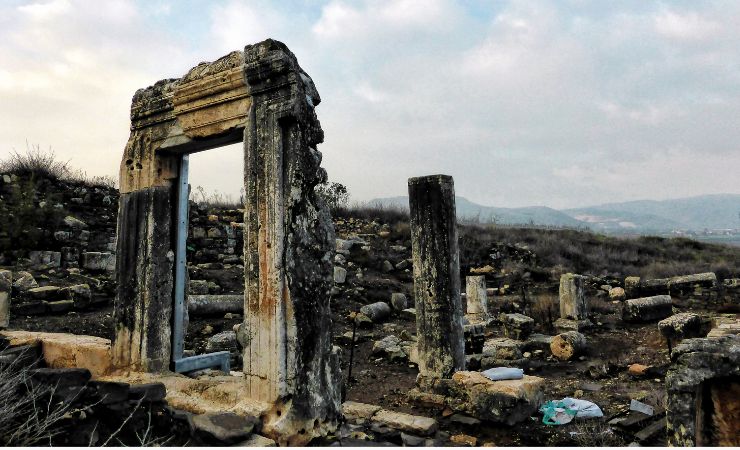
The Arbel Ancient Synagogue sits below the dramatic Arbel cliffs near the Sea of Galilee, dating to the 2nd-4th centuries CE. The site features remarkably preserved ruins including a standing facade with decorative stone carvings, columns, and architectural elements typical of early Galilean synagogues. Visitors can explore the structure while enjoying spectacular views of the surrounding landscape.
The discovery of ancient synagogues in the Galilee region of Israel has provided invaluable insights into Jewish life during the Roman and Byzantine periods. Among these significant finds, the Arbel ancient synagogue presents one of the most architecturally impressive sites in the Lower Galilee, with its substantial limestone facade still rising from the volcanic basalt landscape below Mount Arbel’s dramatic cliffs.
Location
The Arbel ancient synagogue sits at the base of Mount Arbel in the Lower Galilee, approximately 6 kilometers northwest of Tiberias. The synagogue ruins occupy part of the site known as Irbid Ruins (Khirbet Irbid), located on the northern edge of Moshav Arbel. The dramatic limestone cliffs of Mount Arbel rise 181 meters above the Sea of Galilee, providing one of Israel’s most spectacular panoramic views across the ancient Via Maris trade route that once passed through the valley below.
Biblical context
While the Arbel ancient synagogue itself dates to the 4th-8th centuries CE, the area carries deep biblical significance. Most scholars identify this location with the Beth-Arbel mentioned in the Book of Hosea, where the prophet references a devastating battle. The name “Arbel” appears to derive from the Hebrew phrase “Har-Bel” or “Arba-El,” meaning “Mountain of God” or “Four of God,” reflecting the site’s commanding position overlooking the Jewish history in Israel ancient crossroads of the Galilee.
Therefore tumult shall arise among your people, and all your fortresses shall be plundered, as Shalman plundered Beth-Arbel in the day of battle; a mother dashed in pieces upon her children.
Hosea 10:14



History of the Site
Archaeological evidence reveals that the Arbel region supported continuous Jewish settlement from the Hasmonean period through the early Islamic era. During the first century BCE, Arbel became a stronghold for Galilean rebels opposing Herod the Great’s rule. The Roman historian Josephus Flavius documented the dramatic 38 BCE siege, when Herod’s forces used iron boxes with hooks to drag rebels from the mountain’s caves. Many defenders chose to leap to their deaths rather than surrender.
Following the destruction of the Second Temple in 70 CE, a family of priests from the order of Yeshua, the ninth priestly division, settled in Arbel and became known as the “Kohanei Arbel” (Priests of Arbel). This priestly presence contributed to the town’s religious significance throughout the Roman and Byzantine periods.
The Arbel ancient synagogue construction began in the 4th century CE, built in two distinct phases that reflect changing liturgical practices. Initially, the entrance faced east toward Jerusalem, following Second Temple period tradition. In the later Byzantine phase around 300 CE, architects redesigned the building with the entrance on the northern wall and added a semicircular niche for the Torah ark in the southern wall. This configuration aligned with evolving synagogue architecture where worshippers faced Jerusalem throughout the service. Excavations under the main column in 2021 revealed approximately 140 Roman and Byzantine coins spanning the synagogue’s active period from the 4th to 8th centuries CE.
During its peak, Arbel gained renown for producing exceptionally strong flax textiles that contrasted with Bet Shean’s more delicate fabrics, and the Jerusalem Talmud praised the town’s high-quality wheat. The settlement remained active until around 800 CE, when changing political and economic conditions led to its gradual abandonment.
Archaeological Findings
Professional excavations dating back to the beginning of the 20th century have revealed the Arbel ancient synagogue as a masterpiece of Galilean synagogue architecture. The basilica-style structure features a rectangular north-south hall with a large eastern courtyard. German archaeologists Heinrich Kohl and Carl Watzinger first mapped the building’s ground plan and identified its distinctive two-phase construction.
Recent excavations have uncovered the synagogue’s sophisticated architectural details. Three rows of columns once divided the interior into a central nave and side aisles, creating an impressive worship space for the ancient community. Two distinctive heart-shaped columns marked where the column rows intersected, a unique design element found at few other ancient synagogue sites. The building rose two stories high, with Corinthian capitals crowning the ground-floor columns and Ionic capitals adorning the second-floor gallery.
Modern visitors can examine several well-preserved architectural features:
Main Facade: The imposing eastern wall, built from massive limestone blocks that contrast dramatically with the surrounding basalt landscape. This facade originally housed the main entrance, consisting of a single monolithic stone doorway.
Column System: Several columns remain standing, including a monolithic column reinstalled in 2021 after conservation work. Corinthian and Ionic capitals scattered throughout the site demonstrate the builders’ sophisticated architectural knowledge.
Torah Ark Niche: The semicircular niche in the southern wall, elevated by a stone platform (bema), represents the later Byzantine phase when the prayer orientation was formalized toward Jerusalem.
Seating Arrangements: Stone benches line three walls where congregants sat during services. The arrangement includes a wide platform along the east and west walls, with additional stepped benches in the aisles creating amphitheater-style seating.
Gallery Level: Evidence of a second-story women’s gallery includes Ionic half-columns attached to the interior walls and a probable Doric frieze that once crowned the upper level.
Archaeological Findings
Hours: The Arbel ancient synagogue site is accessible 24 hours daily as an open archaeological park. Best visited during daylight hours for optimal photography and safety.
Admission: Free access. No entrance fee required.
Parking: Limited roadside parking available near the site. Additional parking at nearby Mount Arbel National Park (500 meters away) with walking trail connection.
Accessibility: A wooden accessibility deck installed in 2021 provides wheelchair access into the synagogue ruins. The deck leads directly to the main architectural features, though the surrounding terrain remains uneven.
Facilities: No on-site facilities. Restrooms and refreshments available at Mount Arbel National Park visitor center.
Additional Information
- 1st Century BCE (Around 40 BCE): Herod is appointed by the Romans to rule over Judea. The inhabitants of the Galilee, including those of Arbel, oppose his rule and revolt, inflicting heavy losses on his army.
- 38 BCE: Herod returns to fight the rebels who have taken refuge in the caves of Arbel. He uses specialized boxes with hooks to drag them out and throws them into the ravine. Some choose suicide over surrender.
- 1st Century CE (Around 68 CE): During the Great Revolt against the Romans, Josephus Flavius, the commander of the Galilee, fortifies Arbel due to its strategic location at a crossroads.
- Post-Second Temple Destruction (70 CE onwards): A family of priests from the order of Yeshua (the ninth priestly division that served in the Temple) settles in Arbel. They become known as the “Kohanei Arbel” (Priests of Arbel).
- Roman and Byzantine Periods (roughly 2nd-6th Centuries CE): Arbel flourishes as a Jewish settlement.
- Archaeological evidence suggests the main synagogue at Arbel was constructed sometime between the 2nd and 4th centuries CE, with potential later Byzantine period modifications. Some scholars argue for a primarily Byzantine construction date (5th-6th centuries).
- Arbel becomes known for its production of strong flax textiles, in contrast to Bet She’an’s delicate flax production.
- The town’s high-quality wheat is also praised in the Jerusalem Talmud.
- The Jerusalem Talmud records a story involving Rabbi Hiyya Rabba and Rabbi Shimon ben Halafta walking in the Arbel Valley at dawn, using the breaking light as a metaphor for the gradual redemption of Israel.
- A 4th-century CE inscription in the Hamat Gader synagogue mentions contributions from the people of Arbel, indicating their connection to other Jewish communities.
- Archaeological excavations in 2000 reveal structures and two ritual baths (mikva’ot) from the Roman and Byzantine periods west of the main synagogue.
- In 2007, another synagogue is discovered about a kilometer north at Khirbet Wadi Hamam.
- Medieval Period:Medieval travelers, both Jewish and Muslim, identify Irbid Ruins (on the northern outskirts of modern Moshav Arbel) as the location of ancient Arbel.
- 19th Century (1875): The Survey of Western Palestine expedition of the Palestine Exploration Fund, including Claude Conder, surveys the site of Arbel. Conder identifies it as an important archaeological site and sketches the plan of the synagogue.
- Early 20th Century (1905): A German expedition led by Heinrich Kohl and Carl Watzinger further investigates the synagogue, dating it based on decorations to the 2nd-3rd centuries CE and producing a plan of the structure.
- 1960s: Nahman Avigad examines the niche in the synagogue and dates it to a later Byzantine period as a Torah Ark niche.
- 2000: Arbel is added to UNESCO’s Tentative List for World Heritage Travellers. Excavations west of the synagogue uncover more structures and mikva’ot.
- 2021: A 5-ton monolithic column from the 3rd-4th century CE synagogue is reinstalled after conservation work. Excavations under its base reveal about 140 Roman and Byzantine coins, indicating two construction phases. A new accessible wooden deck leading into the synagogue is also constructed, funded in part by the family of Max Steinberg, a lone soldier killed in action.
How old is the Arbel ancient synagogue?
The Arbel ancient synagogue dates from the 4th century CE, with construction occurring in two distinct phases through the 8th century CE. Archaeological evidence from coins found beneath the main column confirms the building remained in active use for approximately 400 years during the Byzantine period.
Can you visit the Arbel ancient synagogue ruins?
Yes, the Arbel ancient synagogue is freely accessible 24 hours daily as an open archaeological site. A wooden accessibility deck installed in 2021 provides wheelchair access to the main ruins, and the site features information panels for self-guided exploration.
What makes the Arbel synagogue architecturally significant?
The Arbel ancient synagogue showcases sophisticated Galilean synagogue architecture with its basilica design, two-story construction, and distinctive heart-shaped columns. The 20 by 18.5-meter limestone structure demonstrates advanced engineering with Corinthian capitals below and Ionic capitals in the upper gallery, representing one of the best-preserved examples of its period.
Why was the Arbel synagogue entrance changed?
Archaeological evidence reveals two construction phases at the Arbel ancient synagogue reflecting evolving liturgical practices. Initially, the entrance faced east toward Jerusalem following Second Temple tradition, but later Byzantine renovations moved the entrance to the north wall and added a Torah ark niche in the south wall, ensuring worshippers faced Jerusalem throughout services.
Nearby Sites
- Mount Arbel National Park: A dramatic cliffside hikes and be rewarded with sweeping views across the Sea of Galilee.
- Magdala: An ancient first-century synagogue and a beautiful Duc in Altum prayer center.
- Horns of Hattin: A historic hilltop famous for the 1187 battle between Crusaders and Saladin.
Capernaum (Kfar Nachum):
An ancient fishing village where Jesus taught in the synagogue.Capernaum (Kfar Nachum):
An ancient fishing village where Jesus taught in the synagogue; the ruins include a 4th-century synagogue built on top of a 1st-century one.
Keep reading
Part of our Jewish Heritage Guide →