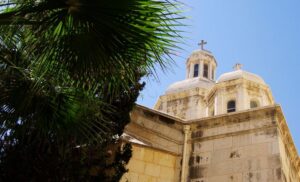
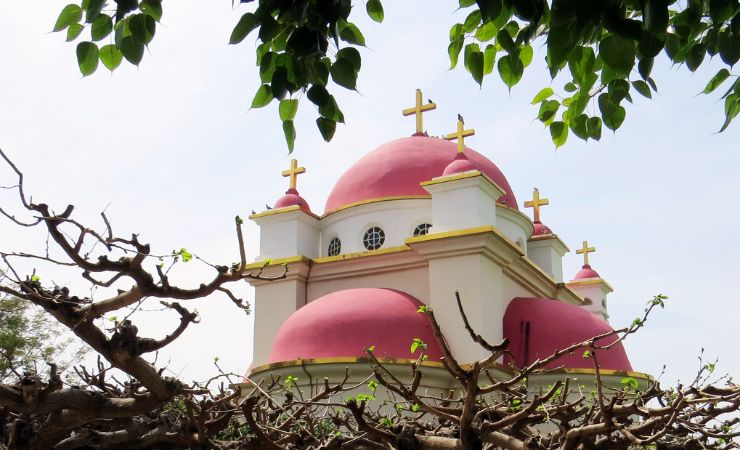
The Church of the Twelve Apostles is a Greek Orthodox church located among the ancient ruins of Capernaum on the Sea of Galilee's northern shore. Built in 1925 with distinctive red domes, it marks the traditional site where Jesus called his first disciples and stands within the Greek Orthodox monastery complex adjacent to the ancient synagogue ruins.
The Church of the Twelve Apostles (also known as the Greek Orthodox Church of the Holy Apostles or simply the Church of the Apostles) is a distinctive white-domed Greek Orthodox church set among the ancient black basalt ruins of Capernaum. Part of the Greek Orthodox Monastery of the Holy Apostles, this modest yet spiritually significant structure commemorates the twelve disciples whom Jesus called to follow him during his ministry around the Sea of Galilee.
Location
The Church of the Twelve Apostles sits on the northeastern shore of the Sea of Galilee, approximately 200 meters east of the Catholic-controlled section of Capernaum with its famous synagogue ruins and octagonal church. Visitors can reach the site by car via Route 87, with parking available near the monastery entrance.
Biblical Context
Capernaum became Jesus’ adopted hometown after he left Nazareth, and the Gospels record more miracles performed here than anywhere else. The church’s dedication honors all twelve apostles whom Jesus chose, including Peter, Andrew, James, and John, several of whom were fishermen from this very shoreline. This region witnessed the miraculous catch of fish, Jesus teaching from Peter’s boat, and his post-resurrection appearance to seven disciples. According to John 21, it was near this shore that Jesus prepared breakfast for his followers and commissioned Peter to “feed my sheep,” establishing the foundation of apostolic ministry that would spread throughout the Roman world.
When morning came, He called his disciples to him and chose twelve of them, whom He also designated apostles: 14 Simon (whom he named Peter), his brother Andrew, James, John, Philip, Bartholomew, 15 Matthew, Thomas, James son of Alphaeus, Simon who was called the Zealot, 16 Judas son of James, and Judas Iscariot, who became a traitor.
Luke 6:13-16



Architectural and Artistic Grandeur
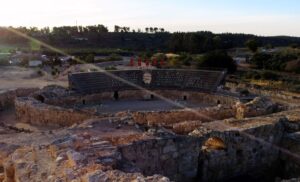
Archaeological evidence suggests the Church of the Twelve Apostles was built upon the remnants of a 6th-century Byzantine church dedicated to St. John the Theologian, which investigations have revealed through foundation stones and pottery fragments. The original Byzantine structure likely suffered destruction during the catastrophic earthquake of 749 CE that devastated much of the Galilee region, after which the site lay buried beneath accumulated debris for over a millennium.
The modern church, reconstructed in 1931, features a compact cruciform plan with pristine white limestone walls that create a striking visual contrast against the dark basalt ruins of ancient Capernaum. Eight distinctive domes crown the structure: two larger central domes flanked by six smaller ones, each topped with traditional Orthodox crosses. The architectural design reflects traditional Byzantine church planning while adapting to the modest scale appropriate for this remote lakeside location.
After the 1948 Arab-Israeli War, the church found itself stranded in the United Nations-supervised demilitarized zone between Israel and Syria. Cut off from both Christian pilgrims and local Greek Orthodox communities, the abandoned building deteriorated rapidly and local Druze farmers repurposed it as a cattle barn. The Six-Day War of 1967 brought the site under Israeli control, allowing restoration efforts to begin with the massive task of removing accumulated livestock debris that had covered the original floor stones to a depth of several feet.
Artistic Highlights of the Church of the Twelve Apostles
Major reconstruction during the 1980s transformed the church interior while preserving the original 1931 carved stone iconostasis, a rare survivor from the early 20th-century building phase. The iconostasis features traditional Orthodox styling with ornate columns and arched openings that frame the sacred altar space.
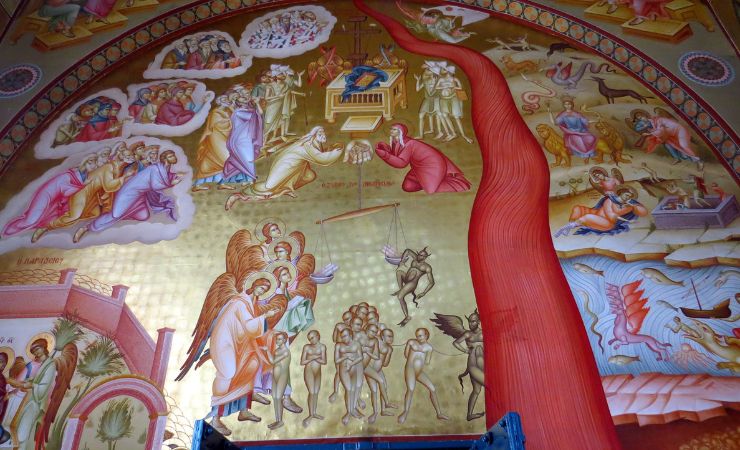
Between 1995 and 2000, renowned Greek artist Konstantin Dzumakis covered virtually every interior surface with vibrant frescoes depicting scenes from the Gospels, with particular emphasis on events that occurred around Capernaum and the Sea of Galilee. His work transforms the modest structure into a comprehensive visual narrative of Jesus’ ministry in this region.
The two main domes showcase contrasting theological themes through Dzumakis’ masterful iconography. The eastern dome presents Christ Pantocrator (All-Ruler) surrounded by the twelve Old Testament prophets who foretold his coming, while the western dome depicts Christ as the Ancient of Days encircled by the twelve patriarchs of Israel. These celestial compositions draw the eye upward and connect the New Testament apostolic mission with its Hebrew roots.
Gospel scenes painted on the walls include Jesus walking on the Sea of Galilee’s waters, the miraculous calming of the storm that threatened the disciples’ boat, and the extraordinary catch of 153 fish described in John 21. Each fresco incorporates recognizable geographical features of the actual lake and surrounding hills visible through the church windows.
The western wall presents Dzumakis’ most dramatic composition: a monumental depiction of the Last Judgment that confronts visitors as they prepare to leave. This powerful fresco illustrates the eternal consequences of earthly choices, showing the stark divide between the saved who ascend toward Christ and the condemned who descend into darkness. The artist’s unusual approach combines traditional Greek Orthodox iconographic conventions with figures from Hebrew scripture and even classical antiquity, including representations of Alexander the Great and Aristotle, reflecting the multicultural heritage of this region.
Additional Information
Is there a difference between visiting the Greek Orthodox site and the Catholic Capernaum site nearby?
The Greek Orthodox Church of the Twelve Apostles focuses on the apostolic calling and features Byzantine church ruins, while the Catholic site preserves the ancient synagogue where Jesus taught and Peter’s house foundations. Visiting both provides a complete picture of Jesus’ ministry in Capernaum from different Christian perspectives.
Why is this church dedicated to all twelve apostles rather than just those from the Galilee region?
The church honors all twelve apostles because Capernaum served as Jesus’ primary base during his ministry, where he called most of his disciples and taught them. The site represents the launching point of the apostolic mission that would eventually spread throughout the Roman Empire, making it appropriate to commemorate all twelve rather than just the local fishermen.
Can visitors see the Byzantine church foundations beneath the current building?
Archaeological remains of the 6th-century Byzantine church are visible around the modern structure’s perimeter, including foundation stones and architectural fragments. However, the current The Church of the Twelve Apostles was built directly over the Byzantine foundations, so the ancient structure is not accessible to visitors.
What makes the frescoes by Konstantin Dzumakis unique compared to other Orthodox churches?
Dzumakis’ frescoes uniquely blend traditional Orthodox iconography with Hebrew biblical figures and even classical Greek philosophers like Aristotle. This unusual synthesis reflects the multicultural history of Galilee and creates a visual dialogue between Jewish, Christian, and Hellenistic traditions that is rarely seen in Orthodox church art.
Nearby Sites
- Mount of Beatitudes: A hilltop location believed to be where Jesus delivered the Sermon on the Mount.
-
Church of the Multiplication: A church that commemorates Jesus’ miracle of feeding the 5,000 with five loaves and two fish.
-
Bethsaida: An ancient city known as the birthplace of several of Jesus’ apostles.
-
Church of the Primacy of Peter: The spot where Jesus is believed to have reinstated Peter as the chief of the apostles.
-
Domus Galilaeae: Amodern Christian retreat center offers spiritual teachings and stunning views of the surrounding landscapes.
Keep reading
Part of our Christian Pilgrimage Guide →